30+ Best Places to Visit in Dharamshala & McLeodganj 2026
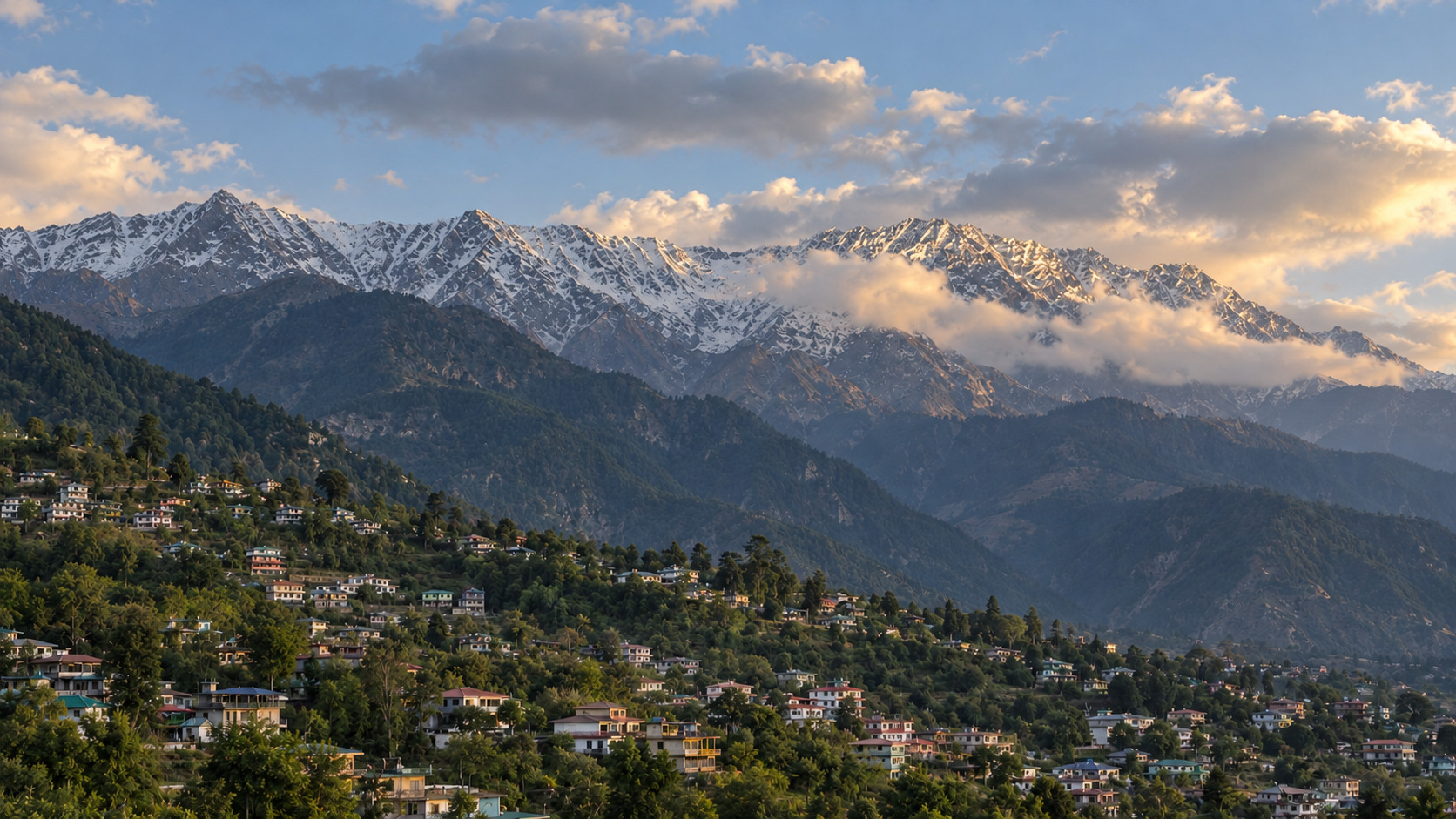
temples, waterfalls, a cricket ground at 1,457 m and the walks above town — with what each costs, how long it takes, and a plan for one, two or three days.
most of the famous places to visit in Dharamshala are not in Dharamshala. they're in McLeodganj, 9 km up the hill, and the two are different towns with a 350-metre climb between them. nobody tells you that before you book a hotel in the wrong one.
every week somebody books a hotel in the lower town because the photos looked right, checks in, opens Maps — and finds the temple, the cafés and the waterfall are all up there. three days of taxis to fix a booking they made in four minutes.
So this is the sorted version. fifteen places across both, grouped by which town they're in, with opening hours and entry fees where there are any, and an honest note on the two that aren't worth the taxi.
we build Gigavent, an app for finding what's on in small Himachal towns — and this is the one we live in.
see what's on in Dharamshala this week →
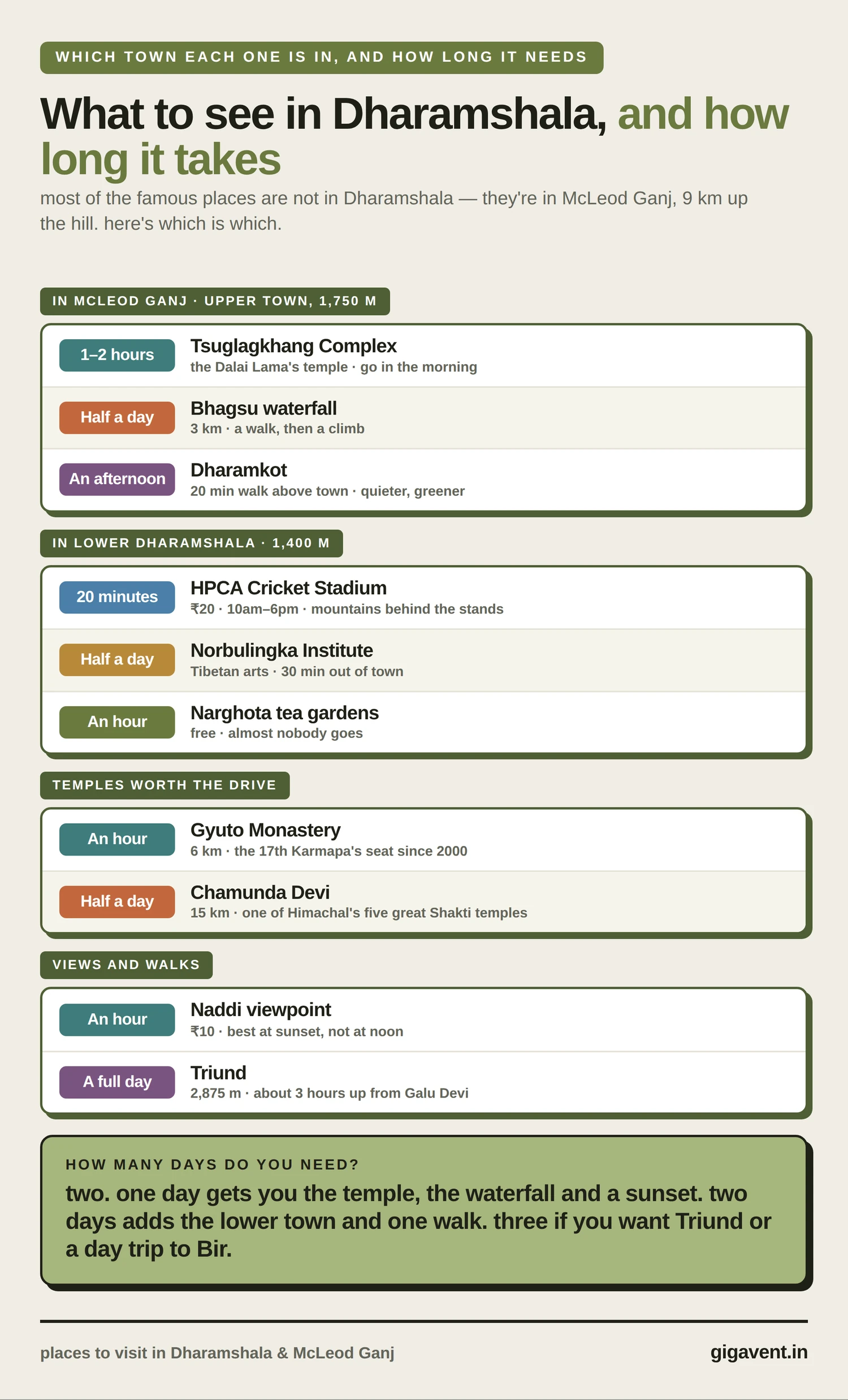
The 15 you shouldn't skip
In McLeodganj (upper town)
- Tsuglagkhang Complex — the Dalai Lama's temple · 1–2 hours
- Namgyal Monastery — inside the same complex · 30 min
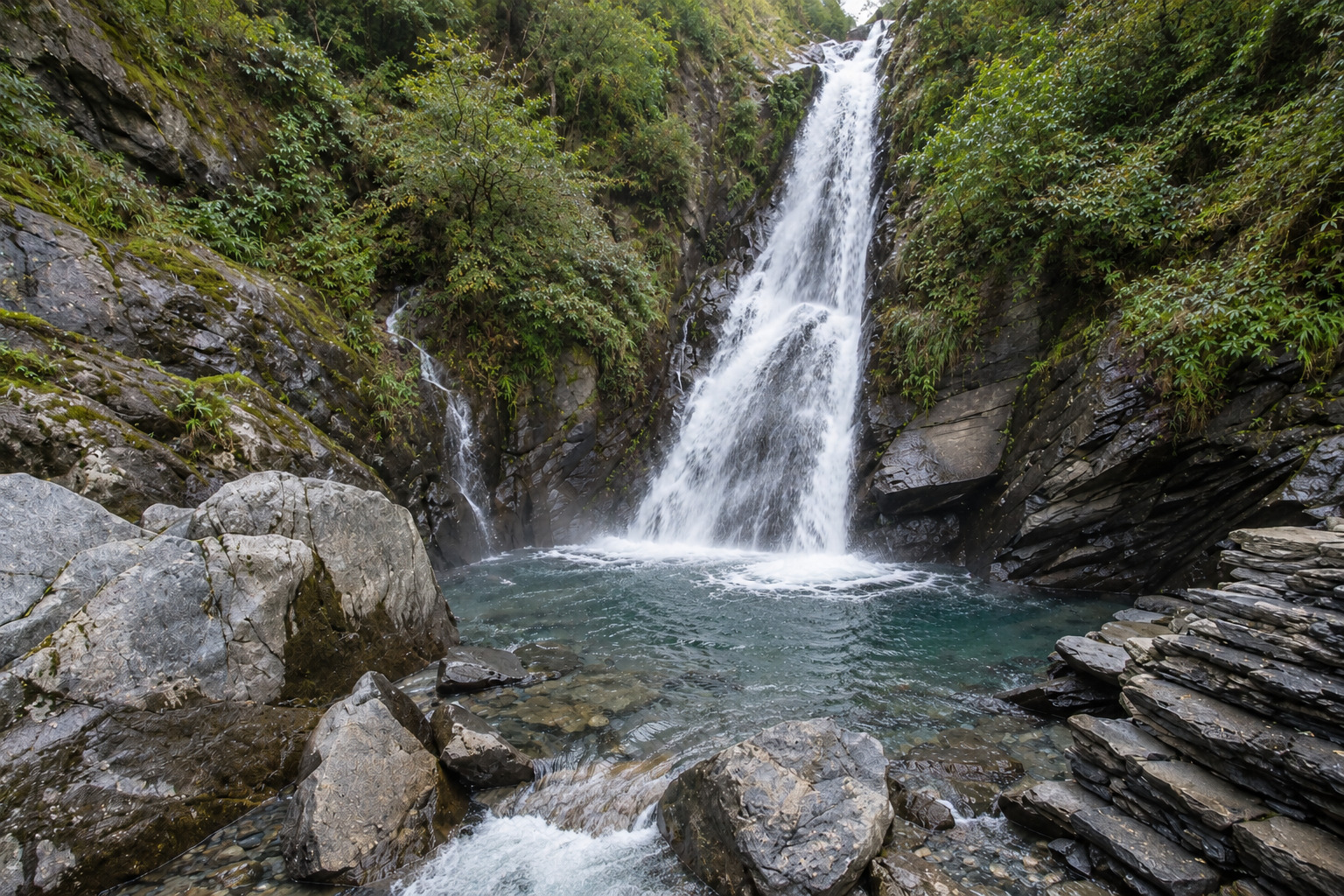
- Bhagsu waterfall — 3 km, a walk plus a climb · half a day
- St John in the Wilderness — 1852 church, a Viceroy's grave · 30 min
- Dharamkot — 20 min walk above town · an afternoon
In lower Dharamshala
- HPCA Cricket Stadium — ₹20, 10am–6pm · 20 min
- Kotwali Bazaar — the real market · an hour
- Norbulingka Institute — Tibetan arts, 30 min out · half a day
- Narghota tea gardens — quiet, free, nobody there · an hour
- Dharamshala Skyway — 1.8 km ropeway, 5 min each way
Temples worth the drive
- Gyuto Monastery — the Karmapa's seat, 6 km · an hour
- Chamunda Devi — 15 km · half a day with the drive
Views and walks
- Naddi viewpoint — ₹10, best at sunset · an hour
- Galu Devi temple — an hour up from Dharamkot
- Triund — 2,875 m, about 3 hours up · a full day
Also in this guide: Tibet Museum · Library of Tibetan Works and Archives · Nechung Monastery · Kalachakra Temple · TIPA · Tushita · Tsechokling Gompa · Bhagsunath temple · Kangra Art Museum · Andretta · Lahesh Cave · Dal Lake · Kunal Pathri · Aghanjar Mahadev · Adi Himani Chamunda · Chinmaya Ashram · War Memorial · Tibetan Museum · Naam Art Gallery · Rising Star, Guna Devi, Kareri Lake and Indrahar Pass · Kangra Fort, Masroor, Palampur and Bir
Another twenty-odd are covered further down. Numbers 1 to 15 will be there whenever you arrive. The thing that actually makes a trip is the one this guide can't give you — more on that at the end.
Dharamshala and McLeodganj are not the same place
Lower Dharamshala sits at about 1,400 m. It's the working town — the bus stand, Kotwali Bazaar, the district offices, the cricket stadium.
McLeodganj is 9 km up, at about 1,750 m, and it's the one on the postcards: the Dalai Lama's temple, the Tibetan cafés, the backpackers. The bus between them takes about ten minutes.
If you booked "Dharamshala" and meant the monasteries, you're staying in the wrong town. It's a ₹20 bus ride to fix, but check before you unpack.
Places to visit in McLeodganj
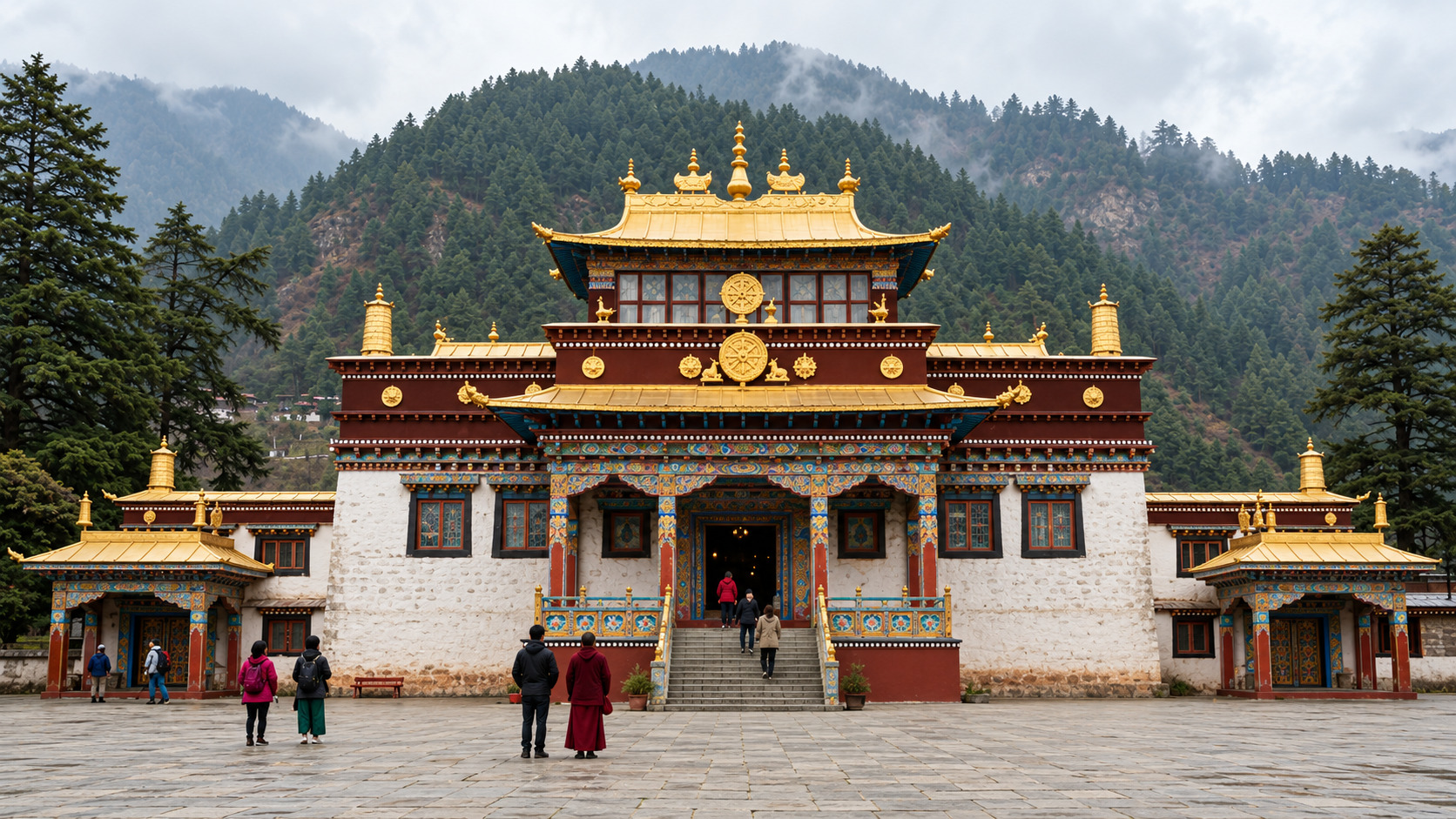
Tsuglagkhang Complex is the Dalai Lama's temple and the largest Tibetan temple outside Tibet. The Dalai Lama arrived here in 1959 and the Tibetan government-in-exile has been based in the area since. Go in the morning, when the monks are debating in the courtyard and the place is still working rather than being looked at.
Namgyal Monastery is inside the same complex, so you see both in one visit. An hour, unless you sit down — which you should.
Bhagsu waterfall is about 3 km from town — an easy walk to Bhagsu village, then roughly a kilometre uphill. Busy on weekends, empty on a Tuesday.
Bhagsunath temple, at the bottom of that walk, has a spring-fed bathing tank and a history most writeups skip entirely for the Bhagsu-and-the-snake legend. The Kangra district record credits its construction to the 1st Gorkha Rifles around the 1800s, and names Gurkha platoons and local villagers as its congregation. Where: 2 km from McLeodganj bazaar, 11 km above Dharamshala · Time needed: 20–30 min · Entry: free · Hours: not officially published, but it's a working temple — daylight is safe
Dharamkot is a twenty to thirty minute walk above McLeodganj, and the reason to go is that it feels like a different decade. Quieter, more trees, more people staying three months than three days.
Kalachakra Temple is the westernmost building in the Tsuglagkhang complex, so you walk past it whether you mean to or not. The walls are covered in Avalokiteshvara murals, and once a year — on the fifteenth day of the third Tibetan month, which moves in our calendar — monks build a coloured sand mandala here and then sweep it away. Where: inside Tsuglagkhang · Time needed: 20–40 min · Entry: no charge documented
Tsechokling Gompa sits at the bottom of a long flight of steps off Nowrojee Road, which is why almost nobody goes. Built in 1987 to replace a monastery destroyed in Tibet. The Sakyamuni statue in the prayer hall wears a jewelled headdress, which is unusual — Sakyamuni is normally shown plain. Where: 10–15 min down the steps from the main square · Time needed: 20–30 min, plus the climb back, which is the part people underestimate
TIPA — the Tibetan Institute of Performing Arts — trains musicians and lhamo opera performers, and has a small folk museum on site. Where: TIPA Road, above the square · Entry: the folk museum is free — the institute says so plainly · Time needed: 30–45 min Performances are irregular and there's no online calendar. Two fixed things to plan around: the ten-day Shoton opera festival, and an annual folk opera festival usually in March or April. Otherwise ring the office on +91 76500 56654 — that's what TIPA itself tells you to do.
Tushita Meditation Centre in Dharamkot runs residential courses and drop-in meditation sessions. Where: uphill in Dharamkot · Hours: Mon–Sat 9:30–11:30am and 12:30–4pm, closed Sunday · Time needed: an hour for a drop-in session Two things that catch people out: there's a lunch gap from 11:30 to 12:30, so turning up at noon gets you turned away. And those hours are published for February to November only — assume it's shut in deep winter and check before you walk up.
Temple Road and the main square is where you'll end up anyway — momos, Tibetan bakeries, bookshops, and the only traffic jam in the Himalayas made entirely of taxis reversing.
find a class or a gig while you're up there →
The Tibetan institutions below McLeodganj
Halfway down the hill, about 2 km below Tsuglagkhang, is a compound called Gangchen Kyishong — the seat of the Tibetan government-in-exile. Three of the better things to see here are inside it, within a few minutes' walk of each other, and almost every guide lists them separately as if they were in different parts of town. They aren't. Do them in one trip.
Tibet Museum documents the occupation of Tibet and the exile. Established 1998, rehoused in a purpose-built building in 2022. Where: Gangchen Kyishong, next to the library · Hours: 9am–5pm, closed 1–2pm for lunch, open every day except SATURDAY · Entry: ₹20 adults, under-18s free · Time needed: 1–1.5 hours
Two warnings on this one. Saturday is the closure day, not Monday — the opposite of nearly every museum in India, and the single most likely thing to break your day. And if you read anywhere that the Tibet Museum is at the Tsuglagkhang complex, that was true until 2022 and isn't now. Most published guides, including some very well-known ones, still have it in the wrong place.
Library of Tibetan Works and Archives was founded by the Dalai Lama and holds the Tibetan manuscript collection, a foreign-language library and a museum. Where: same compound · Hours: 9am–5pm, closed 1–2pm, closed Sundays — and closed on the 2nd, 3rd, 4th and 5th Saturday of each month · Time needed: 45–90 min Read that closure rule again: the first Saturday of the month it's open, the rest it isn't. Upstairs there's a wooden three-dimensional Avalokiteshvara mandala, which is a rare thing to see carved rather than drawn.
Nechung Monastery is behind the government building, a two-minute walk from the library. This is the exile seat of the Nechung State Oracle — around seventy monks, consecrated by the Dalai Lama in 1985, with the fourteenth Kuten enthroned in 1987. Where: same compound · Time needed: 20–30 min · Hours: not published — go during the working day
Places to visit in lower Dharamshala
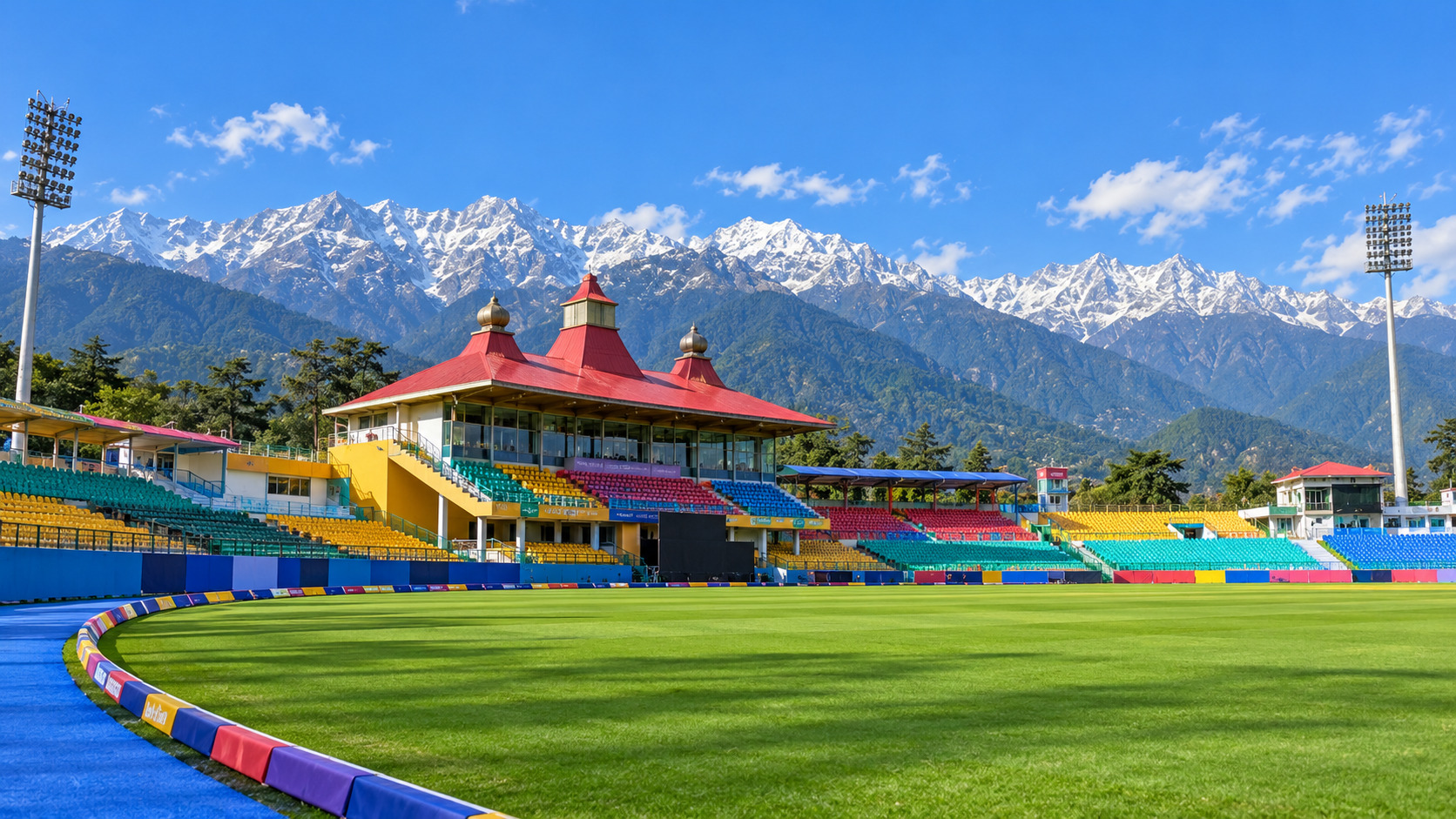
HPCA Cricket Stadium is the one thing here that beats anything in McLeodganj. It sits at 1,457 m with the Dhauladhar range directly behind the stands — the most photographed cricket ground in India for a reason. Open 10am to 6pm, entry about ₹20. Twenty minutes, and worth it even if you don't like cricket.
Kotwali Bazaar is the real market — hardware, fabric, sweets, nobody selling you a singing bowl. Go here for lunch rather than McLeodganj if you want to eat what the town eats.
Norbulingka Institute is about half an hour out towards Sidhpur, a Tibetan arts centre where you can watch thangka painting, wood carving and metalwork being done properly. The gardens alone are worth the trip.
Narghota tea gardens are about fifteen minutes from the bus stand and almost nobody goes. Kangra tea has been grown on these slopes since colonial times; the rows run down the slope with the Dhauladhar standing behind them, and on a weekday you'll have the path to yourself. Free, and the best quiet hour in the lower town.
Dharamshala Skyway is the ropeway between the two towns — 1.8 km, about five minutes, running 9:30am to 6pm, from Kotwali Bazaar up to Temple Road in McLeodganj. Prices aren't published online, so check at the counter. Better than the bus if the weather is clear, pointless if it isn't.
Dal Lake and Naddi, honestly
Everyone's list puts these in the top five. Here's the honest version.
Dal Lake is about 4 km past Naddi, and it is small, green and often crowded. It's a pond with a temple beside it. Go if you're passing; don't build a morning around it.
Naddi viewpoint is about 10 km out, costs around ₹10 to enter, and is genuinely good — a clean, wide view of the snow line on the Dhauladhar. Go at sunset, not at noon.
The two are usually sold as a pair by taxi drivers. The second one earns the fare.
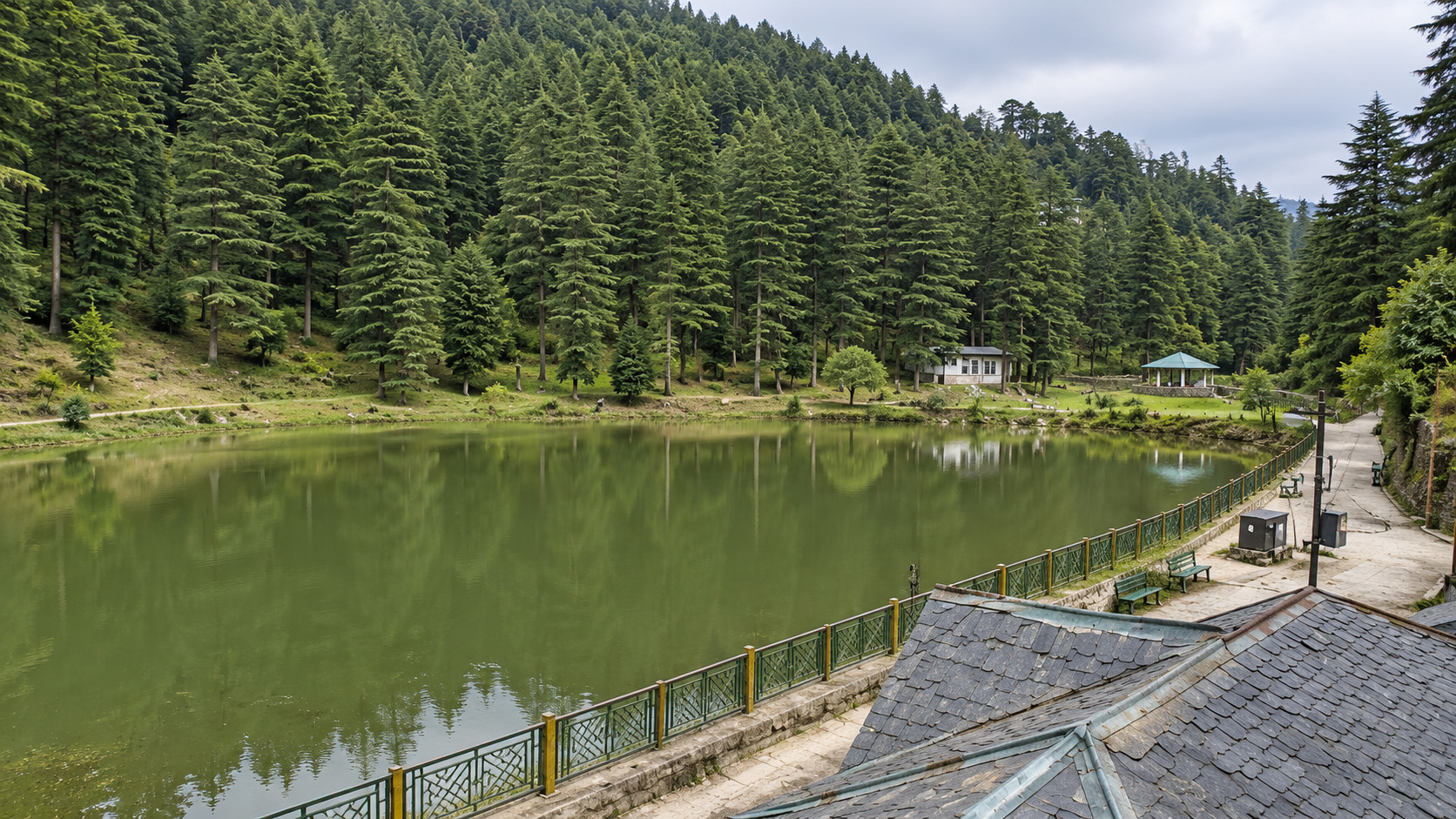
The walks above town
Triund is the walk everyone talks about. The ridge sits at 2,875 m, and the usual route is a roughly three-hour climb from Galu Devi above Dharamkot. Go up in the morning, come down the same day unless you've booked a tent — and don't start it at 2pm, which people do, constantly.
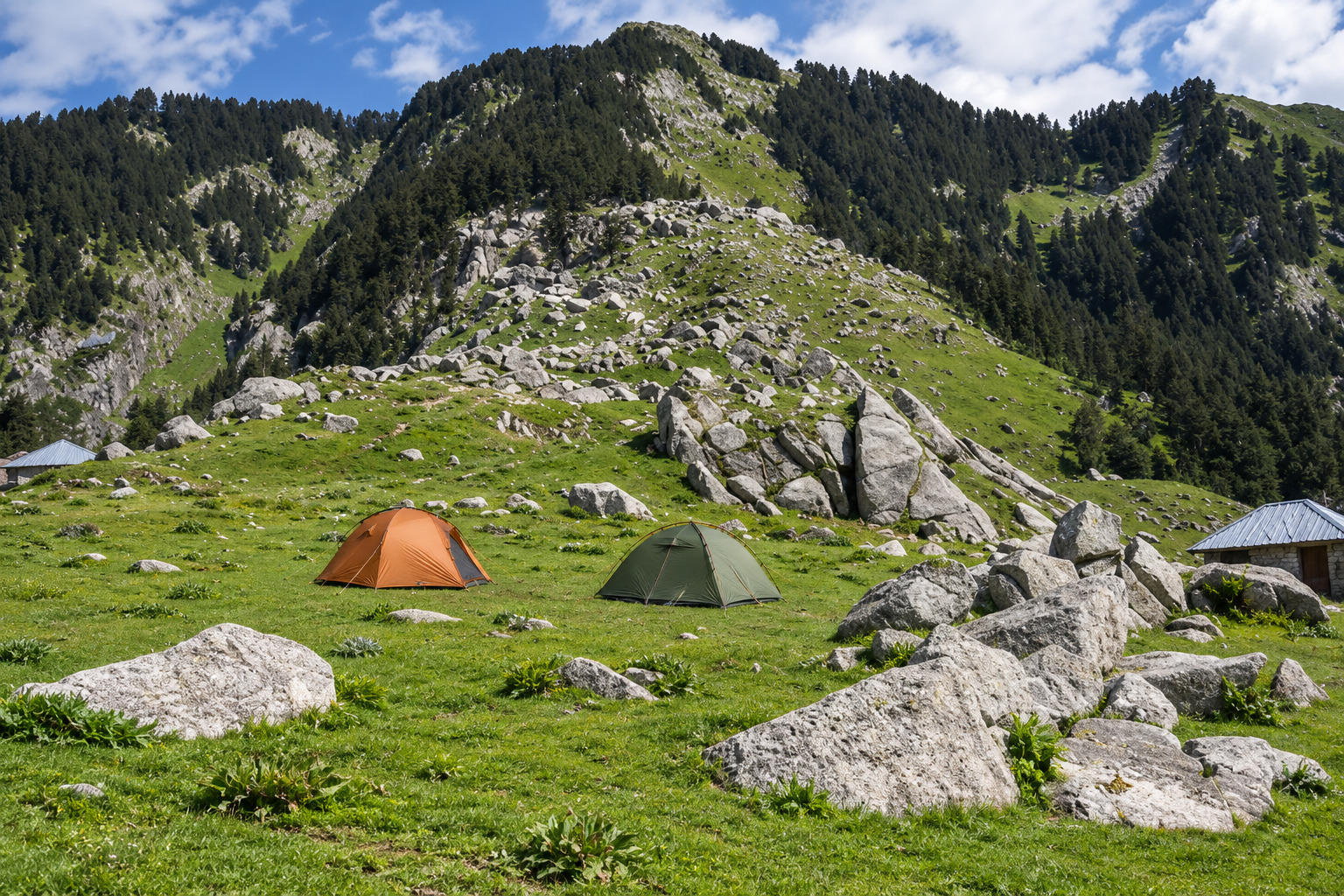
Every walk from here, shortest first:
| trek | how long | what it is |
|---|---|---|
| Bhagsu to Shiva Café | 45 min each way | the easiest — ends at a café built into a rock |
| Galu Devi temple | 1 hour from Dharamkot | most view for the least effort |
| Guna Devi temple | about 9 km one way | forest path, almost empty, half a day |
| Rising Star | a half-day hill trek | starts at Yol · ridge viewpoint · almost no tourists |
| Triund | ~3 hours up from Galu Devi | 2,875 m, the famous one, a full day |
| Snowline / Laka Got | 1 hour above Triund | needs an early start or a tent |
| Lahesh Cave | 2 days via Triund | a rock overhang at ~3,300 m, not a cave — sleeps 8 or 9 |
| Kareri Lake | 2 days | camping, take a guide |
| Indrahar Pass | 3–4 days | serious high-altitude trekking, guided only |
Rising Star is the one nobody outside Kangra has heard of. It climbs from Yol, below the cantonment, to a ridge with the Dhauladhar laid out across the whole skyline — it's on the Kangra district administration's own list of trails and on HP Ecotourism's, and you will probably have it to yourself. Ask at Yol for the trailhead; it isn't signposted from the road.
Lahesh Cave is worth a word because it's constantly mis-sold. It isn't a cave, it's a large rock overhang on the Indrahar Pass route above Ilaqa Got, used as a shelter by porters since at least the 1990s. It sleeps about eight or nine people and in season it will already have people in it. The trekking window is May to October; outside that, snow closes the upper route. Nobody publishes a permit requirement, but camping rules at Triund have changed repeatedly, so check at the Regional Mountaineering Centre in McLeodganj before you go rather than after.
A note on Hanuman Ka Tibba, which shows up on every Dharamshala attraction list: you can see it on the skyline and you cannot visit it. There is no trek to it from McLeodganj, whatever the aggregator listings say. There are also two different mountains called Hanuman Tibba — one on the Dhauladhar above Kangra, one near Solang on the Manali side, which is the one that expedition companies sell — and the published elevations contradict each other across Wikipedia, PeakVisor and the operators. So: look at it from Triund or Dharamkot, and treat anyone selling you a trek to it as someone who hasn't checked.
Whatever you walk, carry water up. There are shops on the Triund path but they're not cheap and they're not always open.
see which treks have groups going this week →
Dharamshala at night
There isn't a nightlife and that's rather the point. What there is: McLeodganj's cafés stay open to about ten, a few of them with live music on no fixed schedule. Temple Road after dark is quiet enough to hear the valley.
The stretch between McLeodganj and Dharamkot has the open mics and jam nights, usually announced the same afternoon on a chalkboard. If there's live music on, it'll be in a room with thirty people in it — which, if you came alone, is the easiest room in India to end up talking to someone in.
Lower Dharamshala shuts earlier. If you want an evening, be in the upper town for it.
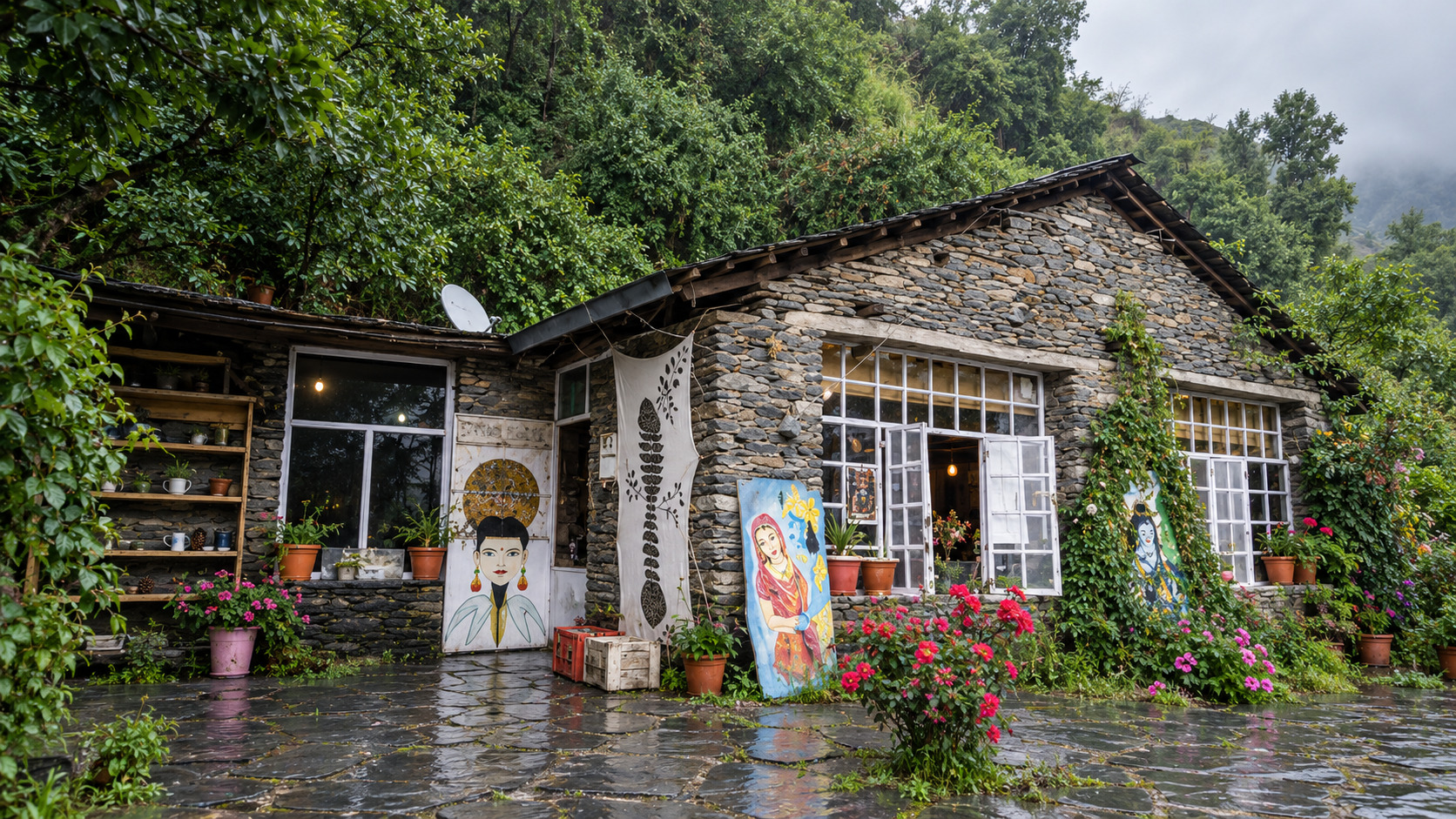
More places worth a stop
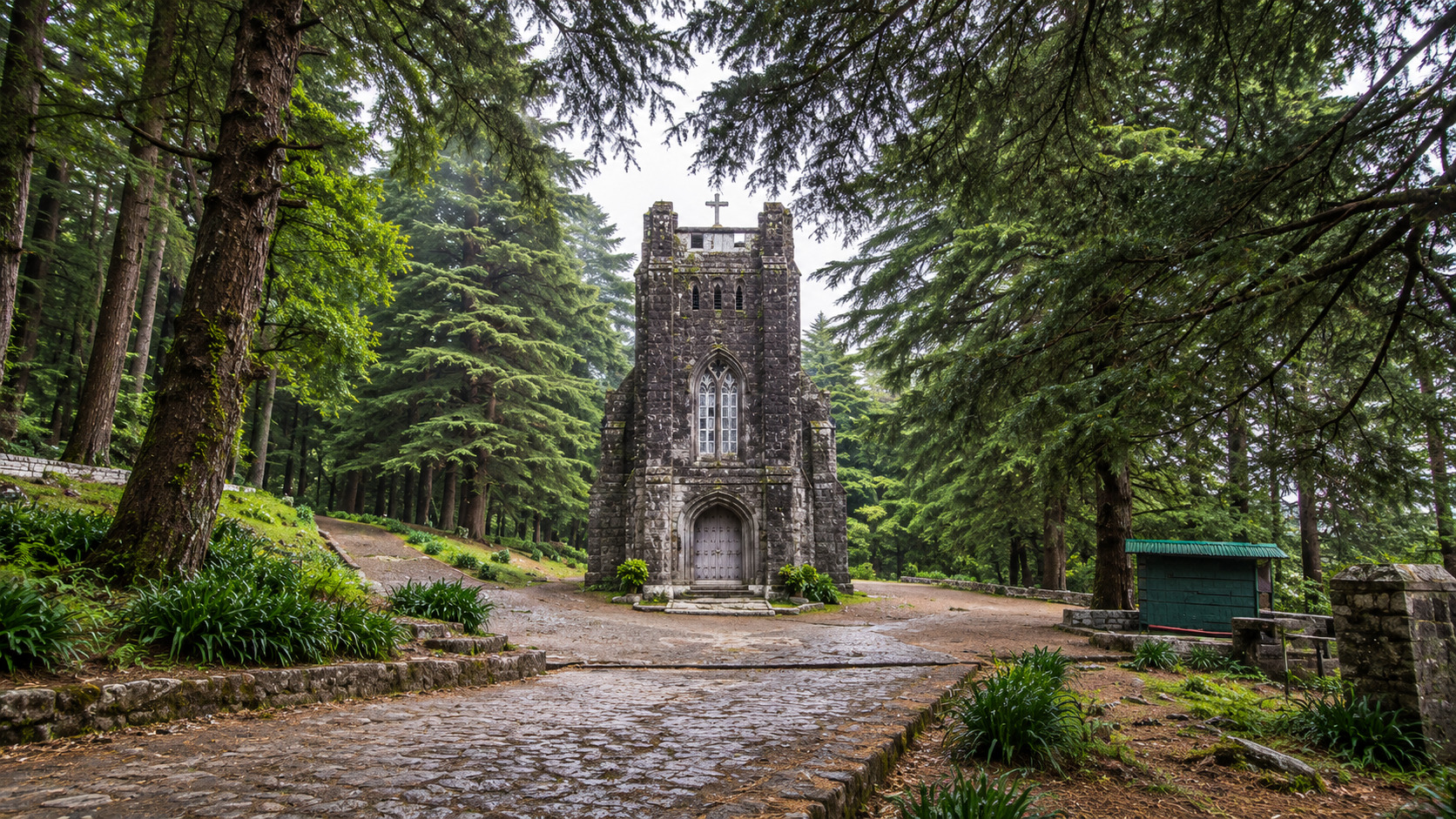
St John in the Wilderness is the one nobody expects. A neo-Gothic church built in 1852, standing in a deodar forest at Forsyth Ganj on the road up to McLeodganj, with Belgian stained glass donated by Lady Elgin. Lord Elgin, Viceroy of India, is buried in the churchyard — he died at Dharamshala in 1863. The 1905 Kangra earthquake, which killed close to 19,800 people and flattened most of Dharamshala and McLeodganj, took down the spire and the bell tower; the building itself survived, and a replacement bell cast in England in 1915 stands in the yard. Thirty minutes, and the quietest thirty you'll spend here.
Kangra Art Museum is in Kotwali Bazar in lower Dharamshala, not in Kangra town — the name sends people 18 km in the wrong direction. Kangra miniature paintings, regional crafts, coins and tribal jewellery. Hours: 10am–5pm, closed Mondays and public holidays · Time needed: 45–60 min · Entry: small, around ₹20 last reported, with a separate camera charge — but no official source publishes a current figure, so take cash and expect to be told at the desk. The Tribune has reported damp damaging the paintings here more than once, so individual galleries are sometimes shut with no notice.
A few more in town: the Dharamshala War Memorial at the entrance to the lower town, with gardens and no entry fee; and the Naam Art Gallery at Sidhbari, which shows European painters who settled here.
Seeing the Dalai Lama teach
This is the one thing people travel here for and the one thing almost no guide explains properly, so here it is from the Office of His Holiness's own pages rather than from a travel blog.
The public schedule is published at dalailama.com/schedule, and it carries its own warning that dates are subject to change. Teachings are free — His Holiness takes no fee.
For teachings in Dharamshala specifically, there's a registration step that catches almost everyone out:
- You cannot register in advance, and you cannot register online. Registration opens a few days before and closes the day before the first session.
- It happens in the Tsuglagkhang courtyard, 9am–1pm and 2pm–5pm.
- Bring: Indian residents, a copy of your Aadhaar. Foreign nationals, copies of your passport, Indian visa and 'C' form.
- There's a nominal ₹10 fee for the registration card.
- Teaching hours are announced only one or two days beforehand.
- Attendance runs into the thousands. The office itself recommends arriving two or three days early and booking a room well ahead.
And the detail nobody tells you: bring an FM radio. Teachings are mostly in Tibetan, translation is broadcast on FM, and no other electronic device is allowed in. Bring a cushion and a cup as well — tea gets served and nobody hands out cups. Seating is on the ground, first come first served; the local custom is to leave a cloth on your spot on day one and keep it for the series.
see what else is on in town while you're here →
Temples and monasteries around Dharamshala
This is the part most guides get thin, and it's the part people here would tell you first.
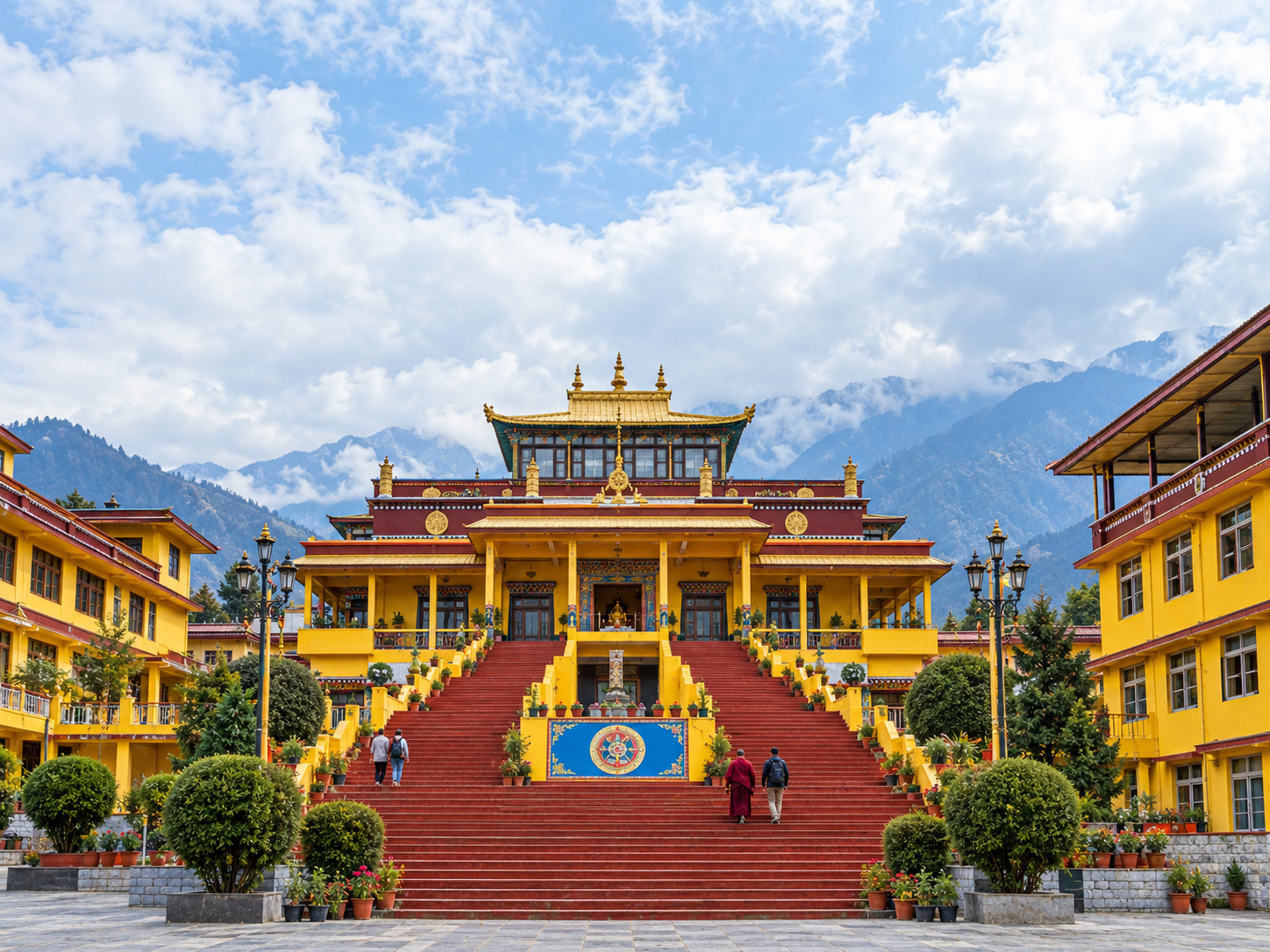
Gyuto Monastery sits at Sidhbari, next to Yol Cantonment, about 6 km from the lower town. It's the tantric monastery where the 17th Karmapa, Ogyen Trinley Dorje, has lived since 2000 — the second-most senior figure in Tibetan Buddhism after the Dalai Lama, in a building most visitors drive past. Huge prayer hall, gold Buddha, almost no tourists. Go in the morning and you'll hear the deep-throated Gyuto chanting the monastery is known for.
Chamunda Devi is about 15 km out, at Chandreshwar in Padar, right on the Dharamshala–Palampur road. The present temple is roughly 400 years old. The story behind it is the good part: the goddess's original shrine was on a ridge high above, and local folklore says a 16th-century king asked her to move somewhere pilgrims could actually reach. She agreed, appeared to a priest in a dream, and the idol was brought down to where the temple stands now.
Adi Himani Chamunda is that original shrine, still up on the hilltop, much older than the one below and a hard climb to reach. Almost no visitor to Dharamshala knows it's there. If you want one walk that nobody else on your trip will have done, this is it — go with someone local and start early.
One correction worth making, since half the internet gets it wrong: Chamunda Devi is not one of the 51 canonical Shakti Peethas. It's grouped with four other major Shakti temples of Himachal by local tradition, which is a different and perfectly good thing to be.
| temple | distance | what it is |
|---|---|---|
| Bhagsunag | in Bhagsu, 3 km | old Shiva temple below the waterfall |
| Kunal Pathri | a short walk from the lower town | rock temple, reached through tea gardens |
| Gyuto Monastery | ~6 km, Sidhbari | the Karmapa's seat |
| Aghanjar Mahadev | Khaniyara, ~2 km past Sidhbari | Shiva temple on a holy stream |
| Chinmaya Ashram | Sidhbari | Swami Chinmayananda's samadhi, quiet gardens |
| Chamunda Devi | ~15 km | one of Himachal's five great Shakti temples |
| Adi Himani Chamunda | hilltop above Chamunda | the original shrine, a serious climb |
| Baijnath | ~50 km | 13th-century Shiva temple, on the way to Bir |
see which temple festivals are on this month →
Places to visit near Dharamshala
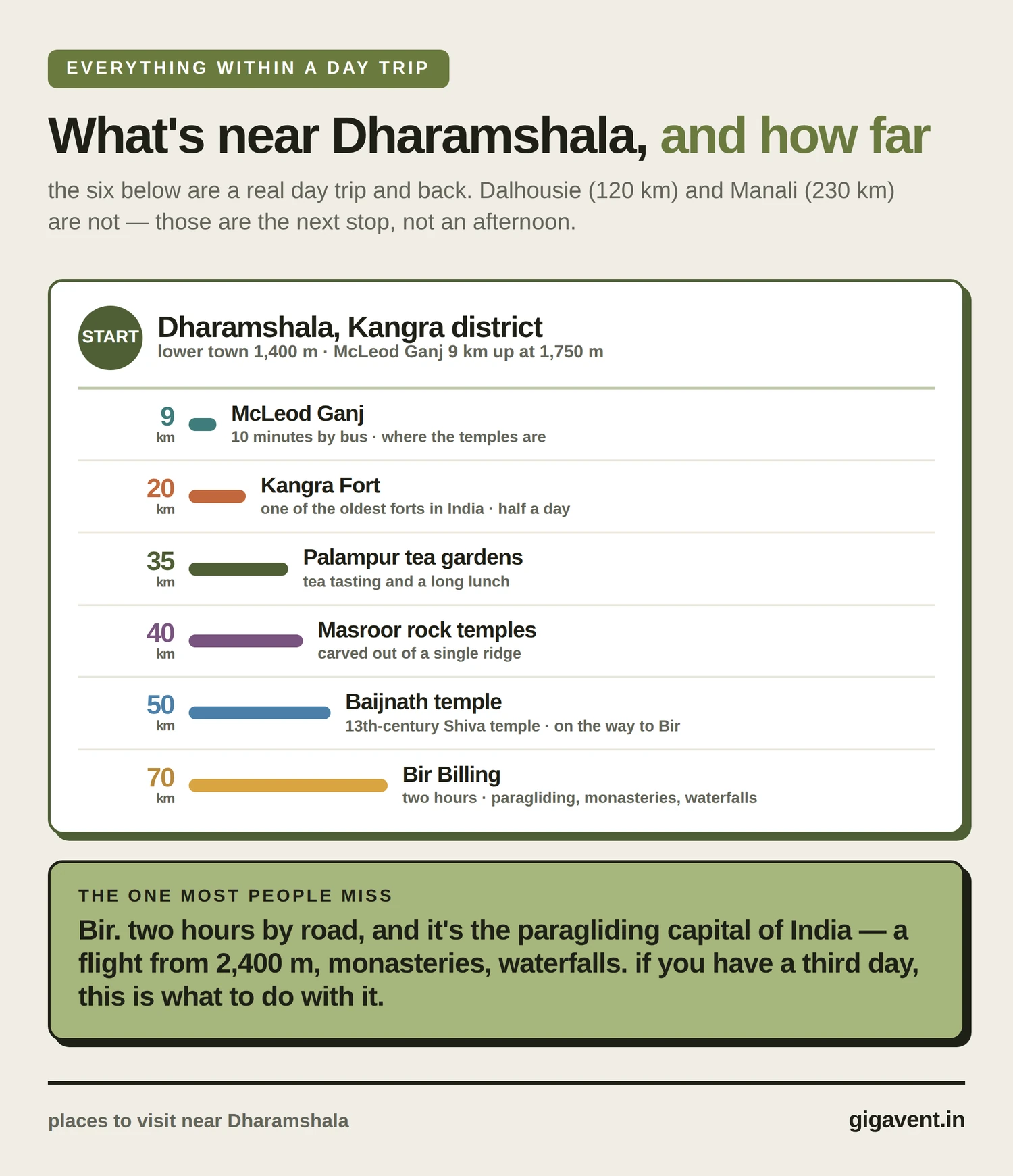
Dharamshala sits in Kangra district, so plenty is within reach — but not everything on the usual lists is a day trip. The honest split:
| place | distance | a day trip? | worth it for |
|---|---|---|---|
| McLeodganj | 9 km | half a day | the temples and the cafés |
| Kangra Fort | ~20 km | yes | one of the oldest forts in India |
| Palampur & tea gardens | ~35 km | yes | tea tasting and a long slow lunch |
| Masroor rock temples | ~40 km | yes | temples carved from a single ridge |
| Baijnath temple | ~50 km | yes | 13th-century Shiva temple |
| Andretta | ~13 km past Palampur | yes | an artists' village and a working pottery |
| Bir Billing | ~70 km | yes, just | paragliding, monasteries, waterfalls |
| Dalhousie | ~120 km | no — stay a night | colonial hill town, a different trip |
| Manali | ~230 km | no | seven hours; a separate holiday |
Kangra Fort is the one locals send you to — genuinely old, high above the river, half a day including the drive.
Masroor gets fewer visitors than it deserves — a row of temples cut straight out of one sandstone ridge, with a water tank in front and the Dhauladhar behind. Go early — no shade.
Palampur is tea country and the easiest of the lot — Wah estate, lunch, back by five.
Andretta is thirteen kilometres further on and the best thing in this table nobody has heard of. An artists' colony settled in the 1920s by the Irish theatre director Norah Richards, later home to the painter Sobha Singh, with a pottery studio still working. Her house, Chameli Niwas, is a traditional Kangra mud house and is looked after by Punjabi University — which is why access can depend on finding a caretaker rather than on posted hours. Three separate sites with three separate schedules and none of them published, so go on a weekday, not a Sunday, when the pottery museum is shut. Half a day including Palampur.
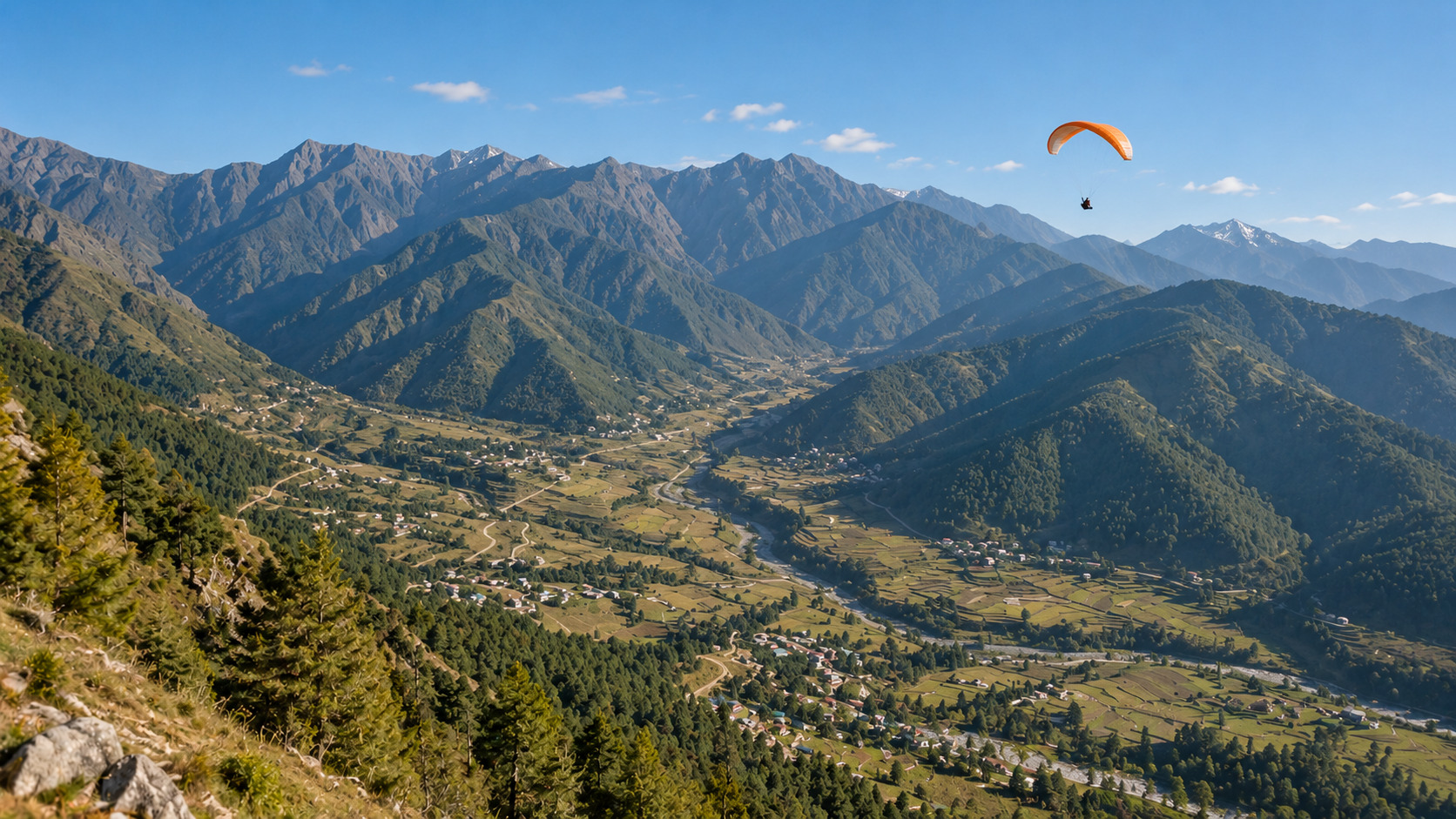
Bir is the one most people miss. Two hours by road, and it's the paragliding capital of India — plus monasteries, waterfalls and the best café scene in the valley. Here's everything that's there, what it costs to fly, and how many days you need. If you have a third day, spend it there.
A note on Dalhousie and Manali: both appear on every "near Dharamshala" list and neither is a day trip. Dalhousie is four hours each way, Manali seven. Next stop, not an afternoon.
see what's on in the towns nearby →
How many days do you need in Dharamshala
Two days is the honest answer. Here's how each option actually plays out.
One day: Tsuglagkhang in the morning, lunch in McLeodganj, Bhagsu waterfall in the afternoon, Naddi for sunset. You'll see the headlines and nothing else.
Two days: add lower Dharamshala — the stadium, Kotwali Bazaar, Norbulingka — and one walk, either Galu Devi or Bhagsu.
Three days: add Triund, or a day trip to Kangra Fort, Palampur or Bir. Three days is when the town stops being a checklist.
fill the gaps in your itinerary →
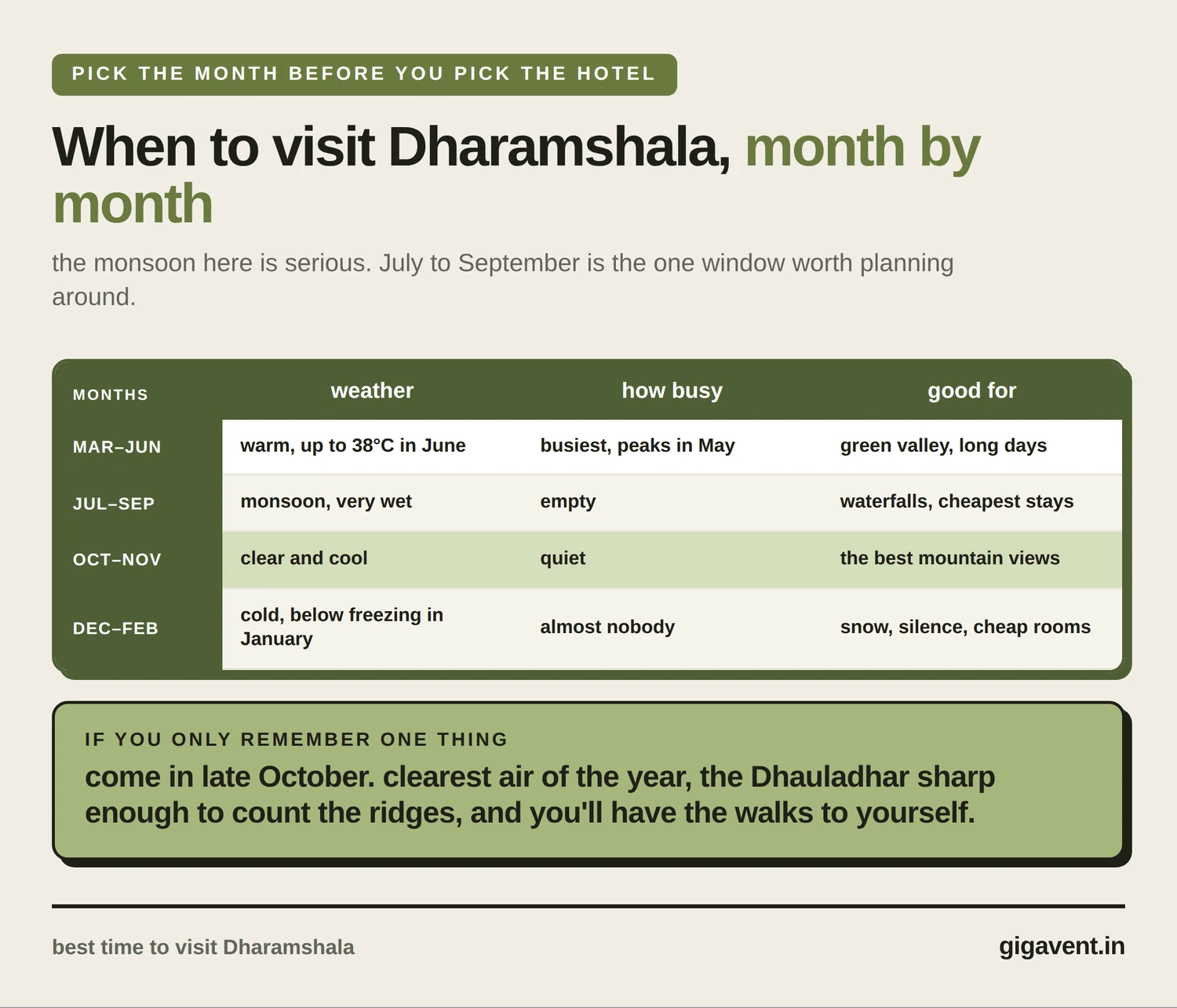
Best time to visit Dharamshala
| months | what it's like |
|---|---|
| March–June | the main season. green, clear, busiest in May. June can hit 38°C in the valley |
| July–September | monsoon, and it is very wet. waterfalls at full force, everything else difficult |
| October–November | the best window. clearest air, best mountain views, fewest people |
| December–February | cold, below freezing in January, occasional snow, very quiet |
If you want the Dhauladhar sharp and the town calm, come in late October. If you want it alive, come in March, when the Dalai Lama's public teachings usually bring the place to a standstill — bring a heavy coat anyway.
How to reach Dharamshala
Nearest airport: Kangra (Gaggal), about 15 km from McLeodganj — twenty-five minutes by taxi.
Nearest railway: Pathankot, about 88 km, roughly three hours by taxi. There's also the narrow-gauge Kangra Valley line — slow, lovely, not a serious way to arrive.
By road: Delhi is an overnight bus of 13 hours or more, or about 10 hours by taxi. Chandigarh is about 6.
Buses terminate at the Dharamshala bus stand in the lower town. From there it's a ten-minute local bus, a taxi, or the Skyway up to McLeodganj.
What no guide can tell you
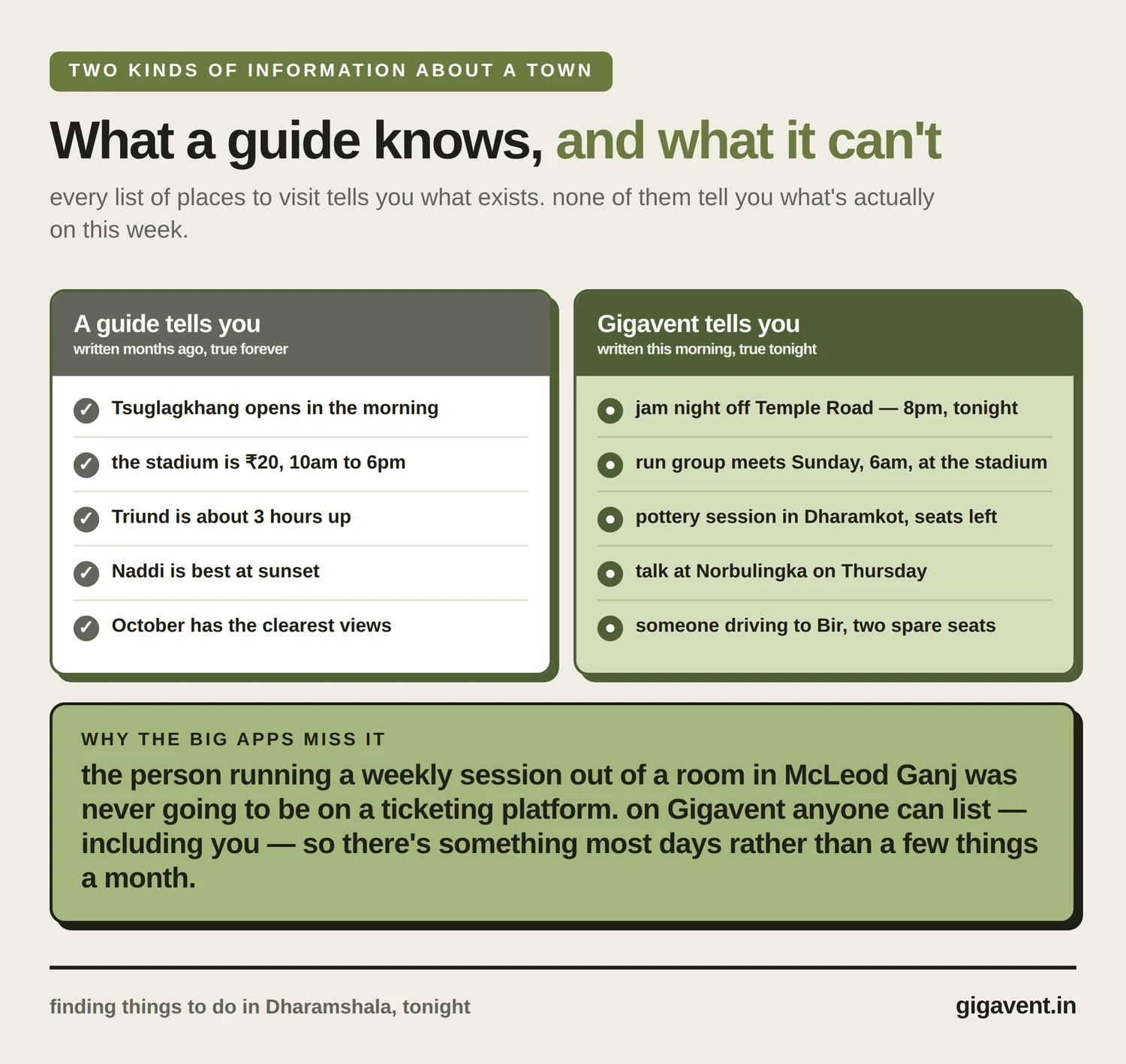
Every list of places to visit in Dharamshala — including this one — tells you what exists. None of them can tell you what's on.
The jam night at the café off Temple Road is tonight. There's a two-hour pottery session in Dharamkot this week with seats left. The Sunday run group meets at the stadium at six. A monk is giving a talk at Norbulingka on Thursday that isn't advertised anywhere except a notice board.
A guide written six months ago doesn't know any of that, and by the time it does, you've gone home. The temples and the waterfall will be there whenever you turn up. The things that make a trip memorable usually happen once, on a particular evening, and you have to hear about them.
That's what Gigavent is for. It's where the small stuff gets listed — workshops, runs, open mics, dance sessions, the things that happen for twelve people in a room above a café. The big ticketing apps don't carry them, because the person running a weekly session out of a studio room was never going to be on a ticketing platform. Anyone can list, including you, so there's something most days rather than a few things a month.
open Gigavent and see tonight →
The short version
Stay in McLeodganj if you came for the temples, lower Dharamshala if you came for the cricket. Tsuglagkhang and the stadium are the two things everyone should see; Naddi at sunset is the best free hour in town; Dal Lake is skippable. Two days covers the list, three if you want Triund or Bir. Come in late October.
And the best evening you have here will be something you didn't plan — check what's on before you fill the calendar.
read next: 15 things to do in Bir Billing, two hours away · Fit Kangra 2026 — what's happening across the district · Nati, the folk dance you join by standing at the back
Timings and entry fees above were checked in October 2026 against official sources — the Tibet Museum's and the Library's own sites, the Office of His Holiness, and the Kangra district administration. Where no official source publishes a figure, this guide says so instead of inventing one. Things change; if you find something different, tell us and we'll fix it.
FAQ
Is Dharamshala worth visiting?
Yes, for two days. The Tibetan temples, the Dhauladhar views and the walks above McLeodganj are the draw. If you only have one day, it's still worth it — just stay in McLeodganj, not the lower town.
What is Dharamshala famous for?
Being the home of the Dalai Lama and the Tibetan government-in-exile since 1959, the Tsuglagkhang temple complex, and the HPCA cricket stadium with the Dhauladhar range behind it.
What is the difference between Dharamshala and McLeodganj?
McLeodganj is upper Dharamshala — about 9 km and 350 m above the lower town, around a ten-minute bus ride. The temples, cafés and backpacker scene are in McLeodganj. The bus stand, main market and cricket stadium are in lower Dharamshala.
How many days are enough for Dharamshala?
Two full days covers the main places in both towns plus one walk. Add a third for Triund, Kangra Fort or a day trip to Bir Billing.
What is the best time to visit Dharamshala?
October and November for the clearest mountain views and the fewest people. March to June is the busy season. July to September is monsoon and genuinely difficult.
Which places in Dharamshala are free?
Most of them. Tsuglagkhang, Namgyal Monastery, Bhagsunath temple, Bhagsu waterfall, Dharamkot, Naddi, St John in the Wilderness, Gyuto, the War Memorial, Narghota tea gardens and TIPA's folk museum all cost nothing. The ones that charge are small: the cricket stadium ₹20, the Tibet Museum ₹20, Naddi viewpoint ₹10, Norbulingka and the Kangra Art Museum a little more.
Can you see Dharamshala without a taxi?
McLeodganj yes — the temple, Bhagsu, Dharamkot and the square are all walkable, and the walk between them is half the point. Lower Dharamshala no. It's 9 km down and 350 m of descent, and walking back up is not a plan. Buses run between the two for about ₹15, which is the cheapest way down and the one most visitors never find out about.
What is there to do in Dharamshala when it rains?
The indoor list is short but real: the Tibet Museum, the Library of Tibetan Works and Archives, the Kangra Art Museum, Norbulingka's workshops, and the cafés on Temple Road, which were built for exactly this. Avoid the treks entirely — the Triund path is slick and the stream crossings above Bhagsu rise fast.
Which day of the week should I avoid?
Saturday, if museums matter to you. The Tibet Museum closes Saturdays, and the Library closes on the second, third, fourth and fifth Saturday of the month. Monday catches you at the Kangra Art Museum instead. Sunday shuts the Library, Tushita and the pottery museum at Andretta.
Is McLeodganj or Dharamshala better to stay in?
McLeodganj, for almost everyone. Most of what you came to see is there, and the lower town is a 20-minute taxi away when you need it. Stay in lower Dharamshala only if you're here for the cricket, arriving late by bus, or want somewhere quieter and cheaper and don't mind the commute.
How do I attend a Dalai Lama teaching?
Check dalailama.com/schedule for dates, then register in person at the Tsuglagkhang courtyard in the few days before it starts — there's no online registration. Bring ID copies, ₹10, a cushion, a cup and an FM radio for the translation.
Is Triund hard?
It's about three hours up from Galu Devi and most reasonably fit people manage it. The mistakes that go wrong are starting in the afternoon, carrying no water, and assuming you can come down in the dark. Go up in the morning.
Can you see snow in Dharamshala?
The Dhauladhar peaks carry snow most of the year and you can see them from town on a clear day. Snow in McLeodganj itself is a January and February thing, and not every year. Triund gets snow from December through March.
What is the Tibet Museum and where is it now?
It's the Central Tibetan Administration's museum on the occupation of Tibet and the exile, and it moved in 2022. It is now at Gangchen Kyishong, about 2 km below McLeodganj, next to the Library of Tibetan Works and Archives — not at the Tsuglagkhang complex, where most guides still place it. ₹20, closed Saturdays.
How far is Dharamshala from Bir Billing?
About 70 km, or two hours by road — an easy day trip, and the obvious second stop on a Kangra trip.

