Best time to visit Dharamshala & McLeodganj (2026)
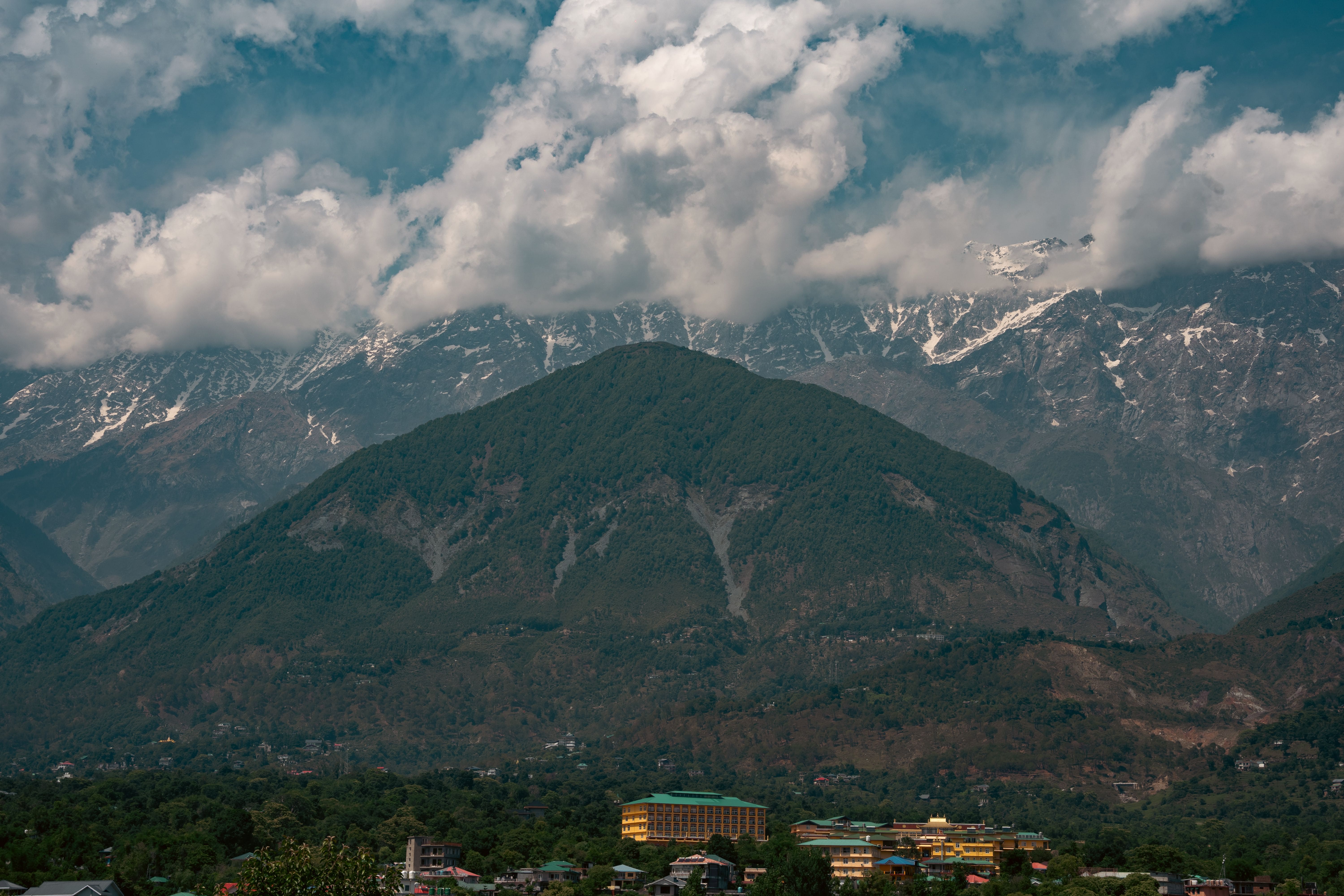
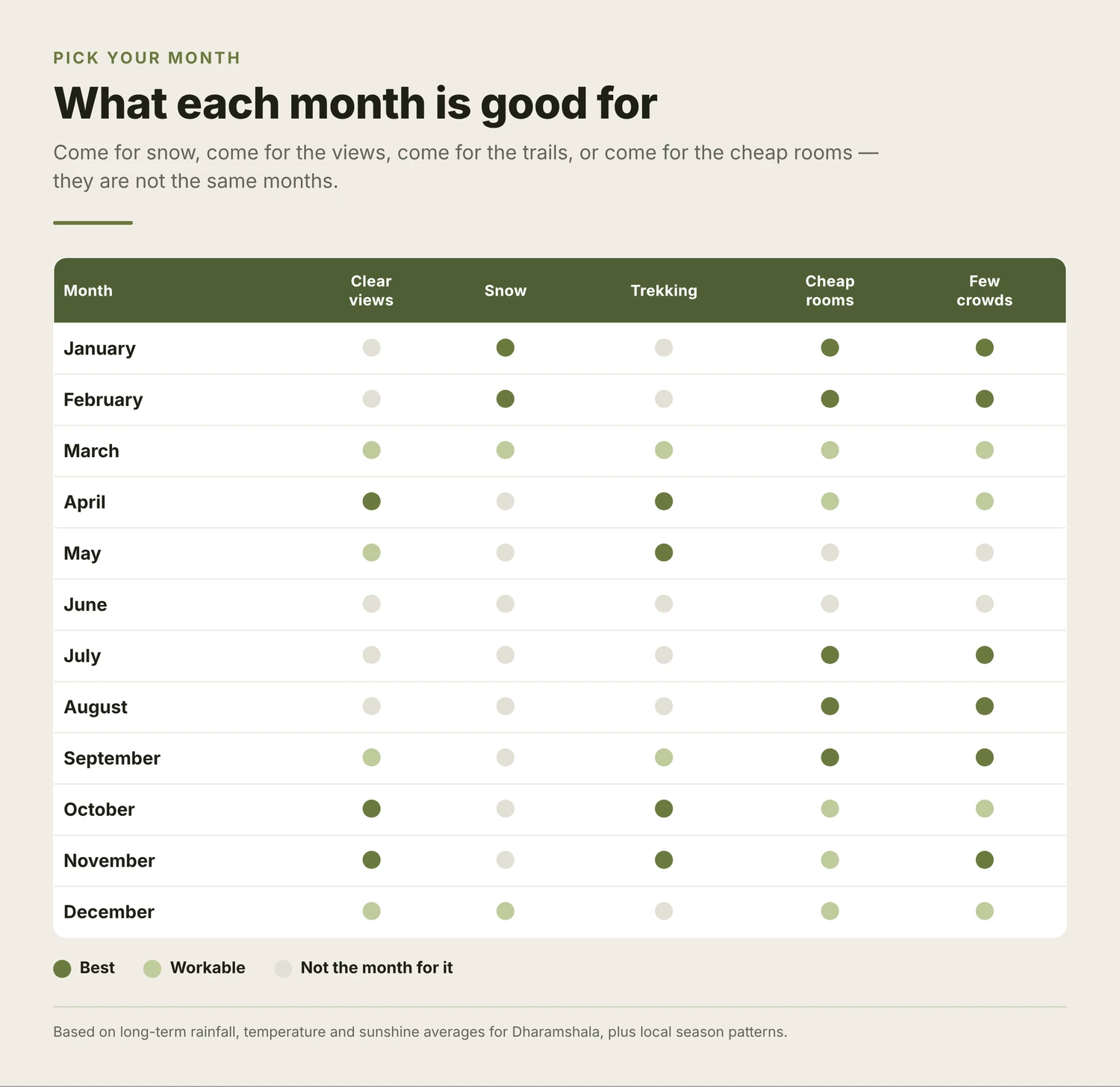
The best time to visit Dharamshala is October and November. It rains on barely two days a month, the air is the clearest it gets all year, and the whole Dhauladhar wall sits sharp behind McLeodganj from the moment you get off the bus.
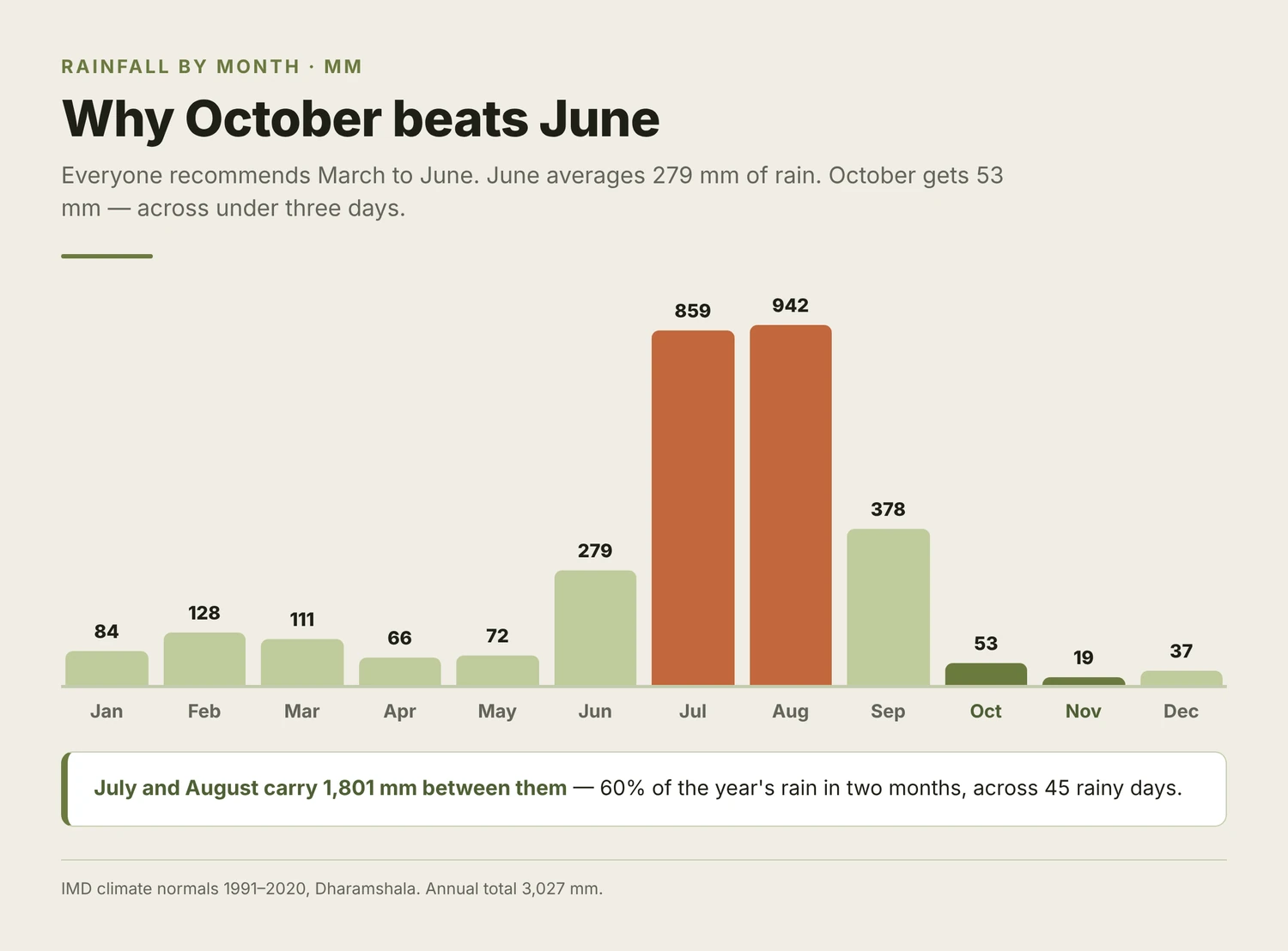
That isn't what you'll read anywhere else. Nearly every page recommends March to June — and June alone averages 279 mm of rain.
You've probably got the leave approved, a rough week in mind and twelve tabs open, every one saying something slightly different. So here's the whole year with the actual numbers, and you can stop cross-checking.
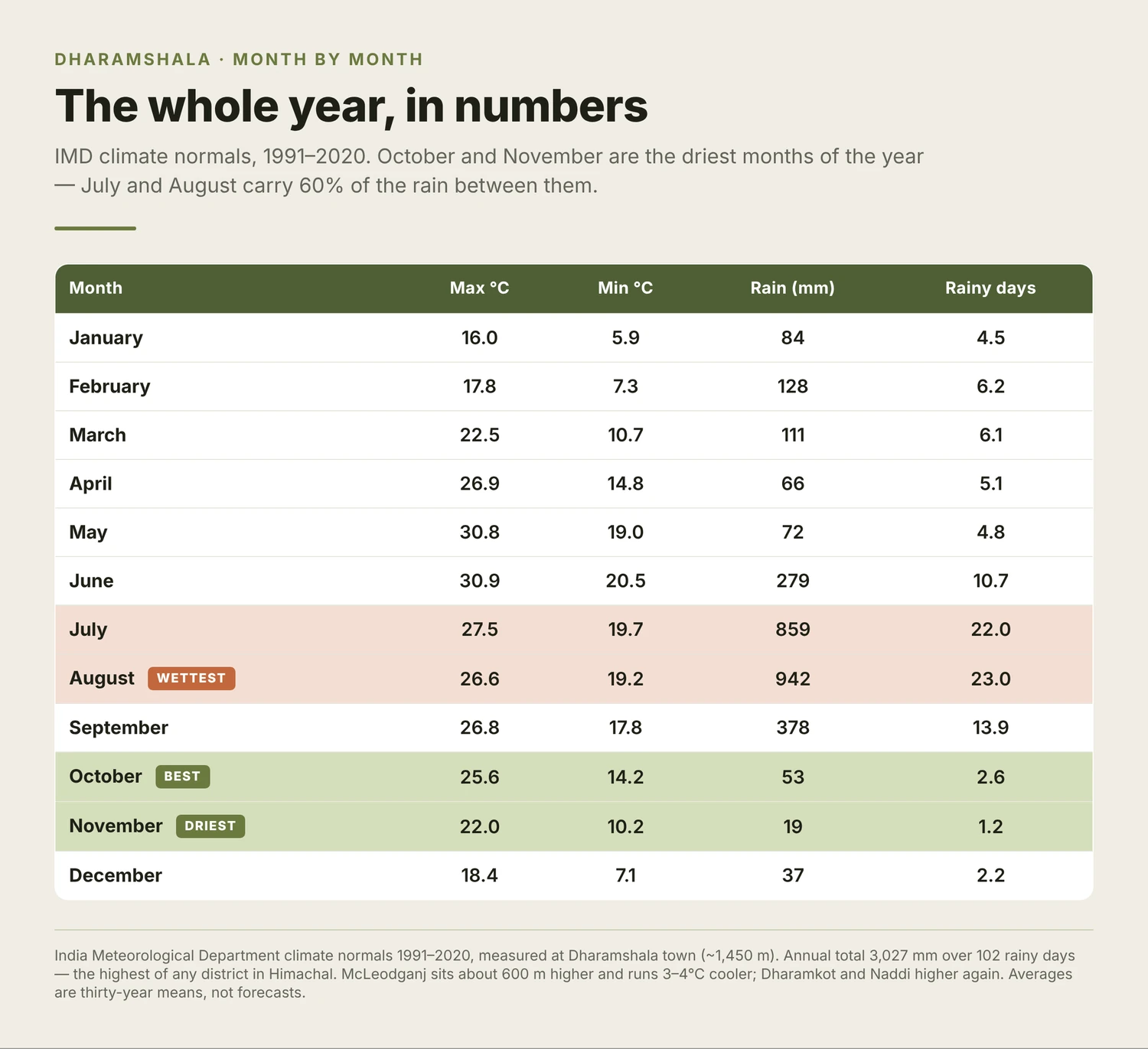
Dharamshala weather, month by month
These are India Meteorological Department climate normals for 1991–2020 — measured at the Dharamshala station, not modelled.
| Month | Max °C | Min °C | Rain (mm) | Rainy days |
|---|---|---|---|---|
| January | 16.0 | 5.9 | 84 | 4.5 |
| February | 17.8 | 7.3 | 128 | 6.2 |
| March | 22.5 | 10.7 | 111 | 6.1 |
| April | 26.9 | 14.8 | 66 | 5.1 |
| May | 30.8 | 19.0 | 72 | 4.8 |
| June | 30.9 | 20.5 | 279 | 10.7 |
| July | 27.5 | 19.7 | 859 | 22.0 |
| August | 26.6 | 19.2 | 942 | 23.0 |
| September | 26.8 | 17.8 | 378 | 13.9 |
| October | 25.6 | 14.2 | 53 | 2.6 |
| November | 22.0 | 10.2 | 19 | 1.2 |
| December | 18.4 | 7.1 | 37 | 2.2 |
Annual total: 3,027 mm across 102 rainy days. Dharamshala gets more rain than any other district in Himachal.
Two things to know before you trust this table.
"Dharamshala" isn't one place. These readings come from the lower town at about 1,450 m. McLeodganj sits roughly 600 m higher and runs 3 to 4 degrees cooler, and Dharamkot and Naddi are higher again. A 31°C May afternoon down near Kotwali Bazaar is high twenties on a Dharamkot terrace, and single digits on the Dhauladhar behind it.
And an average is not a forecast. These are thirty-year means. A 2.6-rainy-day October is the long-run figure, not a promise — mountain weather here turns fast, and a settled week can be interrupted by a three-day system with no warning. Pack for the month; plan for the exception.
So when should you actually go?
Ignore the temperature column for a second and look at the one nobody prints — rainy days. It's the number that decides whether you spend your trip on a terrace or under a roof.
- November: 19 mm across 1.2 rainy days. The driest month of the year by a distance
- October: 53 mm across 2.6 days. Warmer than November, almost as dry, and the Dhauladhar is properly visible
- June: 279 mm across nearly 11 days — and it's half of everybody's "March to June" recommendation
- February is the wettest month outside the monsoon at 128 mm, with March close behind at 111 mm
April and May are the only genuinely dry months in the popular window — 66 mm and 72 mm, under five rainy days each. If you can only travel in spring, those are your two months.
The quick version:
- Came for the mountains? October
- Want it empty and cheap? November
- Stuck with spring? April, not June
- Came for snow? Mid-January to mid-February
- Only free in July or August? Come anyway, but plan indoors and don't book anything you can't move
Which month has the clearest mountain views?
October and November. This is the question nobody seems to answer, and the numbers settle it.
- The monsoon washes months of dust out of the air and then stops. What's left is the clearest sky of the year
- One to three rainy days a month means you're not gambling your one free morning on cloud
- The Dhauladhar sits right behind McLeodganj — on a clear October morning you see the whole wall above the Kangra valley, snow line and all
- By late May a heat haze builds up. The mountains are there; you just can't see them properly
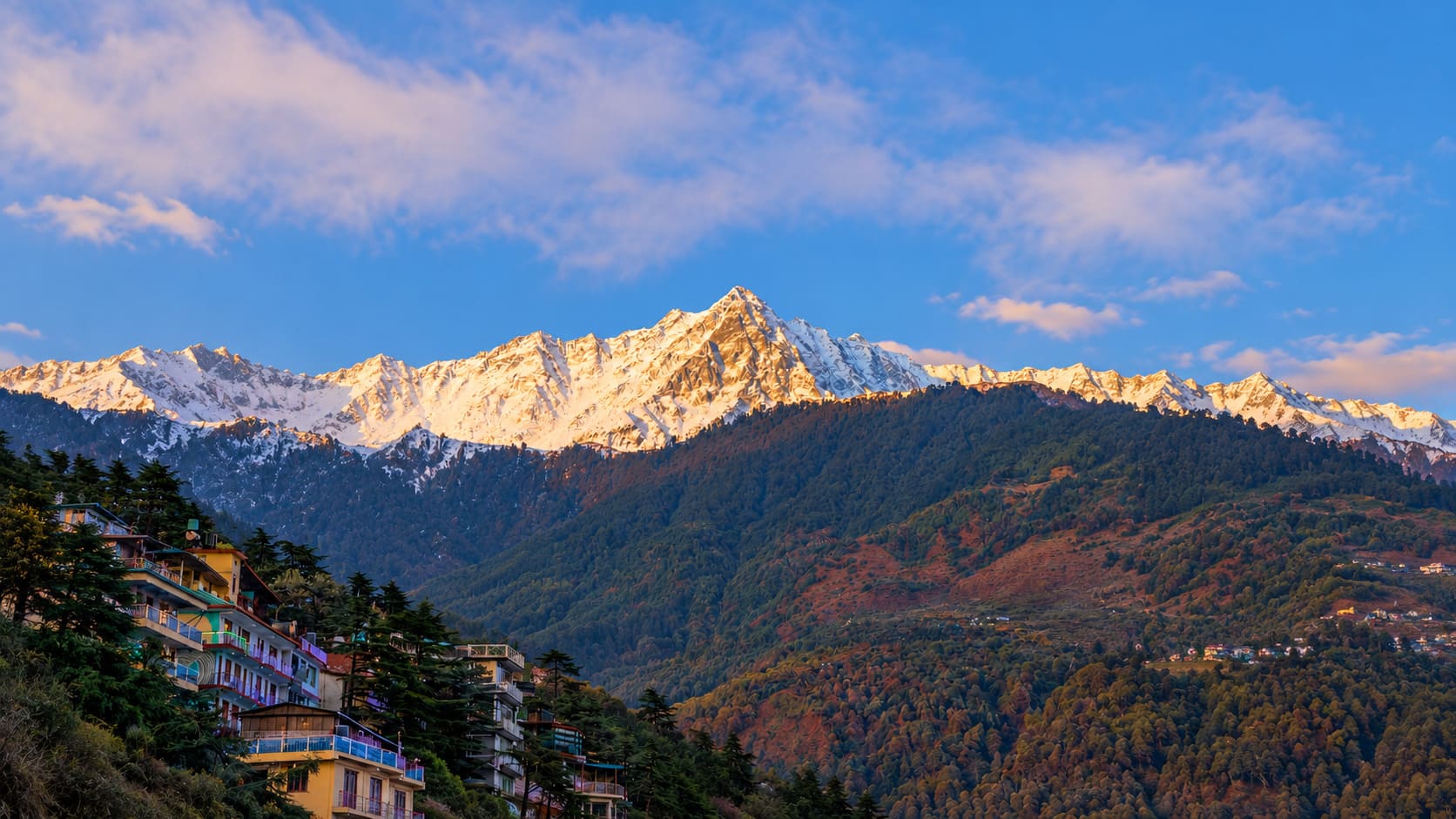
If you're coming for photographs, or for the view from a café in Dharamkot, come in autumn. Naddi, twenty minutes above McLeodganj, is where most people go to watch the sunset hit the range.
Going month by month
January
Cold and quiet. Days around 16°C in the lower town, nights near 6°C — and considerably colder up in McLeodganj. Snow is possible up top. Plenty of guesthouses and cafés on Jogiwara Road shut for the season. Come for the emptiness, not the buzz.
February
The wettest month outside the monsoon at 128 mm over six days — which surprises people who assume winter means dry. It doesn't here. What it does mean is the best snow odds of the year, and a town still half-asleep until the last week or so.
March
Spring arrives, and so does 111 mm of rain across six days. Rhododendrons start turning on the slopes above Dharamkot. Lovely light between showers, but bring a jacket you don't mind getting wet.
April
The best of the popular window. 27°C days, 66 mm of rain, five rainy days. Hills still green, the air not yet hazy, the Triund trail properly open. If you can't do autumn, do April.
May
Hot in the lower town at nearly 31°C, noticeably cooler up in McLeodganj. Fewest rainy days of the spring. This is peak season — rooms fill and weekends get busy.
June
31°C, 279 mm of rain and the monsoon arriving. The busiest fortnight of the year falls in late May and early June, which is also when the weather turns. Book well ahead or skip it.
July
859 mm across 22 rainy days. Dharamshala gets more rain than anywhere else in Himachal and July is why. Landslide risk on the roads, and the views mostly disappear behind cloud.
August
The wettest month of the year — 942 mm over 23 days. Humidity sits around 85%, so washing doesn't dry and nor do your boots. Everything is spectacularly green and almost nothing is visible. Locals get on with it; visitors mostly regret the timing.
September
The turn. 378 mm and 14 wet days, but most of it falls early. By late September the air is washing clean and the trails are drying out.
October
The best month, and it isn't close. 53 mm across under three rainy days, 26°C in town, and the Dhauladhar sitting there sharp enough to count the gullies. Trails open, crowds thinning, and the monsoon has scrubbed months of haze out of the air. Nights turn properly cold by the end of it.
November
The driest month of the year — 19 mm, barely one rainy day. 22°C days, 10°C nights. Very few people about. The Dharamshala International Film Festival usually lands around now and brings the town alive for a few days.
December
18°C days, nights around 7°C in town and colder above. 37 mm. Snow possible up top. A lot of places close for winter and the ones that stay open get cosy.
What is Dharamshala like in December?
December is the month people ask about most, and the honest answer is that it's good for some things and poor for others.
- The weather in Dharamshala in December is dry and cold — 37 mm across barely two rainy days, days around 18°C in the lower town, nights near 7°C and below freezing higher up
- Snow is possible but not reliable in McLeodganj itself. The Dhauladhar behind it will be white
- The air is still clear from the autumn, so views are excellent on a bright morning
- A lot closes. Several cafés and guesthouses shut for winter, particularly up in Dharamkot
- Christmas and New Year are the one busy spell in an otherwise empty month, and prices jump for that week
Things to do in Dharamshala in December lean indoors and uphill: the Tsuglagkhang complex and the Dalai Lama's temple, the Gyuto Monastery down in the valley, a slow morning somewhere with a heater, and the short walk to Bhagsunag waterfall, which runs thin in winter but gets you outside.
If snow is what you came for, mid-January to mid-February is a better bet than December.
When does it snow in Dharamshala?
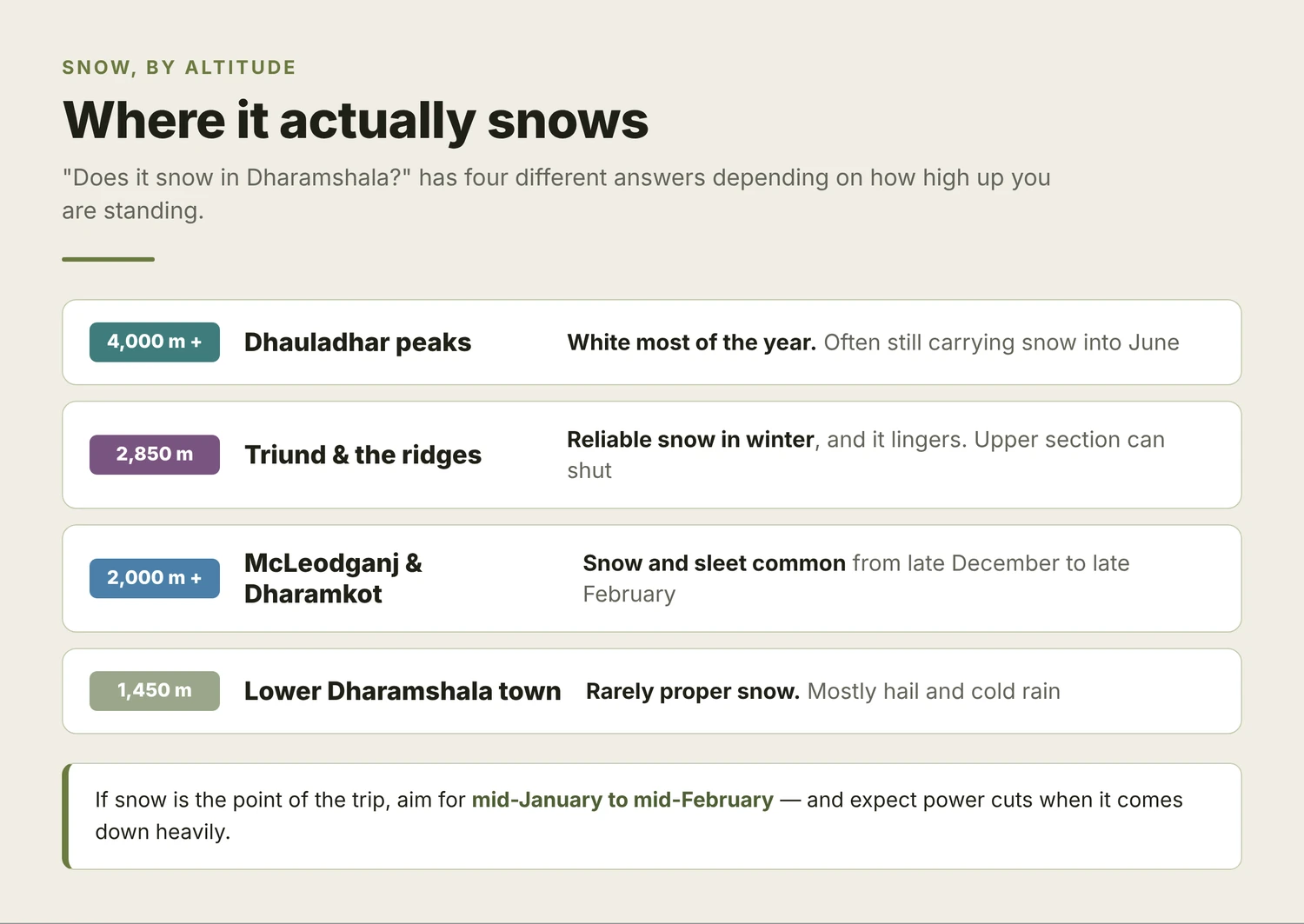
Snowfall in Dharamshala and McLeodganj is really two different questions, and most pages answer them as one. Altitude decides it: six hundred metres is the difference between hail on your jacket and snow on the roof.
| Where | Height | Does it settle? | When |
|---|---|---|---|
| Lower Dharamshala town | ~1,450 m | Rarely — mostly hail and cold rain | Jan–Feb, if at all |
| McLeodganj and Dharamkot | ~2,000 m | Often | Late Dec–late Feb |
| Triund and the ridges | 2,850 m+ | Reliably, and it lingers | Dec–Mar |
| The Dhauladhar peaks | 4,000 m+ | Permanent in effect | White most of the year, often into June |
That first row is the one that catches people out. January nights in the lower town average 5.9°C — above freezing — so what falls there usually arrives as hail or cold rain while McLeodganj, twenty minutes up the hill, is under snow.
The best time to visit Dharamshala for snowfall is mid-January to mid-February — a gamble in the town itself, close to a certainty on the ridges. February is the wettest month outside the monsoon at 128 mm, which is exactly why it carries the best odds. Last season the first real snowfall across Himachal came on 23 January, which is about typical.
Two practical things: power cuts are normal when it comes down heavily, so carry a power bank, and the climb from the lower town to McLeodganj is the stretch that closes, not the road from Pathankot.
Is the monsoon really that bad?
Honestly, yes — if you came for views.
- July and August carry 1,801 mm between them across 45 rainy days. That's 60% of the year's rain in two months
- Landslides close roads, sometimes for a day or more
- The mountains are simply not visible most of the time
- But it's beautiful and cheap, and the valley is greener than you'll ever see it
If you're here anyway, the monsoon is the best time for the indoor half of Dharamshala — the temple, the museum, a cooking class, a long lunch on Temple Road while it hammers down outside. Open Gigavent and see what's running indoors that week.
When is it cheapest?
- July to September is the bargain window — rooms go for a fraction of peak rates
- January and February are the other cheap stretch, with the catch that many places are closed
- Late May and early June are the most expensive fortnight of the year, and the hardest to book
- October and November sit in the middle — not cheap, not peak, and worth it
Rates move a lot by season and by how far ahead you book, so check before you commit rather than trusting a number in a blog post.
What about treks?
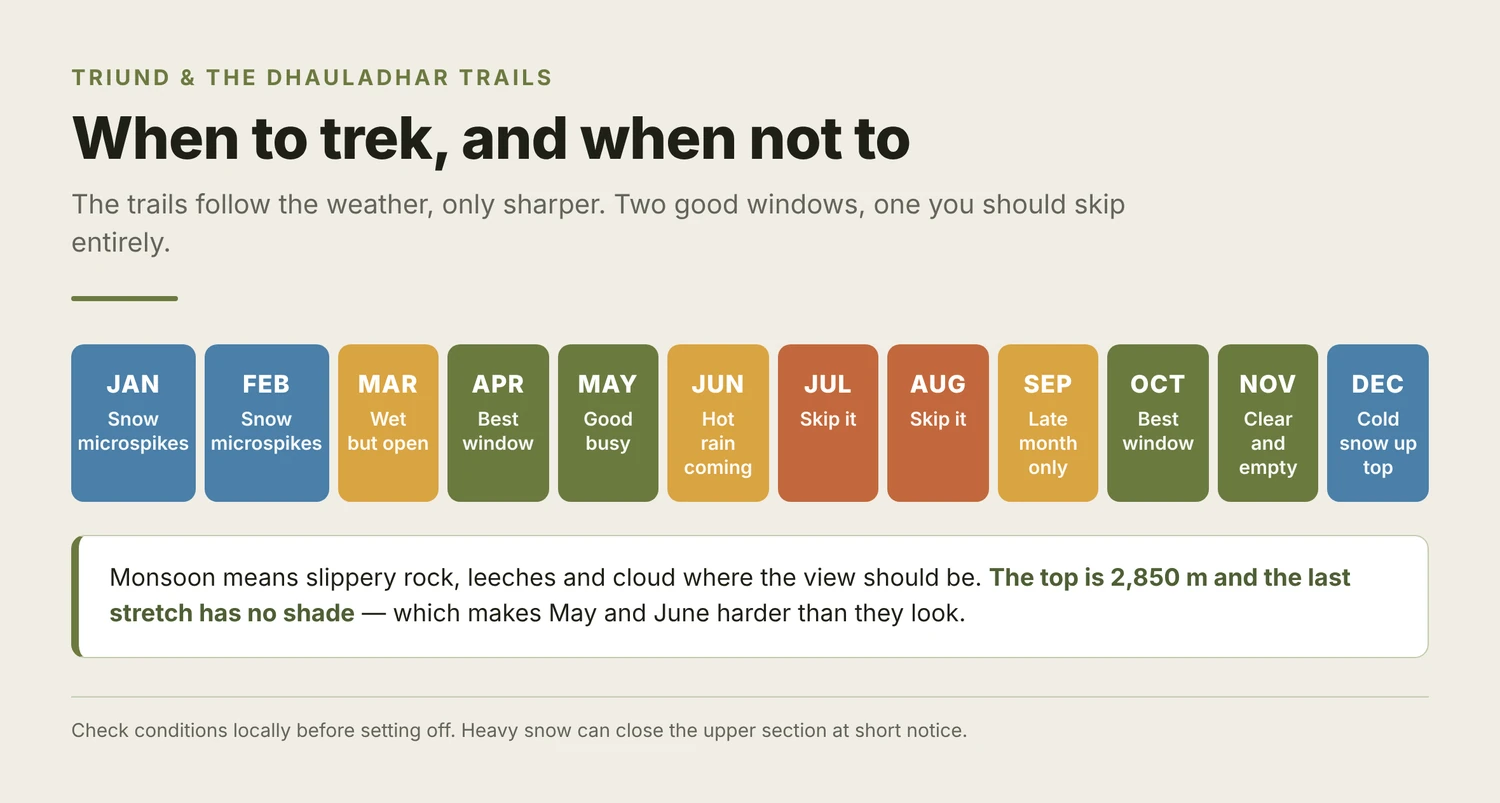
The trails follow the same curve as the weather, only sharper.
- April–May and October–November are the windows. Clear, dry, and busy at weekends. Early June still works; late June doesn't
- Avoid the monsoon entirely — slippery rock, leeches, and no view at the top
- Winter is doable with microspikes and local advice, but snow can shut the upper sections
- The last stretch to Triund has no shade, which makes May and June harder than they look
There are seventeen walks worth doing around here, from a forty-minute stroll to a 4,550 m pass. All of them, with heights, timings and the rules that changed in 2025 and 2026, are in treks in Dharamshala. For the one everybody does, the Triund trek guide has distances by trailhead and what it costs.
No one to walk up with? People post treks on Gigavent with the date, the trailhead and how many spots are left. Take one, or put up your own and let people find it.
If you're already here
Most of what's written about Dharamshala is for someone planning from Delhi. If you live here, or you're staying a month, the question is different — not when should I come, but what's worth doing this week.
- The weather changes what's on, not just what's open. Autumn is gigs on terraces; winter moves everything indoors and halves the crowd
- The good stuff is rarely advertised. A jam night in a Dharamkot café, a Sunday walk, someone's birthday turning into a party
- That's the bit a seasonal guide can't help with — no page knows what's happening on a given Thursday
Gigavent shows what's actually on around you, day by day, and lets you put your own up — a trek, a gig, a walk, whatever.
Questions people ask
When should you not visit Dharamshala?
July and August. Between them they average 1,801 mm of rain across 45 rainy days — 60% of the year's total. Roads close with landslides and the mountain views disappear behind cloud for most of it.
Which is more beautiful, Dharamshala or McLeodganj?
They're different. Lower Dharamshala is a working town — the HPCA stadium, Kotwali Bazaar, ordinary Himachal. McLeodganj, 600 m higher, has the Tsuglagkhang complex, the cafés and the mountain views, which is why most visitors stay up there. Go up for the atmosphere; come down for the real place. We've listed the places worth your time in Dharamshala across both.
What is the best time to visit Dharamshala with family?
October, or April. Both give you dry days and comfortable temperatures without the extremes — 26°C and 27°C respectively, with few rainy days and no snow to complicate the roads. Avoid the monsoon with children in tow: landslides and road closures turn a four-hour drive into an unpredictable one.
When is the best time to travel from Delhi?
October to November, then February to April. The overnight bus and the Pathankot train both run year-round, but the mountain stretch is slowest and least predictable in the monsoon. Winter is fine on the road as far as the lower town; it's the climb to McLeodganj that gets interesting after heavy snow.
How many days are enough for Dharamshala?
Three days covers McLeodganj, the Dalai Lama temple, Bhagsu and a slow morning in Dharamkot. Four or five if you want Triund as a day trek without rushing it. A week if you're not in a hurry, which is how most people end up doing it.
Dalhousie or Dharamshala?
Dharamshala, if you want more than a viewpoint. Dalhousie is quieter and prettier in a postcard way; Dharamshala has the monasteries, the trekking, the café culture and far more going on in the evening.
Is there snowfall in Dharamshala?
Yes, but it depends which Dharamshala you mean. The lower town at 1,450 m rarely gets snow that settles — January nights there average 5.9°C. McLeodganj and Dharamkot, 600 m higher, get it most winters between late December and late February, and Triund above them gets it reliably. The Dhauladhar peaks behind the town stay white into June.
Does it snow in McLeodganj?
Usually, yes — most often in January and February, sometimes into early March. It's less reliable than people hope, and the lower town often gets hail instead of snow.
What is the best month to visit Dharamshala?
October. Fifty-three millimetres of rain across under three days, 26°C, and the clearest mountain views of the year. November is drier still — 19 mm and barely one rainy day — if you don't mind the cold.
Is September a good time to visit?
The second half, yes. September still averages 378 mm, but most of it falls early. By the last week the monsoon has usually pulled back and the air is as clean as it gets.
How much rain does Dharamshala actually get?
3,027 mm a year across 102 rainy days — the highest of any district in Himachal Pradesh. Nearly all of it arrives between June and September.
Pick your month, book the room, and work the rest out when you get here — that part tends to sort itself. And if you'd rather not spend the first evening wondering what to do, Gigavent will tell you what's on.

