How to Make Friends in a New City in India

How to make friends in a new city comes down to one thing: seeing the same people again and again.
Not meeting more people. The same few, more than once.
You've been here three weeks now. The flat is sorted, the job is fine, and the last real conversation you had was about rent.
Most of us try the opposite. We go to one big night out, meet twenty strangers, swap Instagram handles with three of them, and never see a single one again. It feels like a good night. It builds nothing.
And no — this isn't because you're shy, or bad at small talk, or not trying hard enough. It's just maths. Someone sat down and counted the hours it takes. Once you know that number, the whole thing stops feeling like your fault.
How to make friends in a new city: the short answer
| What matters most | Repetition — seeing the same people more than once |
| Hours to a casual friend | About 50 |
| Hours to a real friend | About 90 |
| Hours to a close friend | 200+ |
| How long that takes in practice | 3–6 months at two meet-ups a week |
| Best first move in India | A free recurring group — run club, open mic, box cricket |
| Worst first move | A one-off party where you know nobody |
Start here: the hardest part is finding one thing near you that happens again next week. See what's actually on in your city — then read the rest of this knowing where you'll go first.
The 50-hour rule nobody mentions
It takes about 50 hours spent together to turn an acquaintance into a casual friend, 90 hours to become actual friends, and more than 200 hours to become close. Those numbers come from a 2018 study by Jeffrey Hall at the University of Kansas, published in the Journal of Social and Personal Relationships.
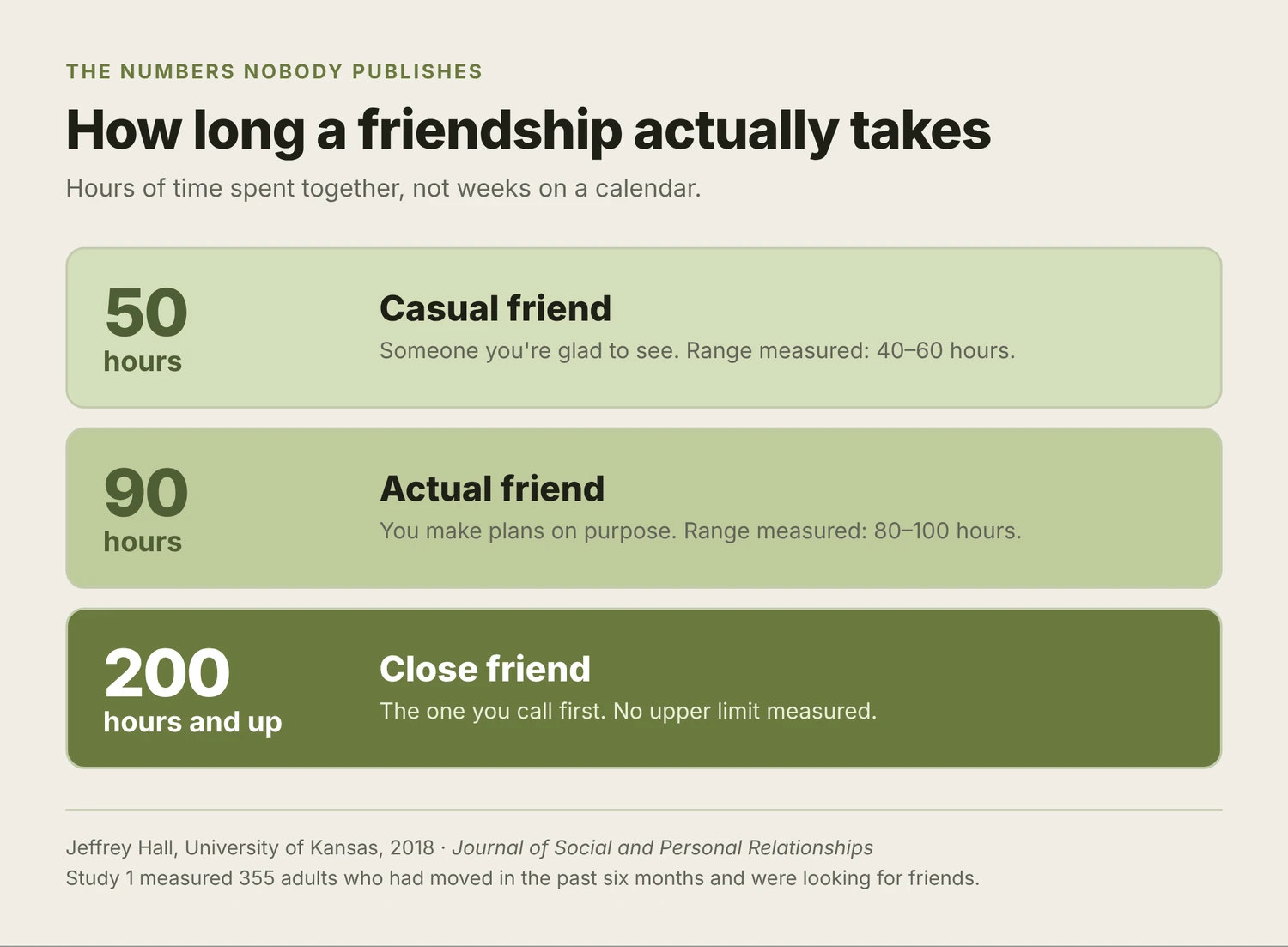
The people in that first study were 355 adults who had moved somewhere new in the past six months and were looking for friends. That is exactly you. The numbers aren't a general theory about friendship — they were measured on people in your situation.
What the hours actually look like
Fifty hours sounds enormous until you divide it across a weekly group — at roughly three hours a week, that's about four months.
A run club meeting twice a week, plus the chai afterwards, is about that. And you aren't banking those hours with one person — you're banking them with everyone who keeps showing up.
A one-off event where you meet twenty people gets you forty minutes each. Then zero, forever.
This is the whole game. One recurring thing beats ten brilliant one-offs, and it isn't close.
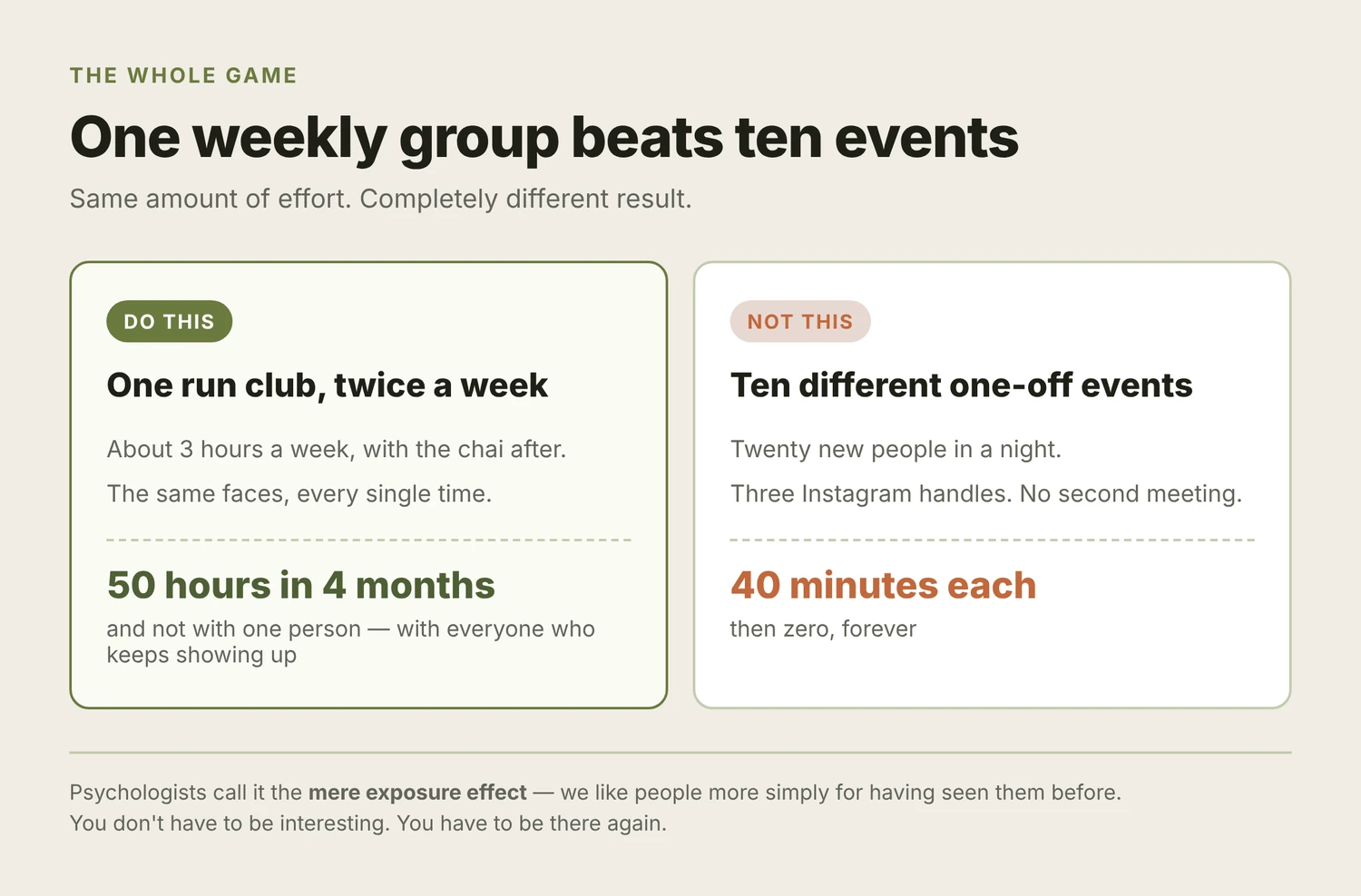
Psychologists call this mere exposure — we like people more simply for having seen them before. You don't have to be interesting. You have to be present, repeatedly.
Three hours a week is the whole ask. Get Gigavent on your phone so the week's list is somewhere you'll actually look, and pick your three.
Why it feels harder in an Indian city
Making friends in an Indian city is harder than most advice admits, because nearly all of that advice was written for America. Get to know your neighbours, join a church group, chat to people at the neighbourhood bar.
In Gurgaon, Koramangala or Kothrud — Delhi, Bangalore, Pune — almost none of that applies.
- Your building isn't a community. You'll nod at the lift and that's the relationship. Society WhatsApp groups are for plumbing and parking.
- Work friendships stop at the office door. Teams are large, people live forty minutes apart, and nobody wants a second commute on a Saturday.
- Everything is far. A group 12 km away will not become a habit, however good it is. Distance kills repetition, and repetition is the only thing that works.
- Most people already have a circle — school friends, college friends, cousins. They're not unfriendly. They're just not looking.
None of that is about you. The city just doesn't hand you a group, so you have to go and stand in one.
Does it get harder in your 30s?
Making friends in a new city does get harder in your 30s, but not because you've lost the knack — it's because the hours got harder to find.
In your early 20s a hostel, a campus or a first office handed you 50 hours a week with the same people, and nobody had to plan it. In your 30s nothing hands them to you, so the same hours have to be scheduled on purpose. Learning how to meet people in a new city at 32 isn't a harder skill than at 22 — it's the same skill with less spare time, which is why the "one thing, every week" rule matters more the older you get.
The four-week plan
Here is a four-week plan: pick two things, go back to one of them, make one small ask, then invite someone yourself.
It's deliberately small. The most common mistake is trying to rebuild a whole social life in two weeks, burning out, and deciding you're the problem.
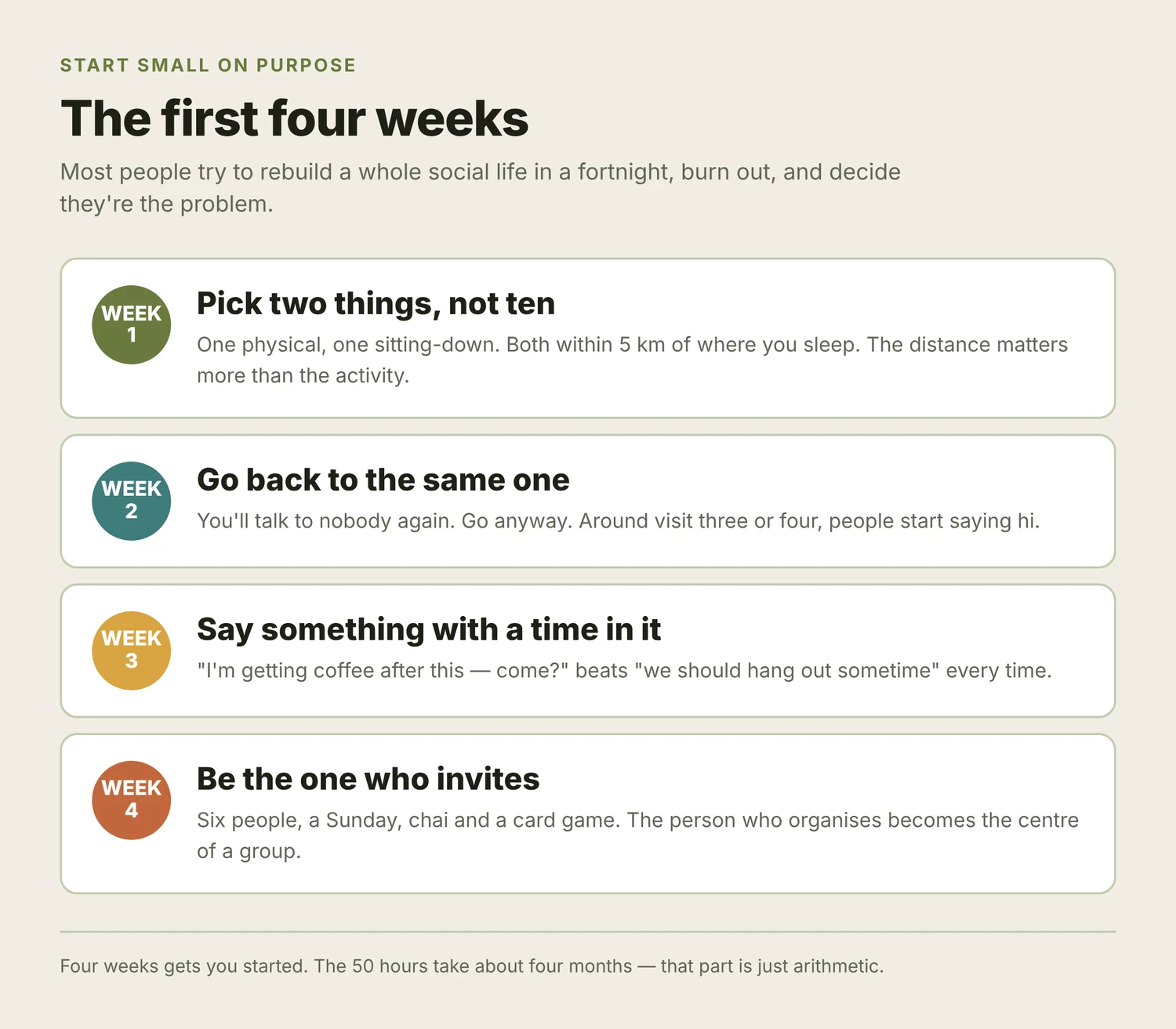
Week 1: Pick two things, not ten
Choose two recurring things within about 5 km of where you sleep. Not ten. Two.
One physical — a run club, badminton, a box cricket slot. One sitting-down — a board game night, an open mic, a pottery session.
The 5 km rule matters more than which activity you pick. Something you can reach in fifteen minutes is something you'll still be doing in March.
Don't know what's running near you? That's the step most people get stuck on. Gigavent lists what's on in your city this week, with days and times.
Week 2: Go back to the same one
Week two is going back to the same group a second time — the step almost everyone skips, and the one that actually works.
Same group, same day. You will probably talk to nobody the second time either. Go anyway.
Around the third or fourth visit something shifts: people start saying hi because they recognise you. That's not charm. That's mere exposure doing its job on schedule.
Week 3: Make the first move
By week three, make one small invitation with a time attached to it. There are two or three faces you know by now. Pick one and say something specific.
Not "we should hang out sometime" — that dies on the vine. Something with a time attached:
- "I'm getting coffee after this, want to come?"
- "A few of us are going on Thursday — you in?"
- "Can I get your number so I can tell you when I'm coming next week?"
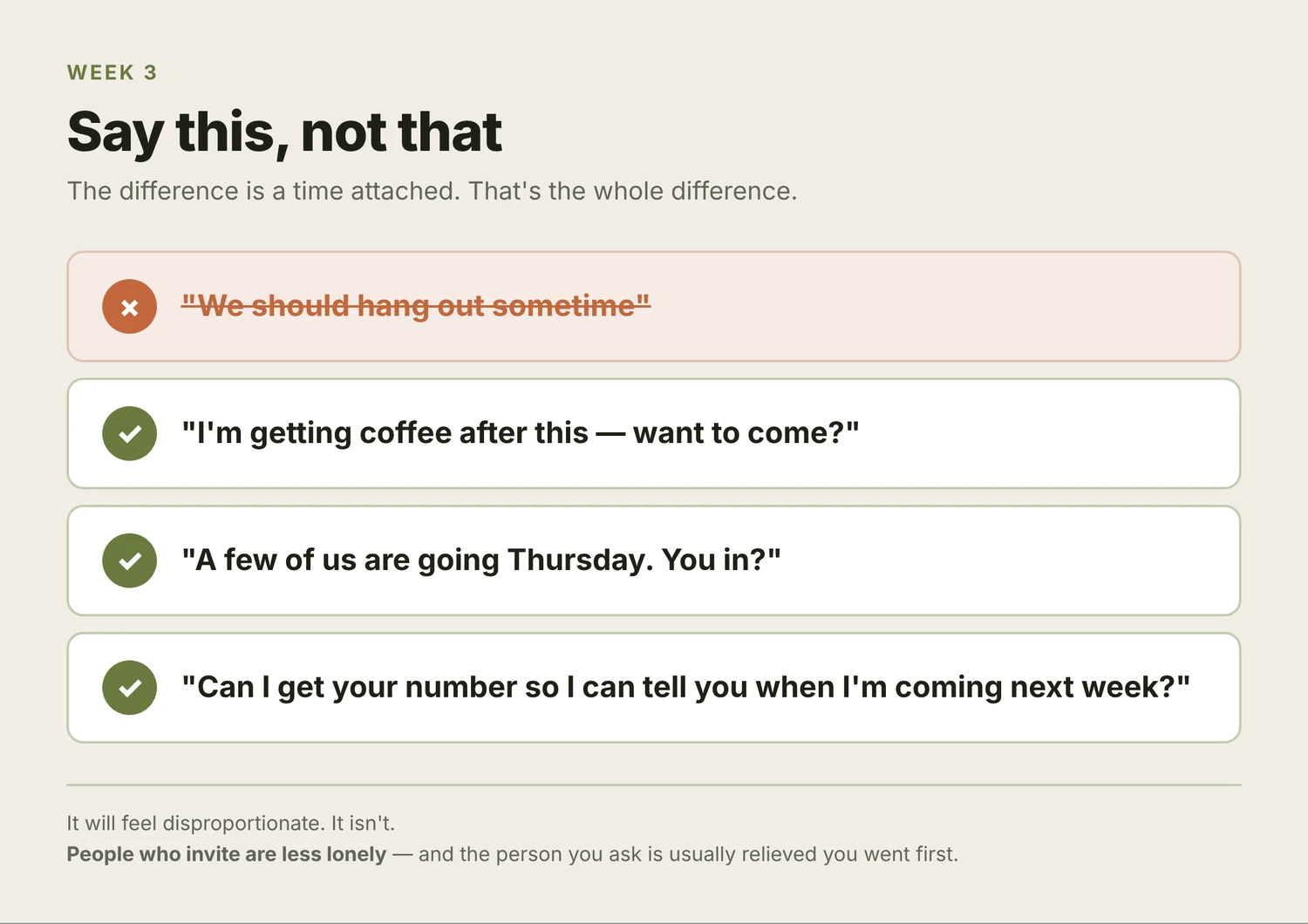
It will feel like too much. It isn't. People who initiate are less lonely, and the person you invite is usually relieved you did. Everyone in that room is waiting for somebody else to go first.

Week 4: Become the person who invites
The fastest shortcut from "people I see weekly" to "friends" is hosting something tiny.
Not a party. Six people, a Sunday, chai and a card game. Or suggest the group do something off-schedule — a trek, a film, a breakfast.
The person who organises becomes the centre of a group in a way nobody else does, and it takes almost nothing. If you want it even smaller, a house party for six people is a genuinely low-effort place to start — and you can put it on Gigavent so the people you've met have an actual thing to say yes to, instead of a vague group chat message.
What actually works in Indian cities
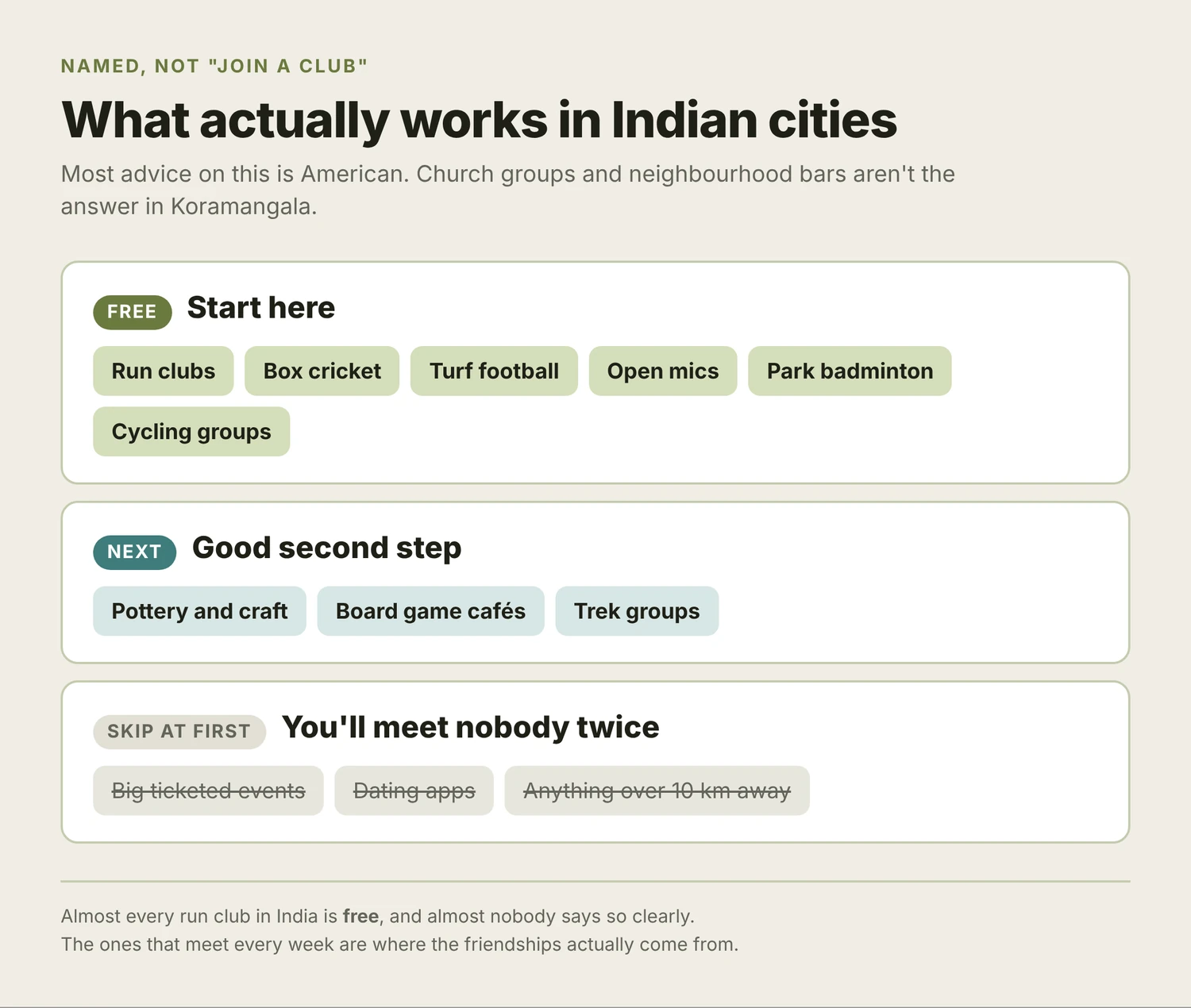
The things that actually work in Indian cities are free recurring groups: run clubs, box cricket and turf football, open mics, and park badminton or cycling groups. Named specifics, because "join a club" is not advice.
Free and recurring — start here
- Run clubs. The single best option, and almost nobody says this clearly: the overwhelming majority are free. They meet at a fixed time and place, usually weekend mornings, and nobody cares how slow you are. Most run entirely on Instagram.
- Box cricket and turf football. Teams are permanently short one player, which makes you useful on day one — and nobody asks how good you are before they let you field. Worth reading the rules once so your first game isn't spent confused.
- Open mics and live music nights. You do not have to perform. Audiences are regulars too, and the same faces turn up every week.
- Park badminton and cycling groups. Early morning, free, and startlingly social.

Good second step
- Pottery, ceramics and craft workshops. Slower, quieter, and you end up talking for two hours because your hands are busy. The best option if large groups drain you.
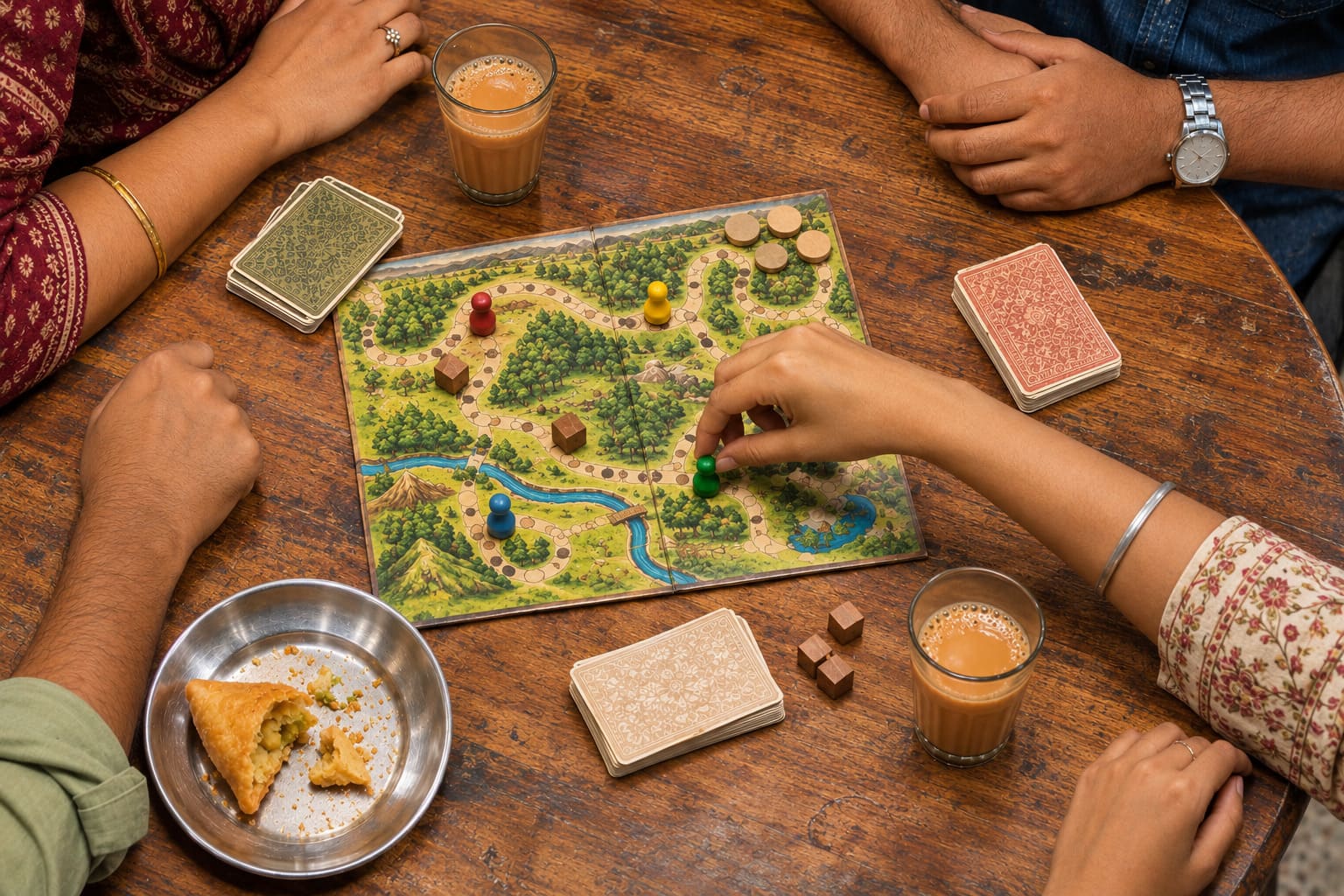
- Board game cafés. Most run a weekly open table where strangers are seated together — the format does the introducing for you.
- Trek and hike groups. A full day with the same people is worth several evenings. If you're new to it, start with a beginner-friendly trek rather than something that will put you off walking forever.

This list works the same whether you've moved to Bangalore, Mumbai, Delhi, Pune or Hyderabad. The names change, the maths doesn't.
Pick one from this list and find it near you. Browse what's on in your city this week — or post the thing you want to do and see who joins.
What to skip at the start
- Huge ticketed festivals, alone. Fun, but you'll meet nobody twice unless you go with someone.
- Pure dating apps when what you want is friends. Different intent, different outcome.
- Anything more than 8–10 km away. You'll go twice.
What is the 5-3-1 friendship rule?
The 5-3-1 rule is a social health guideline from Kasley Killam, a Harvard-trained social scientist, and it's a useful way to check whether what you're doing is enough:
- 5 — spend time with five different people in a week
- 3 — keep up three close relationships
- 1 — aim for about an hour of social contact a day
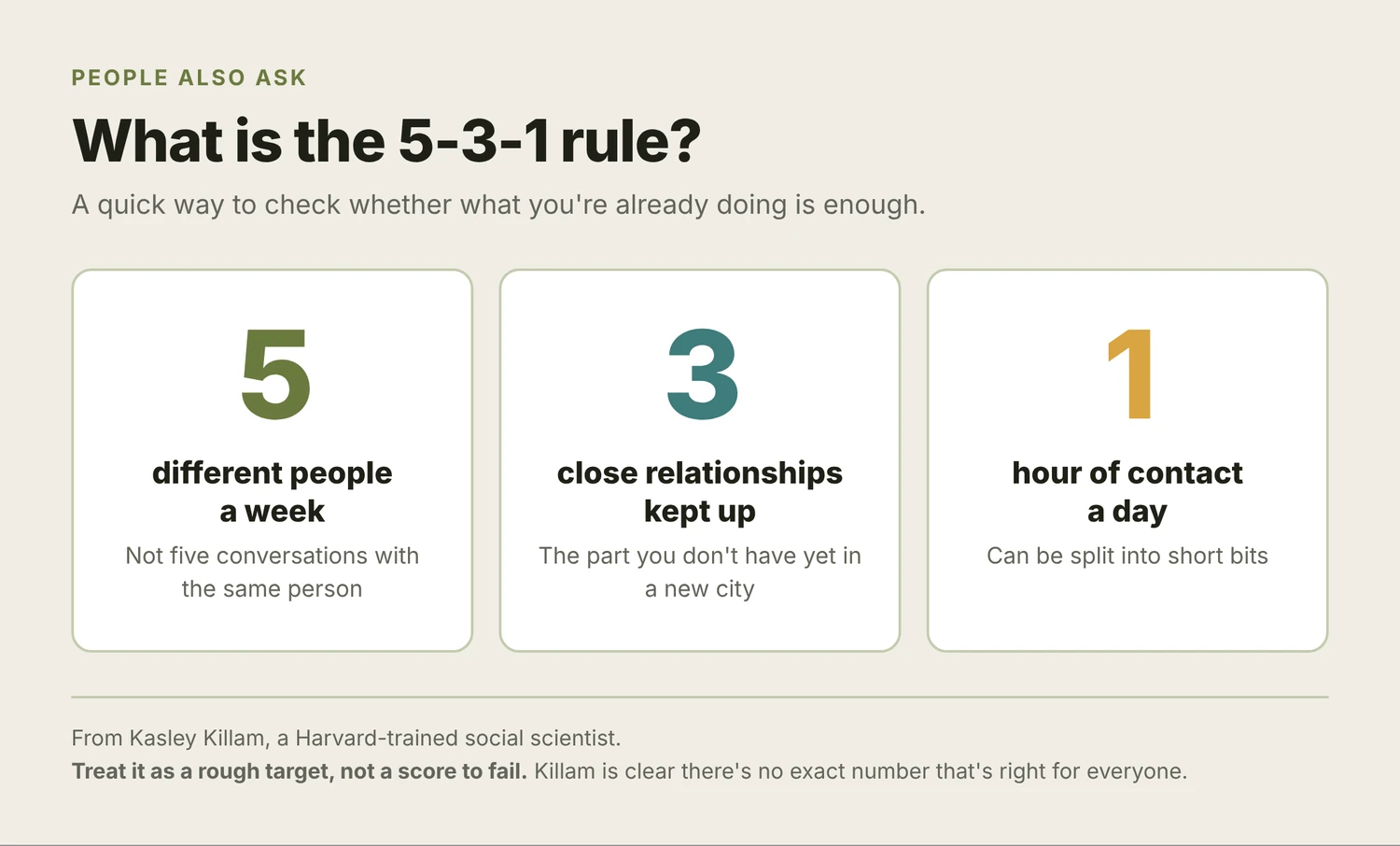
Treat it as a rough target, not a score to fail. In a new city the "3" is the part you don't have yet — which is fine. That's what the 200 hours are for.
How to make friends in a new city as an introvert
Introverts make friends in a new city by being regular, not by being outgoing. Nothing on this page asks you to work a room. It asks you to turn up to the same thing repeatedly — a completely different skill, and one introverts are usually better at.
Two adjustments:
- Pick activities with a built-in task. Pottery, board games, running, cricket. When there's a thing to do, silence is comfortable and conversation happens sideways instead of head-on.
- Leave early if you want. Ninety minutes and then home is fine. Showing up often for a short time beats showing up rarely for a long one. Same hours either way.
Prefer the quiet end? Look for the small, hands-busy things on Gigavent — pottery, craft, board games. Ten people, not a hundred.
If you've tried and it hasn't worked
If you've been going to things and still have no friends, there are usually two reasons: you haven't hit the hours yet, or you picked something you don't actually enjoy.
The hours. Four things across four different groups is maybe six hours with any one set of people. Six is not fifty. The plan isn't failing; it hasn't run long enough. Pick the least bad of the four and go back six more times.
The activity. A group you're putting up with won't survive a rainy Tuesday. It has to be something you'd do anyway, alone, if nobody turned up.
And if what you're feeling is heavier than new-city lonely — if it's been months and the flatness follows you into things you used to enjoy — that's worth saying out loud to someone, a friend back home or a professional. Not every version of this is a scheduling problem, and there's no prize for treating it like one.
Where Gigavent fits in all this
Every step above runs into the same two walls: finding the thing, and finding someone to do it with.
That's where most people stall — not because these groups don't exist, but because they're almost impossible to find. A run club lives in somebody's Instagram story. A trek group is a WhatsApp chat you'd have to already be in.
Gigavent is where all of it gets posted. Events, sports tournaments, treks, workshops, open mics — what's on in your city, with the day, the time and the place.
Three ways it helps when you're new and know nobody:
- You can see what's actually on. No guide, no local friend, no asking around at work. Just what's happening near you this week.
- You can turn up alone. Most of what's listed is the sort of thing people come to on their own. Nobody is going to ask where your friends are.
- You can post your own and ask people to come. "Going to Triund this Sunday, looking for someone to go with." Free or paid, big or tiny — your call, no restrictions. This is the Week 3 ask with the awkward part taken out.
That last one matters most. Finding something to do is easy once you know where to look. Finding someone to go with is the part nobody solves — and it's the step that turns one Sunday into a second Sunday with the same people.
You don't need to know anyone to start. You need one thing happening near you, and the nerve to say "I'm going, come along."
Open Gigavent and see what's on — then go twice.
Frequently asked questions
How long does it take to make friends in a new city? Making friends in a new city takes about 50 hours together to reach a casual friendship, 90 hours for a real friendship and over 200 hours to become close, based on Jeffrey Hall's 2018 University of Kansas research. At two meet-ups a week, that's roughly three to six months.
What is the 5-3-1 friendship rule? The 5-3-1 friendship rule, from social scientist Kasley Killam, suggests spending time with five different people each week, maintaining three close relationships, and getting about one hour of social interaction a day. It's a research-informed rule of thumb, not a strict target.
What is the 80/20 rule in friendships? The 80/20 rule in friendships is the Pareto principle borrowed from business, usually stated as roughly 80% of your social satisfaction coming from about 20% of your relationships. It is a rule of thumb with no friendship research behind it, unlike the 50-hour figure, which was actually measured.
How do you make friends in a new city in your 30s? Making friends in a new city in your 30s uses the same method as at 22 — one recurring group, attended every week. The difference is that nobody hands you the hours any more, so they have to be scheduled on purpose. That is why a fixed weekly slot matters more the older you get.
Where does Gen Z meet people in India? Gen Z in India mostly meets people through recurring interest groups rather than nightlife — run clubs, open mics, box cricket and turf football, board game cafés, craft workshops and trek groups. Most of these organise on Instagram or through local event apps rather than advertising publicly.
How do you make friends in a new city as an introvert? Introverts make friends in a new city most easily through activities with a built-in task — pottery, board games, running, cricket — where conversation happens alongside something else. Regular short visits work better than occasional long ones.
Is it normal to have no friends after moving to a new city? It is completely normal to have no friends several months after moving. The research puts a casual friendship at around 50 hours of shared time, which simply takes months to add up. It is how the maths works, not a personal failing.
What's the fastest way to make friends in a new city? The fastest way to make friends in a new city is to join one free recurring group within 5 km of home and attend it every single week, rather than attending many different one-off events. Repetition builds familiarity far faster than variety.
Still not sure where to start? See what's on near you this weekend and pick the one that repeats.

