Classical Talent Hunt in Kangra: Who Can Enter & How
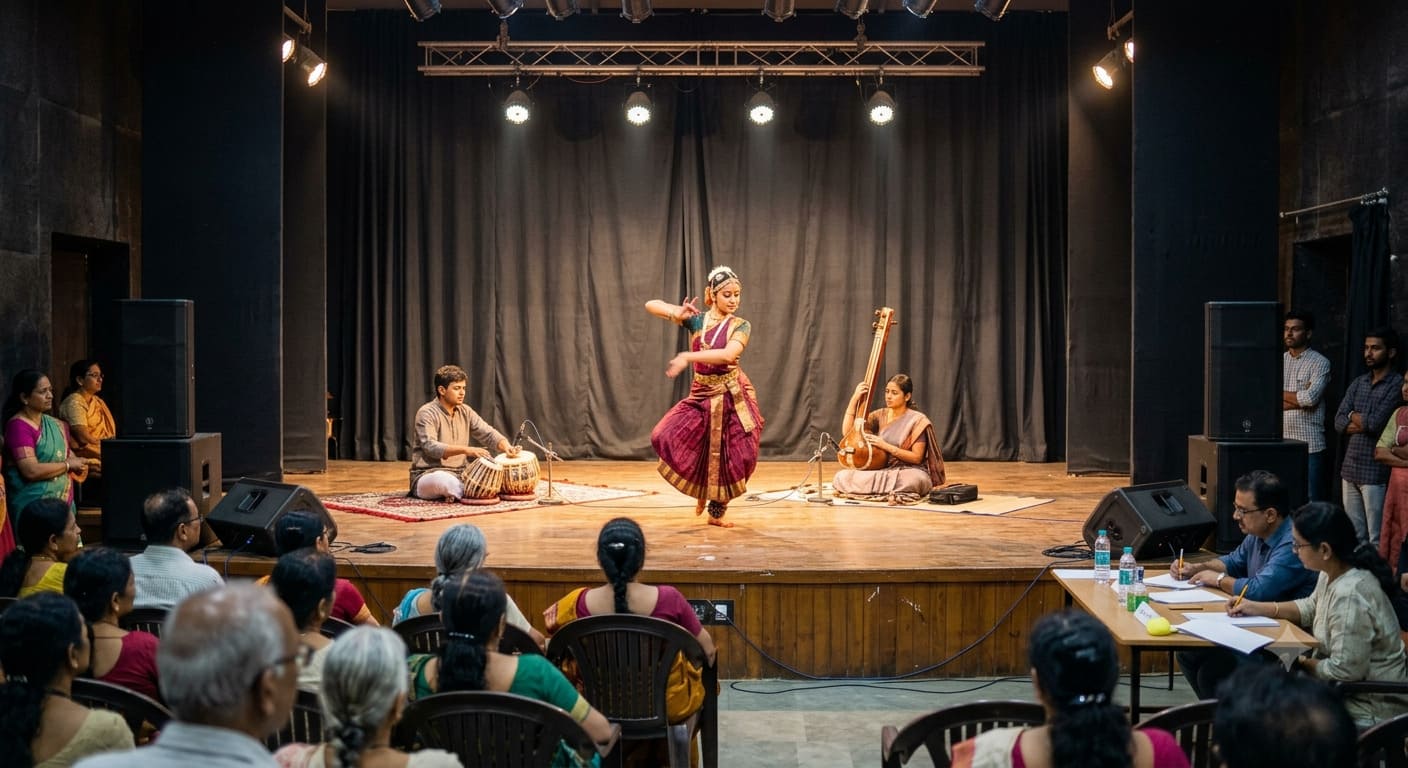
the fit kangra 2026 classical talent hunt runs 2:00 to 5:00 pm on saturday 10 october at baan ganga ghat. classical performers only — singing, dance or instrument. free, judged, and you register beforehand. here's who's eligible and how to enter.
you've been learning for six years. you've done the exams, the riyaz, the same three compositions until your teacher stopped correcting you.
and you've performed in front of — your teacher. maybe a family function.
there's a stage at baan ganga ghat on saturday afternoon with judges in front of it, an audience on the steps, and no entry fee. that is a genuinely rare thing in kangra, and it's open to you.
it's one session of fit kangra 2026, the three-day festival at the ghat, hosted by the Kangra district administration and led by SDM Kangra, Dr. Anjali Garg.
the festival is an anti-chitta initiative — the aim is to give young people a better high, and achievement is one of the six it's built around. that's what this session is for: a real stage for people who've been practising in a room.
it's free to enter. you just register on Gigavent beforehand, because this one isn't a turn-up-on-the-day session.
the short version
what — the fit kangra 2026 classical talent hunt
when — saturday 10 october 2026, 2:00 to 5:00 pm
where — baan ganga ghat, kangra, himachal pradesh
who can enter — classical performers only: singing, dance or instrument
cost — free to enter
how — register in advance on Gigavent, not on the day
What is a classical talent hunt?
a talent hunt is an open competition for performers — you register in advance, you get a short slot on stage, and a panel judges what you do. entries are grouped and shortlisted by category rather than thrown into one pile.
what it covers here — three categories:
vocal — classical singing. dance — classical dance. instrument — a classical instrument, played solo.
how it works, start to finish:
you put your name down with your category before the day. the organisers build a running order from the list. on saturday afternoon you perform your piece in a short slot. judges watch and score.
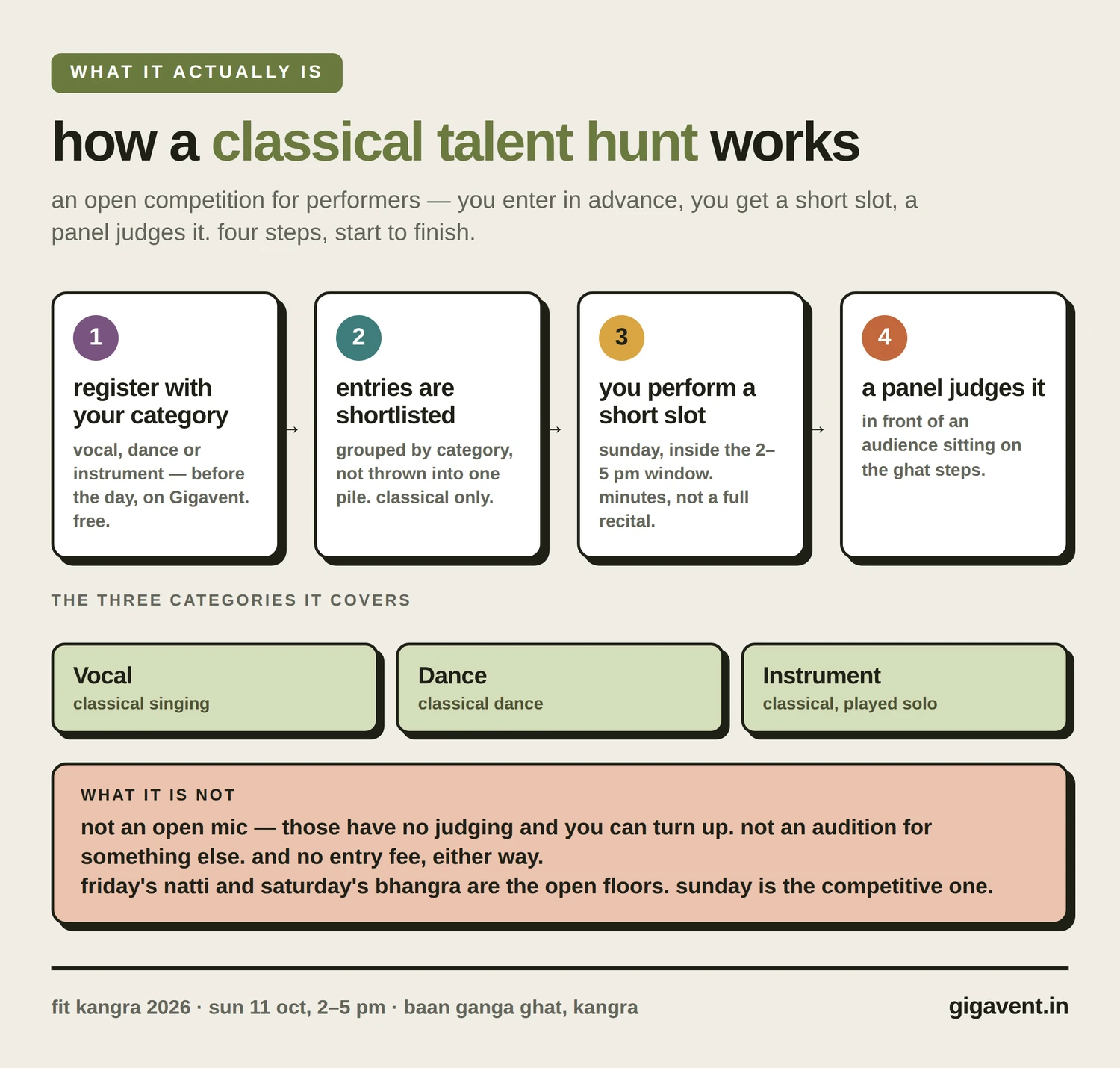
what it is not. not an open mic — those have no judging and you can turn up. not an audition for something else. and no entry fee, either way.
that matters at this festival specifically, because it has both: friday's natti and saturday evening's bhangra are open floors, and the afternoon talent hunt is the competitive one.
Who can enter the classical talent hunt?
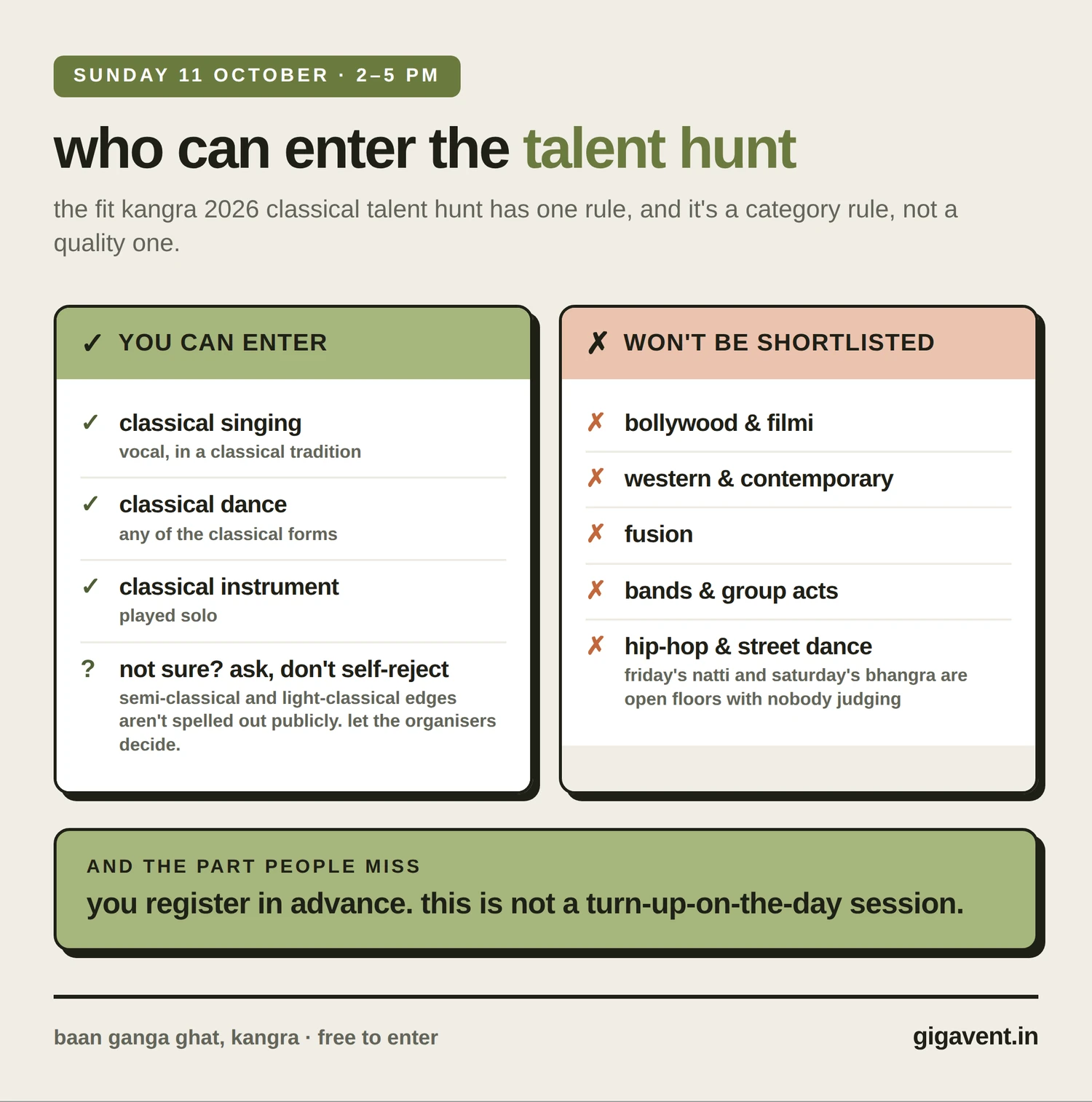
classical performers only. that's the one rule, and it's the whole reason this page exists.
three categories are in:
classical singing — vocal, in a classical tradition.
classical dance — any of the classical forms.
classical instrument — played solo.
other styles won't be shortlisted. bollywood, filmi, western, fusion, hip-hop, contemporary, a band — none of it is being judged here, however good you are. that isn't a quality judgement, it's a category one. this particular session is for classical and the organisers have been clear about it.
so before you plan your saturday around it: if what you do isn't classical, this isn't your slot. the rest of the festival still is — friday's natti and saturday evening's bhangra are open floors with nobody judging anything.
What counts as Indian classical?
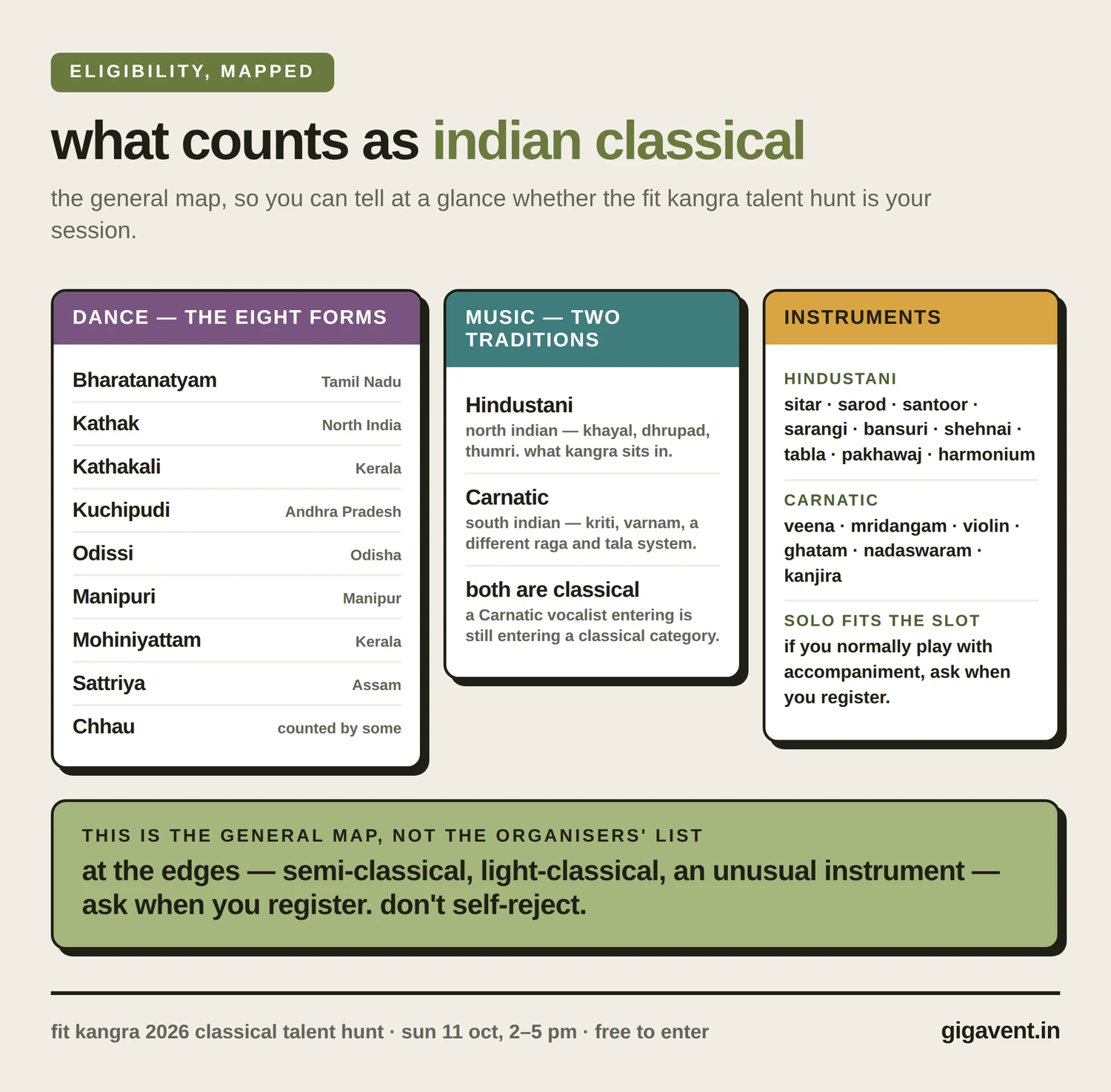
if you've trained in one of these, you're in the right session. this is the general map, not the organisers' own list — see the note below it.
the eight classical dance forms
the Sangeet Natak Akademi recognises eight classical dance forms of India:
| Form | Where it comes from |
|---|---|
| Bharatanatyam | Tamil Nadu |
| Kathak | North India |
| Kathakali | Kerala |
| Kuchipudi | Andhra Pradesh |
| Odissi | Odisha |
| Manipuri | Manipur |
| Mohiniyattam | Kerala |
| Sattriya | Assam |
Chhau is counted as a ninth by some bodies and not others, which is exactly the kind of edge worth asking about rather than assuming.
in kangra and the wider himachal belt, Kathak and Bharatanatyam are the two you'll find taught most often, so they're what most entries here will be.
the two classical music traditions
Hindustani is the north indian tradition — khayal, dhrupad, thumri and the raga system as it developed across north india, pakistan and nepal.
Carnatic is the south indian tradition — kriti, varnam, and a different system of ragas and talas.
both are classical. kangra sits firmly in Hindustani territory, but a Carnatic vocalist entering is still entering a classical category.
classical instruments
Hindustani — sitar, sarod, santoor, sarangi, bansuri, shehnai, tabla, pakhawaj, harmonium.
Carnatic — veena, mridangam, violin, ghatam, nadaswaram, kanjira.
solo is what fits a talent-hunt slot. if you normally play with accompaniment, that's one of the questions to ask when you register.
what if you're not sure whether your form counts?
ask when you register rather than guessing.
the listing says classical, and the honest answer is that the edges — a semi-classical thumri, a light-classical bhajan, a classical piece on a non-traditional instrument — aren't spelled out anywhere public. the organisers can tell you in a sentence and it costs you nothing to ask.
don't self-reject at the edge. if you've trained in a classical tradition and your piece comes out of it, put your name down and let them decide. the worst outcome is a no from someone who had to read your entry first.
When and where is it?
saturday 10 october 2026, 2:00 to 5:00 pm, on the stage at baan ganga ghat, halehr khurd, kangra, himachal pradesh 176001.
three hours is the window for the whole session, not for your piece — with multiple performers across singing, dance and instruments, individual slots will be short. plan for a few minutes on stage, not a full recital.
it's a saturday afternoon, straight after the youth panel ends at two. no 6am start, no evening traffic, and the light at the ghat at three is as good as it gets.
How do you enter?
register on Gigavent, in advance. this is the part people get wrong.
the marathon you can more or less roll up to. this one you can't — a judged session with categories needs a list before the day, and turning up at two o'clock with an instrument is not how you get on stage.
it's free. registering is how the organisers build the running order and group entries by category, and it means your slot and timing sit on your phone rather than in a screenshot.
What should you prepare?
one piece you can already perform without thinking. not your most ambitious one — your most reliable one.
the most useful thing you can do this week is play or sing it to someone who isn't your teacher. a cousin, a neighbour, anyone. the gap between a room and a stage is being looked at, and five minutes of that does more than another hour of riyaz.
things that aren't published, so ask when you register: how long each slot is, whether accompaniment is provided or you bring your own, and whether a sound system and mics are set up for instruments. these are normal questions and the organisers will answer them — but find out before saturday, not on the steps at 1:55.
what to bring on the day: your instrument if you play one, your own tanpura or track if you use one, water, and something warm for afterwards, because the aarti crowd builds as the sun drops.
How do you deal with nerves before a stage performance?
this is what actually stops people, and it has almost nothing to do with how well you play.
the nerves are not a sign you're underprepared. your body reacts to being looked at — faster heart, shallow breathing, hands that won't settle. that happens to people who have performed a hundred times. it just stops frightening them.
four things help, and none of them need more practice.
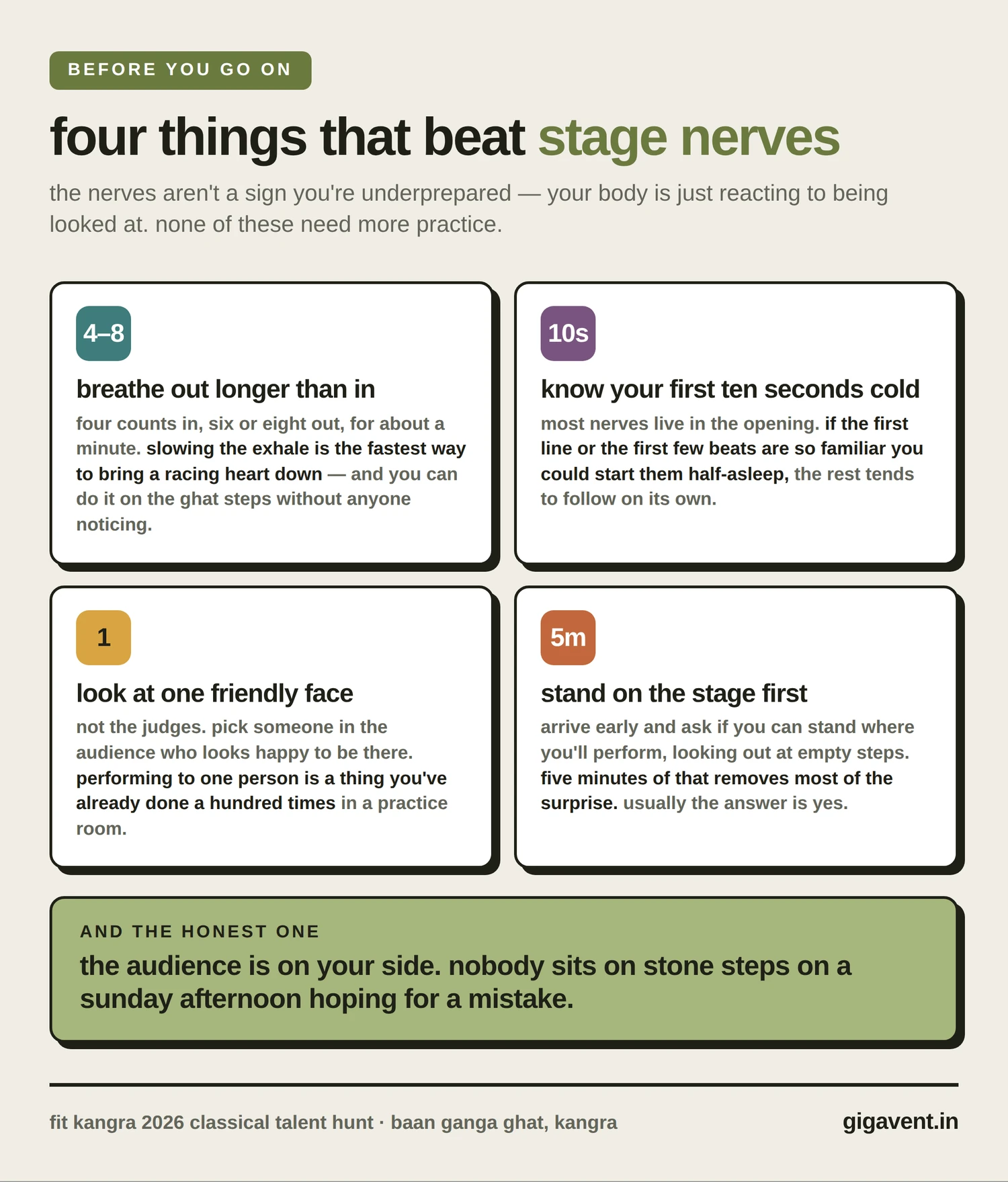
and the honest one: the audience is on your side. people sitting on stone steps on a saturday afternoon to watch classical performance want you to be good. nobody is there hoping for a mistake.
What happens after your slot?
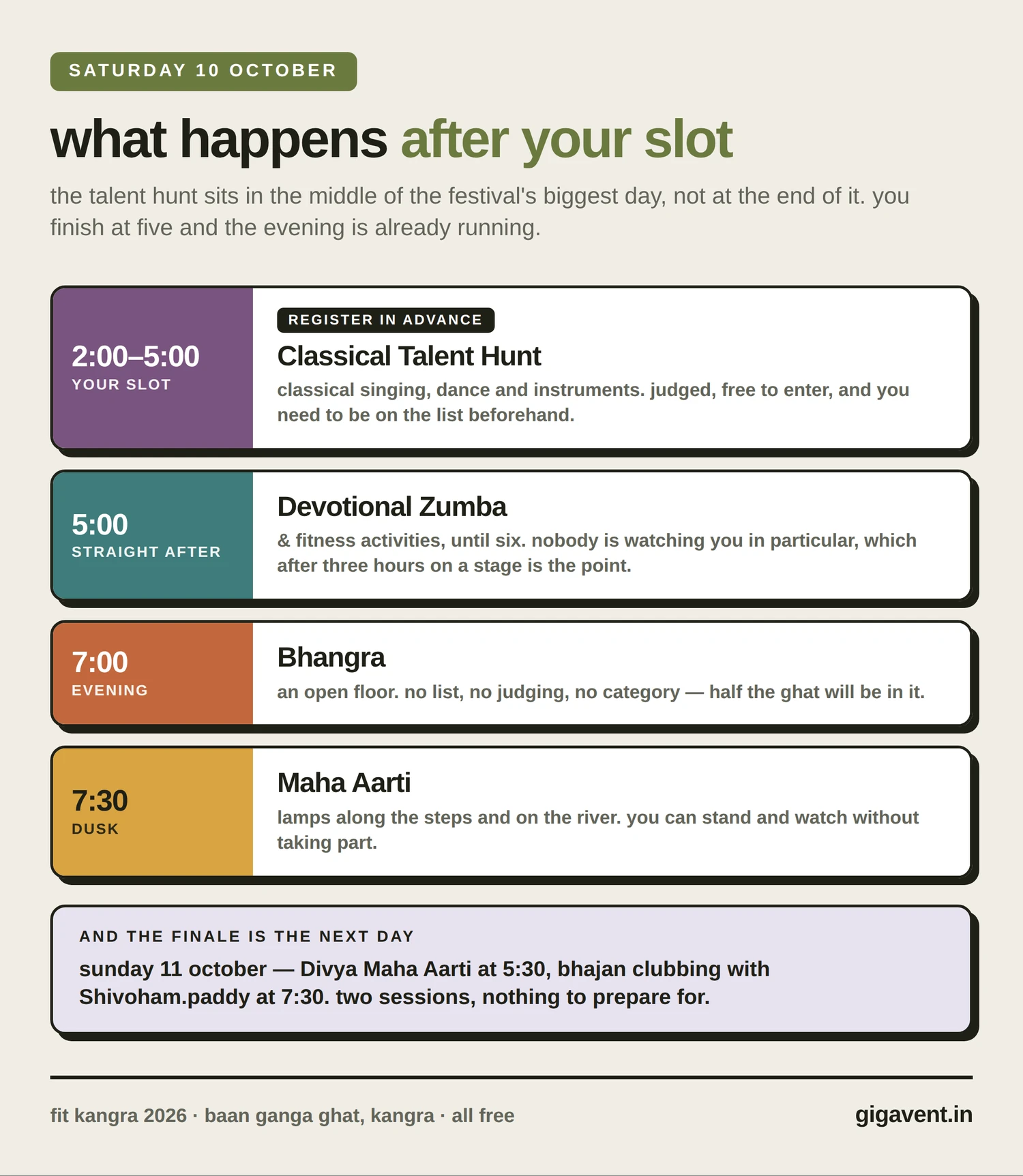
the talent hunt sits in the middle of the festival's biggest day, not at the end of it. you finish at five and the evening is already running.
| Time | What |
|---|---|
| 5:00 – 6:00 pm | Devotional Zumba |
| 7:00 pm | Bhangra |
| 7:30 pm | Maha Aarti |
that's the good part of performing on saturday. whatever the judges thought, you walk off stage into a zumba session, a bhangra floor and an aarti on the river, with nobody watching you in particular. better than going home to think about it.
and the finale is the next day. sunday 11 october: Divya Maha Aarti at 5:30 pm, bhajan clubbing with Shivoham.paddy at 7:30. nothing to prepare for, and the aarti at dusk is the best hour of the three days.
The quick version
who can enter — classical performers only: singing, classical dance, or a classical instrument. other styles won't be shortlisted.
when — saturday 10 october 2026, 2:00 to 5:00 pm.
where — baan ganga ghat, kangra, himachal pradesh.
cost — free to enter.
how — register on Gigavent in advance. not a turn-up-on-the-day session.
what to prepare — one piece you can perform without thinking, and perform it once to someone who isn't your teacher first.
ask the organisers — slot length, accompaniment, mics.
after your slot — zumba at 5, bhangra at 7, aarti at 7:30. the finale is sunday 5:30.
FAQ
Who can enter the Fit Kangra classical talent hunt?
classical performers only — singers, classical dancers and instrumentalists. other styles won't be shortlisted.
When is the Kangra classical talent hunt?
saturday 10 october 2026, 2:00 to 5:00 pm, at baan ganga ghat in kangra.
Is there an entry fee?
no, it's free to enter. you register in advance on Gigavent.
Can I just turn up on the day with my instrument?
no. this session needs you on the list beforehand, unlike the marathon or the open dance sessions. register first.
Is there an age limit?
nothing published sets one, and the festival as a whole is open to everyone. if you're entering for a child or a student, ask when you register.
What if my style is semi-classical or fusion?
ask the organisers rather than deciding for yourself. the listing says classical; the edges aren't spelled out publicly, and they can tell you in one sentence.
What is a talent hunt competition?
an open competition where performers register in advance, get a short slot on stage, and are judged by a panel. entries are shortlisted by category. in india the phrase is also used for school scholarship exams — this one is the performing-arts kind.
What are the classical dance forms of India?
the Sangeet Natak Akademi recognises eight: Bharatanatyam, Kathak, Kathakali, Kuchipudi, Odissi, Manipuri, Mohiniyattam and Sattriya. Chhau is counted as a ninth by some bodies.
What is the difference between Hindustani and Carnatic music?
Hindustani is the north indian classical tradition and Carnatic the south indian one. they use different raga and tala systems and different repertoire. both are classical.
What else is on that day?
saturday is the festival's biggest day — the 6am marathon, yoga, the youth panel, then zumba, bhangra and a maha aarti in the evening. all free, all at the same ghat.
so, kya scene hai saturday? there's a stage, an audience sitting on stone steps by a river, and judges who have not heard you before. six years of riyaz and the only thing left to do is put your name down.
read next
Fit Kangra 2026: the full three-day schedule → — all nine sessions, the venue, and how to join.

