Trekking for Beginners: Complete Your First Trek
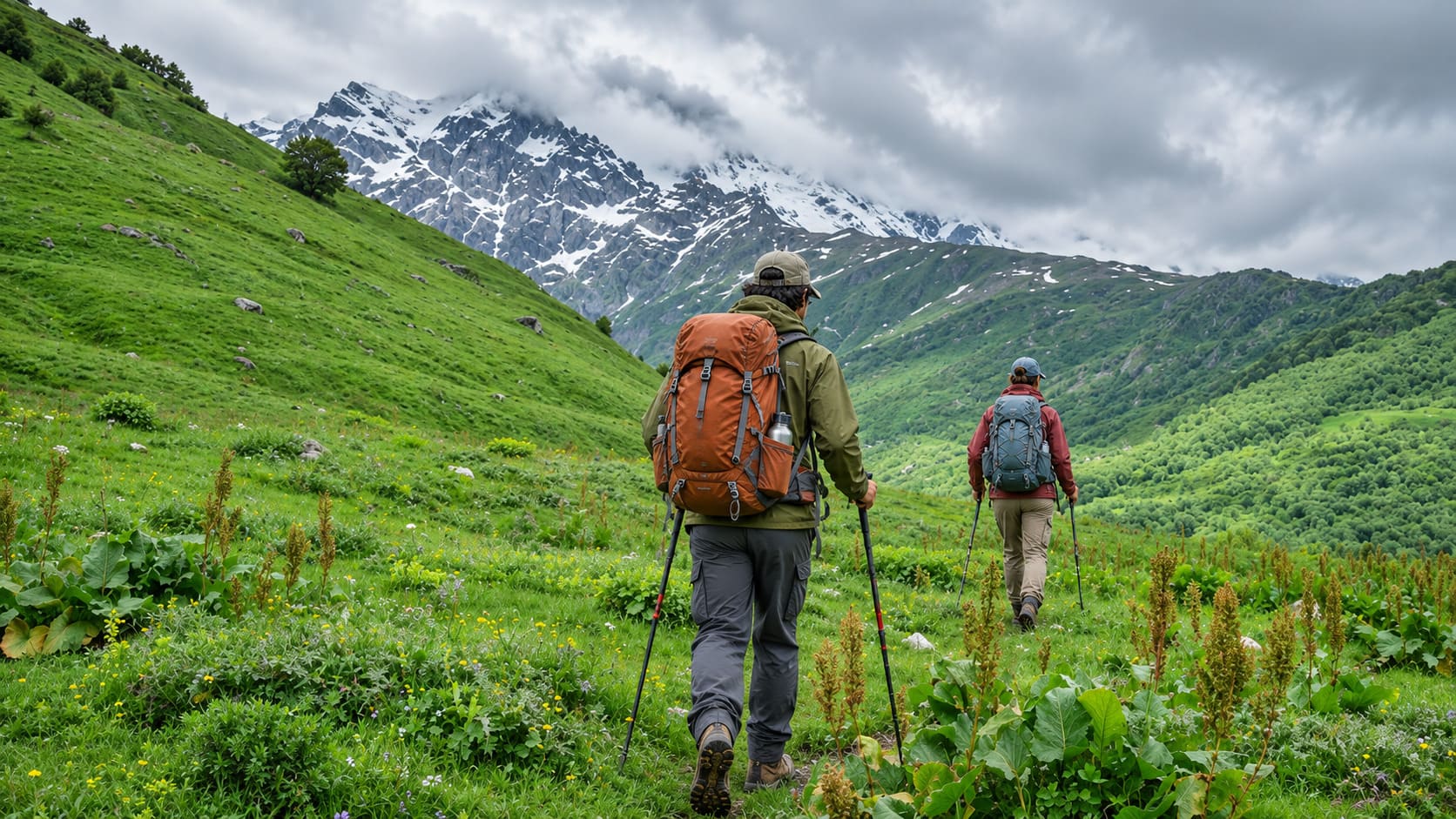
Trekking for beginners is less about picking a famous trek than knowing whether you can finish it. Almost nobody turns back because they were unfit — they turn back because they picked the wrong trek, started too fast, or found out at the trailhead that their shoes rub.
This is how to avoid all three. Six easy treks around Dharamshala are the examples, with figures from the Kangra district administration — the full catalogue is in the pillar guide.
And one thing helps more than any piece of gear: not going up alone. Someone who has walked it before sets a pace you can hold — which is, more than fitness, why people get to the top. Gigavent shows who is heading out around you this week.
Trekking for beginners: the key facts
What decides difficulty: how much a trek climbs, not how far it goes How to pick your first: 3–8 km with under 500 m of climb for a first outing; up to 10 km and 800 m once you have done one Fitness needed: able to walk uphill for an hour without stopping — four weeks of walking builds it What to carry: two litres of water, cash, and your original ID card Best months in the western Himalaya: October and November, then April to June What it costs: most trails charge nothing; where there is a gate it is usually ₹100–200 Worked example: Triund, above Dharamshala — 9 km one way, 2,850 m, about 770 m of climbing, 4–6 hours up Easiest walk there: Bhagsu waterfall — 2 km, 40 minutes, free
What is trekking, and how is it different from hiking?
A hike is a long walk; a trek is a long, hard journey — longer, steeper and further from a road. The line is blurry, and Indians use the words differently from Americans. The reason is historical.
**The word trek originally meant the opposite of walking.** It is Dutch trekken, "to draw or pull" — a wagon pulled by an ox. The Groot Trek of 1835 carried it into English, where by 1849 it meant "a stage of a journey by ox wagon." You did not walk a trek — you were pulled along one.
The Himalayan sense is recent: in 1964 Colonel Jimmy Roberts sold guided walking holidays in Nepal as treks rather than hikes, and the word stuck — which is roughly why Indians say trekking where Americans say hiking.
A trek, by inheritance, is the walk that costs you something to finish.
Choosing your first trek
Which trek should a beginner start with?
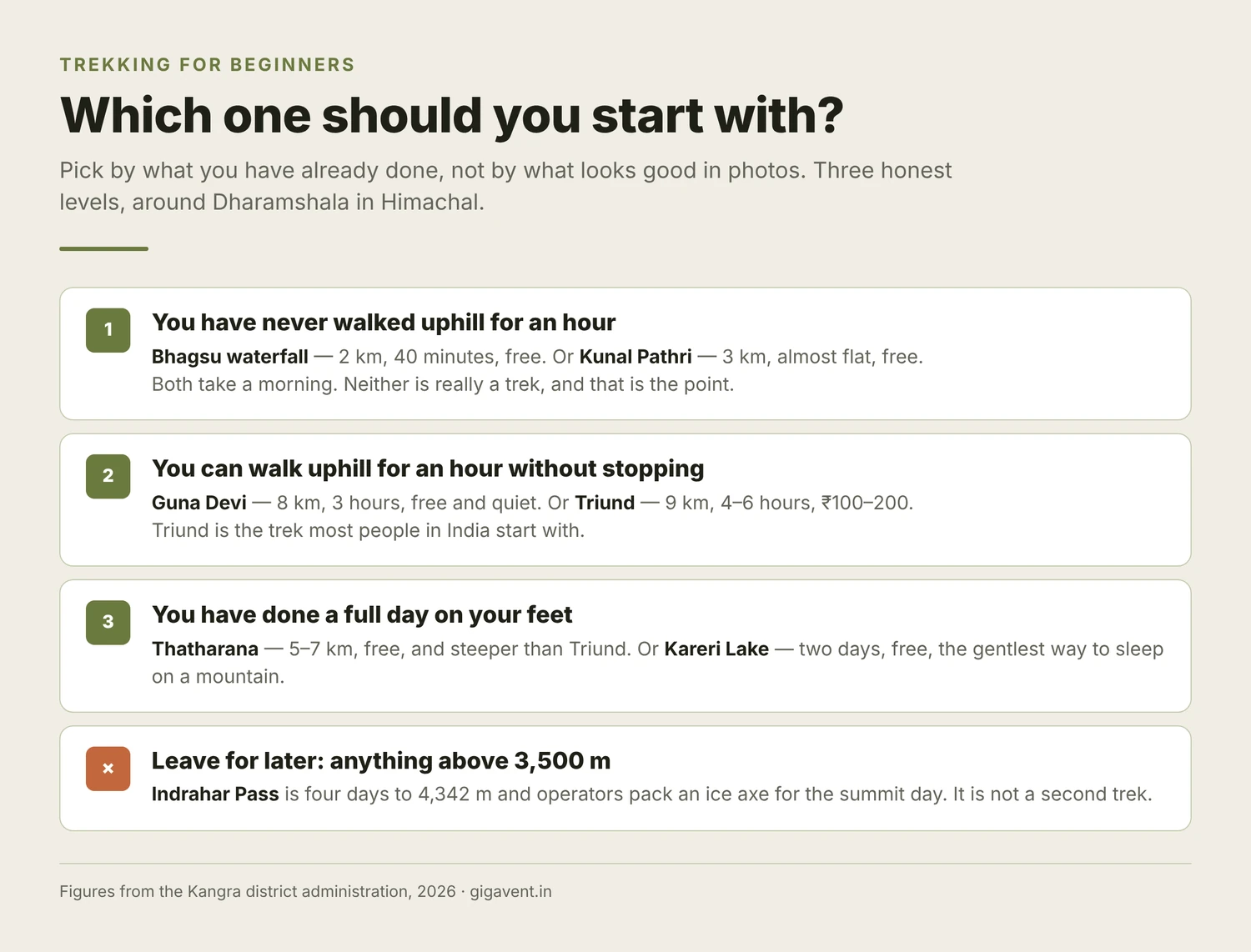
The right first trek matches what you have already done, not what looks best in photos. Three questions settle it:
- Can you walk an hour on the flat without effort?
- Can you walk uphill for twenty minutes without stopping?
- Have you been on your feet for a whole day?
Level one — none or one yes. A walk, not a trek: Bhagsu waterfall (2 km, 40 min) or Kunal Pathri (3 km, almost flat). Free, busy, a morning each.
Level two — two yes. A real day trek: Guna Devi (8 km, 3 hrs) or Triund (9 km, 4–6 hrs), the one most people in India start with.
Level three — three yes. Steeper, or a first night out: Thatharana or Kareri Lake over two days.
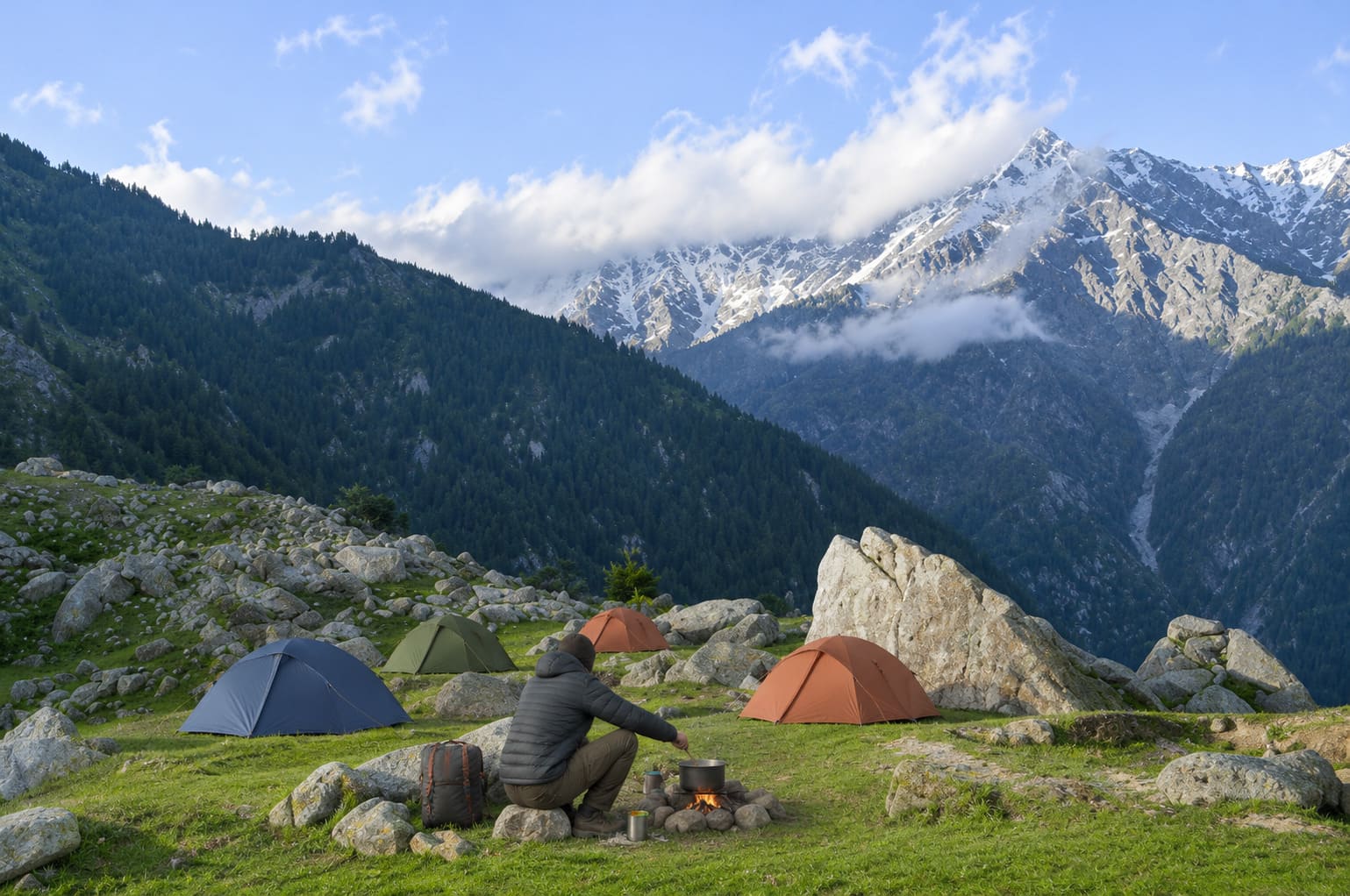
Leave for later: anything above 3,500 m. Indrahar Pass is four days to 4,342 m with an ice axe for summit day — not a second trek.
What makes a trek hard: elevation gain, not distance
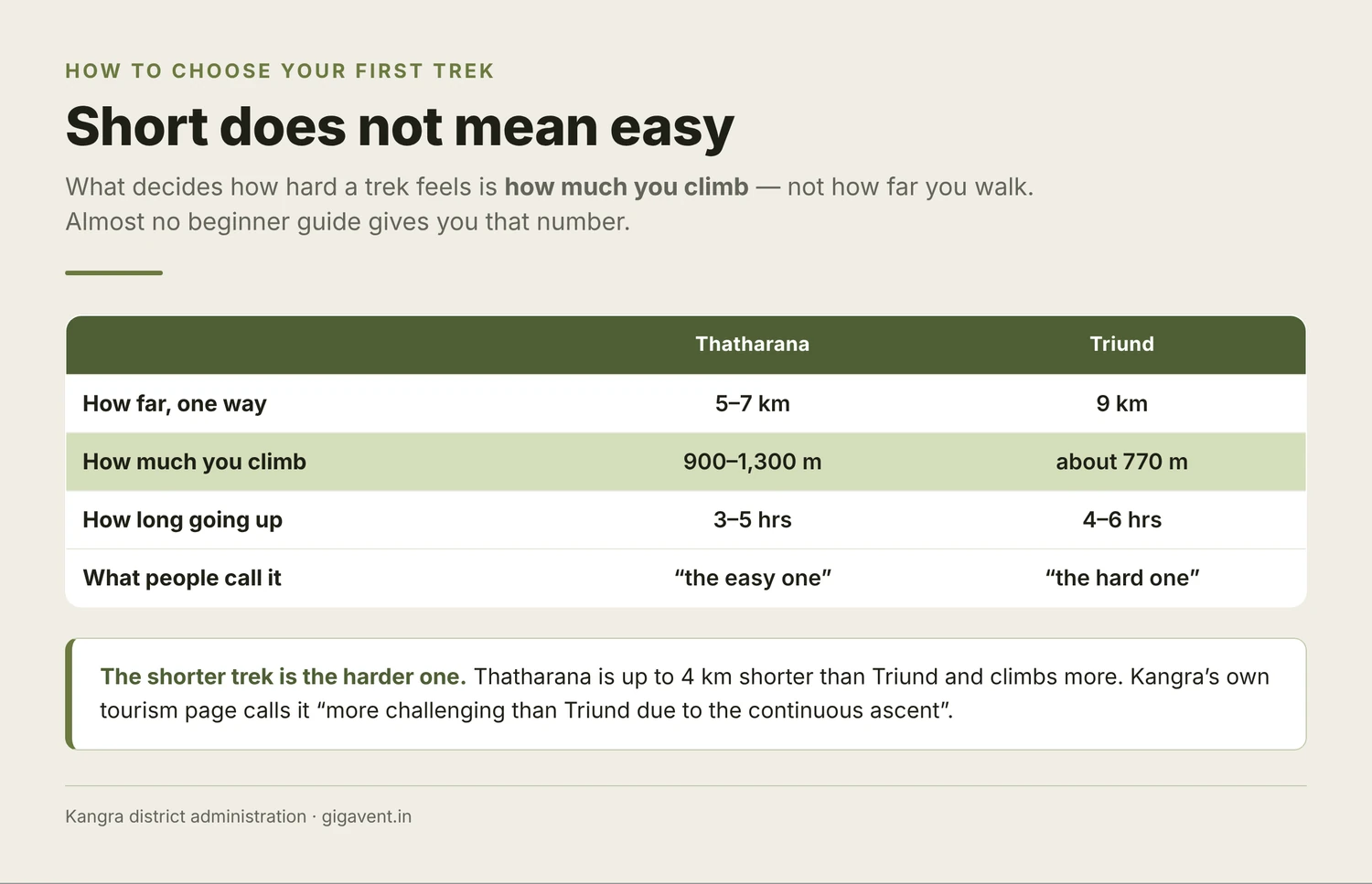
How much a trek climbs decides how hard it feels — not how far you walk. Not one page ranking for this keyword publishes the figure.
| Thatharana | Triund | |
|---|---|---|
| Distance, one way | 5–7 km | 9 km |
| How much you climb | 900–1,300 m | ~770 m |
| Time going up | 3–5 hrs | 4–6 hrs |
The shorter trek is the harder one. Kangra's tourism page calls Thatharana "more challenging than Triund due to the continuous ascent." Anyone who picks it because it is only five kilometres has read the wrong number.
Getting ready
How to prepare your body for trekking
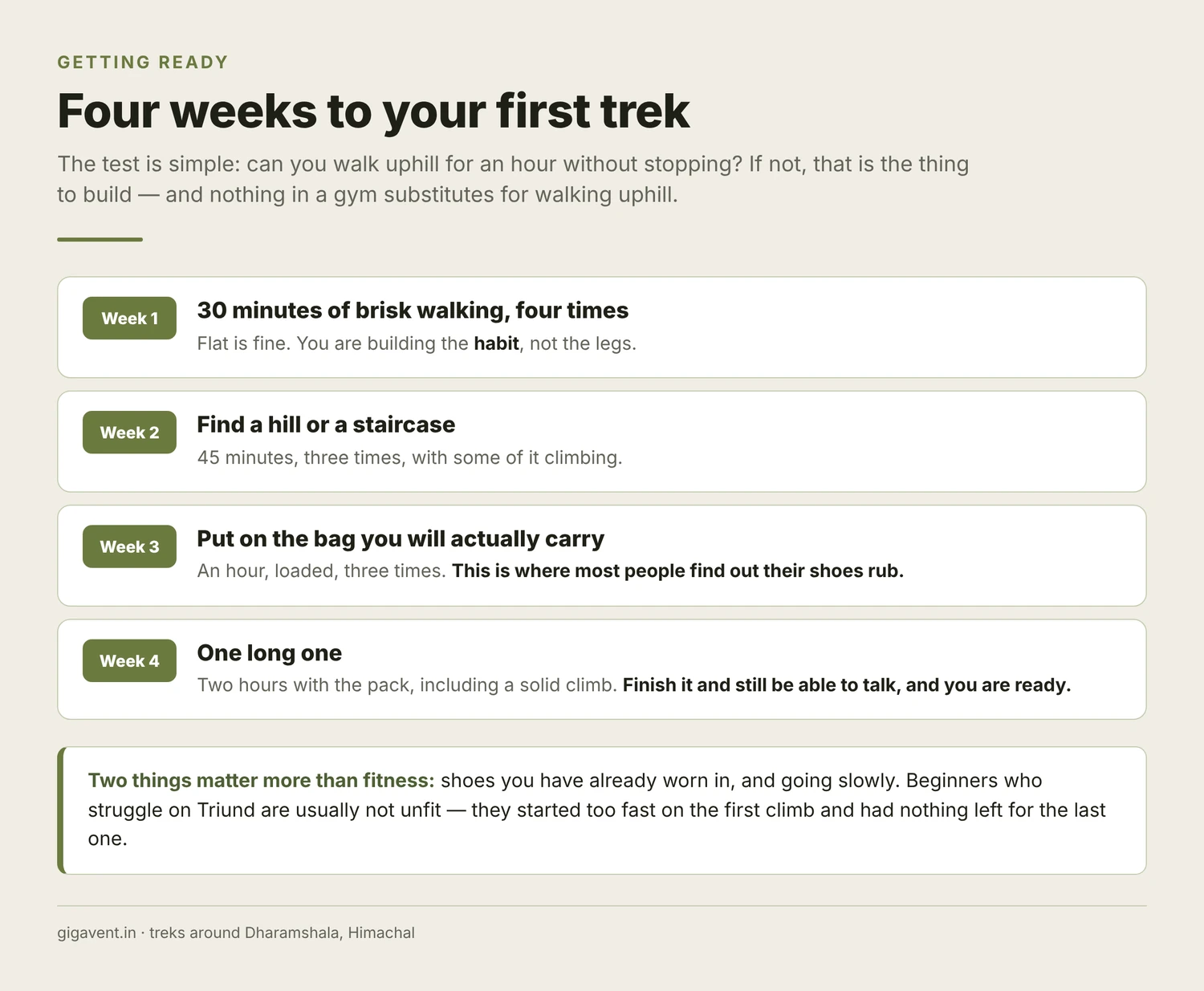
Four weeks of walking uphill is enough to prepare your body for a first trek. The test is whether you can walk uphill for an hour without stopping. Nothing in a gym substitutes for it.
- Week 1 — 30 minutes of brisk walking, four times. Flat is fine
- Week 2 — a hill or a staircase. 45 minutes, three times
- Week 3 — add the bag you will carry. An hour, loaded, three times. This is where shoes announce themselves
- Week 4 — two hours with the pack, including a solid climb
Two things matter more than fitness: shoes you have worn in, and going slowly.
What to put in the bag
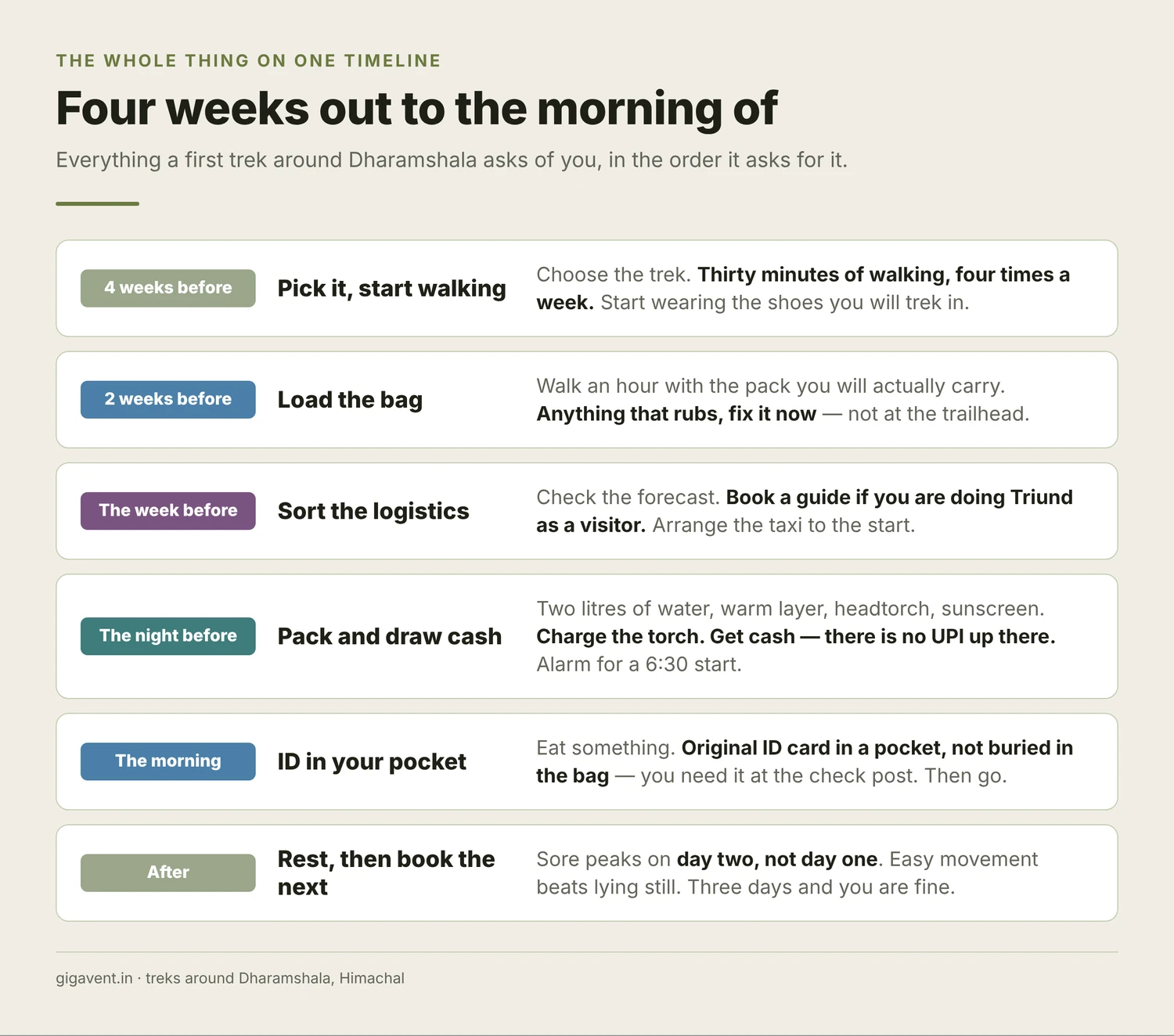
- Original ID card — a phone photo is not accepted at the check post
- Cash — no UPI at the gate, no signal higher up
- Two litres of water — tea shops are at the top, not on the climb
- A warm layer, even in June — it is cold at 2,850 m after dark
- Shoes you have already worn in, with grip
- Sunscreen and a headtorch
- Microspikes, December to February, rentable in McLeodganj
That is the whole list, and a four to five kilo day pack holds it.
Four weeks from now, who else is going? See what's on around you this week →
The best time for a beginner trek
The best months for a beginner trek around Dharamshala are October and November, with April to June the next window.
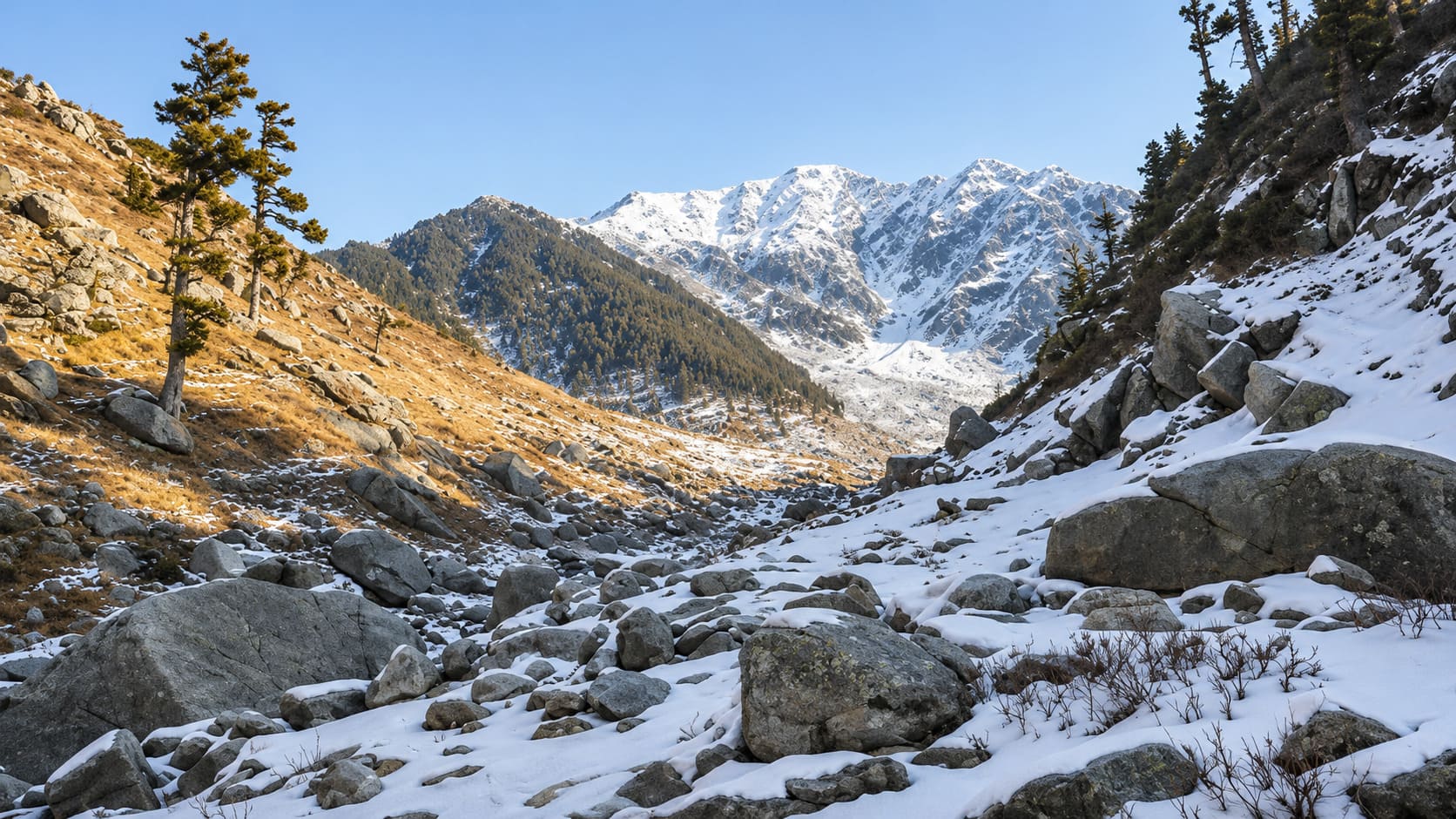
Avoid July and August — Dharamshala records 859 mm and 942 mm of rain in those two months, among the heaviest anywhere in Himachal. December to February brings snow above 2,500 m; Triund is doable with microspikes from McLeodganj, the rest is not beginner territory.
The best time to visit Dharamshala has it month by month.
What a beginner trek costs
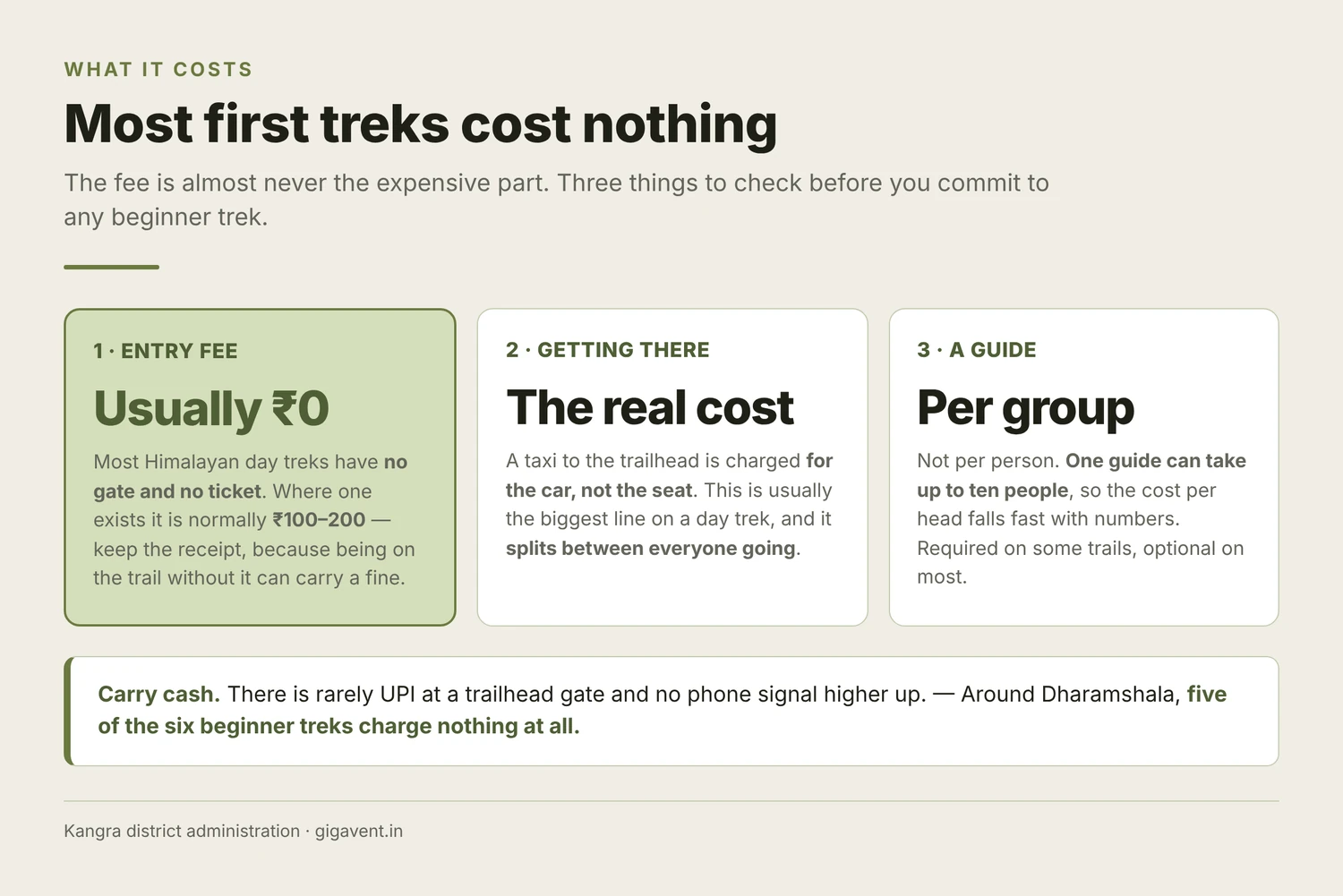
Most Himalayan day treks have no entry fee at all. What you pay for is getting to the trailhead.
Three things to check:
- An entry fee? Most trails have none. Where one exists it is usually ₹100–200, and you keep the receipt — being on the trail without it can carry a fine
- A camping charge? Only where camping is managed. An open meadow is normally free
- A guide: required or optional? The one that moves the number — a guide is charged per group, not per person
Around Dharamshala, five of the six beginner treks charge nothing. Triund is the only one with a gate — the Triund guide breaks it down line by line.
Carry cash. There is rarely UPI at a trailhead gate, and no signal higher up.
A guide takes ten. Split one — see who's going
Permits, registration and the rules
Rules tightened across Himachal in 2025 and most pages still carry the old ones. Kangra is the clearest example; four things apply there:
- Sign in at the check post. Ten went up in November 2025 — free, a minute. The one you will meet is Gallu Temple, covering Triund and everything above it
- Carry your original ID card. A phone photo is not accepted
- Triund has its own rules — a daily cap on numbers, a cap of ten trekkers per guide, and locals with traditional rights exempt from the fee
- Keep your Triund ticket — without a valid one it is a ₹5,000 fine
One winter exception. Kangra has twice banned trekking above 3,000 m — November 2024 and January 2026 — and both orders named Kareri, Triund and Adi Himani Chamunda as needing written permission, even though the first two sit below that line. It is a snowfall precaution that lapses quietly, so ask at the check post if you are going in winter.
On the trail
How long does a trek day actually take?
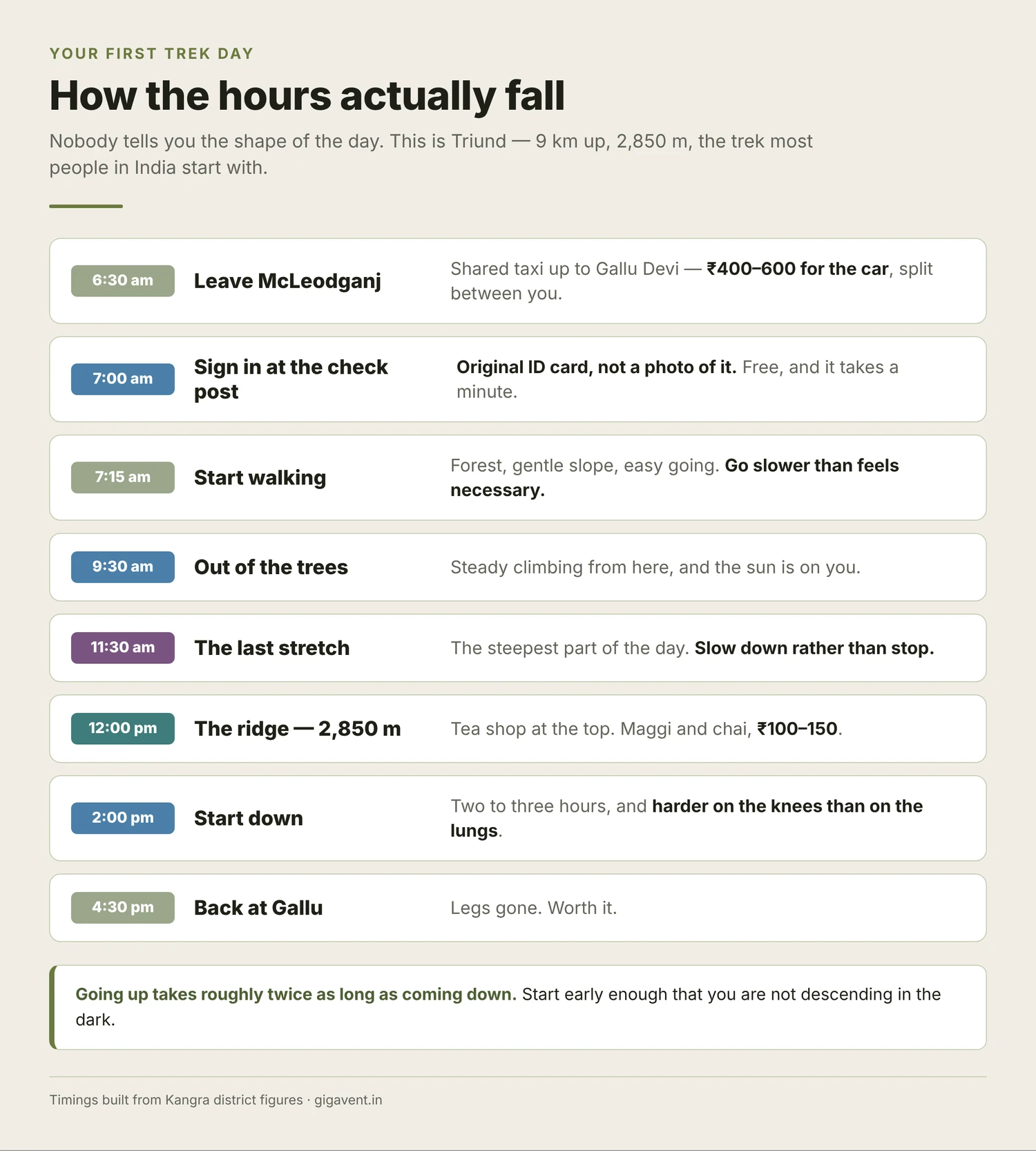
A first trek day runs about ten hours door to door, four to six of it walking uphill. This is Triund; the shape is the same anywhere.
| Time | What is happening |
|---|---|
| 6:30 am | Leave town. Shared taxi to the trailhead |
| 7:00 am | Sign in at the check post. Original ID card, not a photo of it |
| 7:15 am | Start walking. Forest, gentle slope |
| 9:30 am | Out of the trees. Steady climbing from here |
| 11:30 am | The last stretch, and the steepest |
| 12:00 pm | The ridge, 2,850 m. Tea shop at the top |
| 2:00 pm | Start down. Two to three hours, hard on the knees |
| 4:30 pm | Back at the trailhead |
Going up takes about twice as long as coming down. Sip often; rest five minutes every forty-five to sixty.
What first-timers get wrong
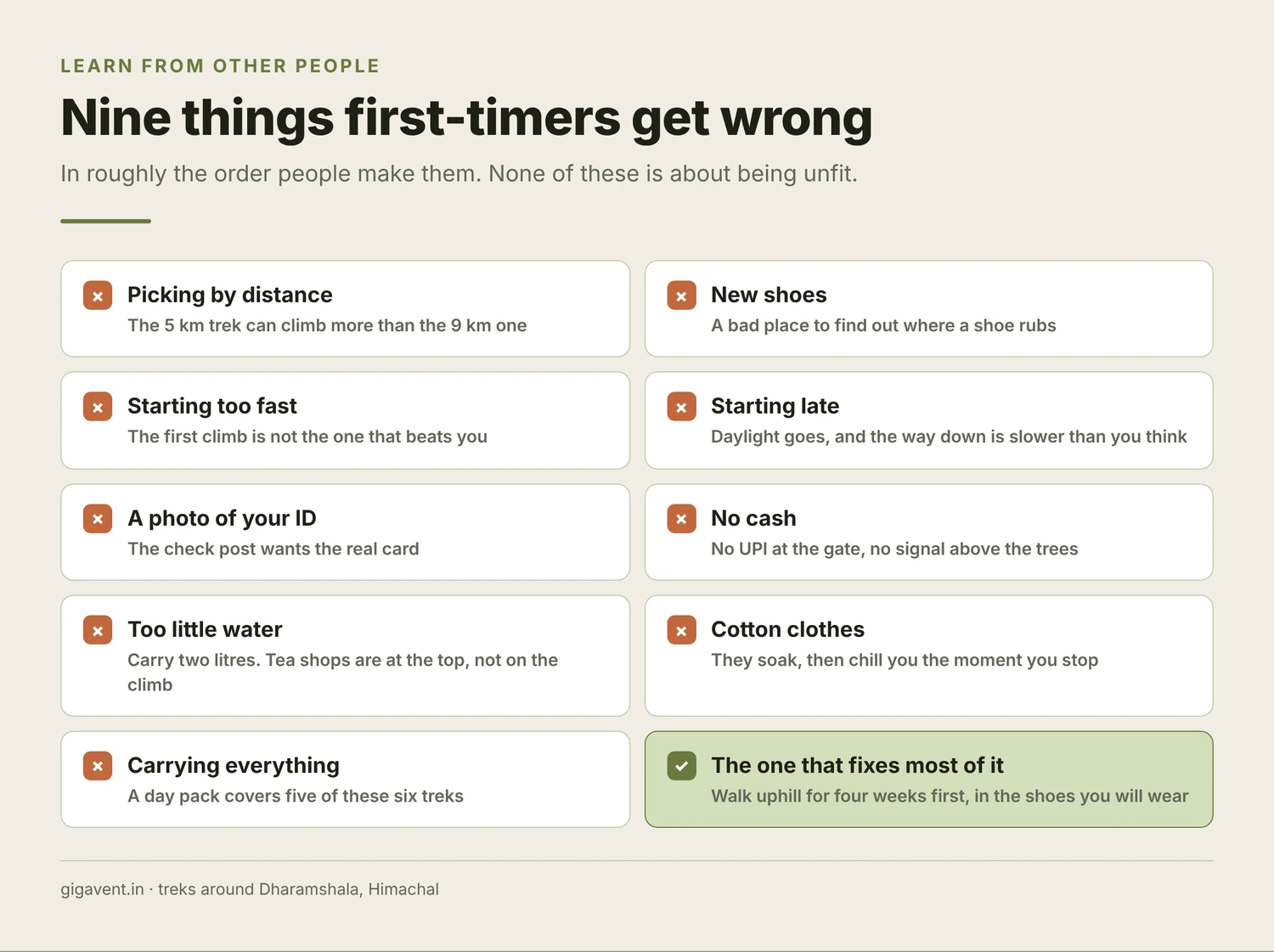
- Starting too fast, and starting late. The first climb is not the one that beats you, and the way down is slower than you expect
- Ignoring a hot spot. Tape it the moment something rubs — waiting for the blister means hours on a raw foot
- Forgetting the descent. Hours of braking is what knees and ankles complain about. Shorter steps help more than slow ones, and grip matters more than anything you buy
- No cash, too little water, cotton clothes, and a bag full of things you never open
No tent, no group? Find people going up this week
If you want to turn back
Turning around is a decision, not a failure. Turn back if a headache will not shift, if the weather closes in, or if carrying on means descending in the dark — on a day trek that costs one taxi fare. Most people who turn back once come back and finish it.
On height: below about 3,000 m altitude sickness is unlikely rather than likely. If a headache, nausea or dizziness comes on, stop going up and go down — that works at any height. You will be sore after, peaking on day two.
Is trekking risky, and should you go alone?
On a marked day trail in season, trekking is low-risk and fine to do alone — a busy trail is a safe trail, which is half the reason to pick a popular one first. Above the treeline is different: a nine-day rescue on Triund and a search on Adi Himani Chamunda in 2025 brought in compulsory registration and GPS tracking.
Going with people is also cheaper. A guide takes up to ten and is charged per group, the taxi splits, a tent splits — the newer rules quietly made walking alone the expensive option.
That is what Gigavent is for. It shows what people around you are doing this week — someone heading up Triund on Saturday, a group doing Kareri over a weekend — with the date, the trailhead and how many places are left. Join one, or put up your own and let people come to you.
It is not only trekking — gigs in the Dharamkot cafés, football on a Sunday, open mics. New here? How to meet new people covers the rest, and the places worth your time covers the valley.
Frequently asked questions
How do you start trekking as a beginner?
Start with a short, marked, busy trail and build up. Pick 3–8 km climbing under 500 m for the first one, go in October–November or April–June, and carry two litres of water and original photo ID.
Which is the easiest trek for a beginner?
The easiest treks are short, marked and low-gain — 3 to 8 km with under 500 m of climb. Around Dharamshala that is Bhagsu waterfall: 2 km, forty minutes, a made path. Of the longer ones Triund is easiest at 9 km and roughly 770 m — though easy by Himalayan standards still means four to six hours uphill.
Is trekking risky for a beginner?
Trekking is low-risk for a beginner on a marked day trail in season — the hazards are dehydration, a twisted ankle and being caught out after dark. They turn serious above the treeline, where route-finding is a skill and weather changes fast.
How much does a beginner trek cost?
Most beginner treks in the Himalaya have no entry fee at all — you pay for transport, and for a guide only if you want one. Where a gate exists the fee is usually ₹100–200.
Do you need a guide for your first trek?
No — a guide is useful rather than required on any of these six. One may take no more than ten trekkers and is charged per group, so the cost per head falls fast with numbers.
Do you need a permit to trek in Himachal?
No permit is needed to trek in Himachal, but signing in at a check post is compulsory where one exists. Kangra has ten; the one beginners meet is Gallu Temple above Dharamkot, and registration is free.
You will complete it. Pick one that matches what you have already done, walk uphill for four weeks in the shoes you will wear, start early, and go slower than feels necessary on the first climb. That is the whole method — and it is easier with someone beside you who has done it before.
Your first trek, this weekend. See who's going on Gigavent →
Rules verified November 2026. Kangra's trekking orders have changed repeatedly since 2023, so ask at the check post before you walk.

