Bhangra Dance: History, Steps, Workshops & Events Nearby
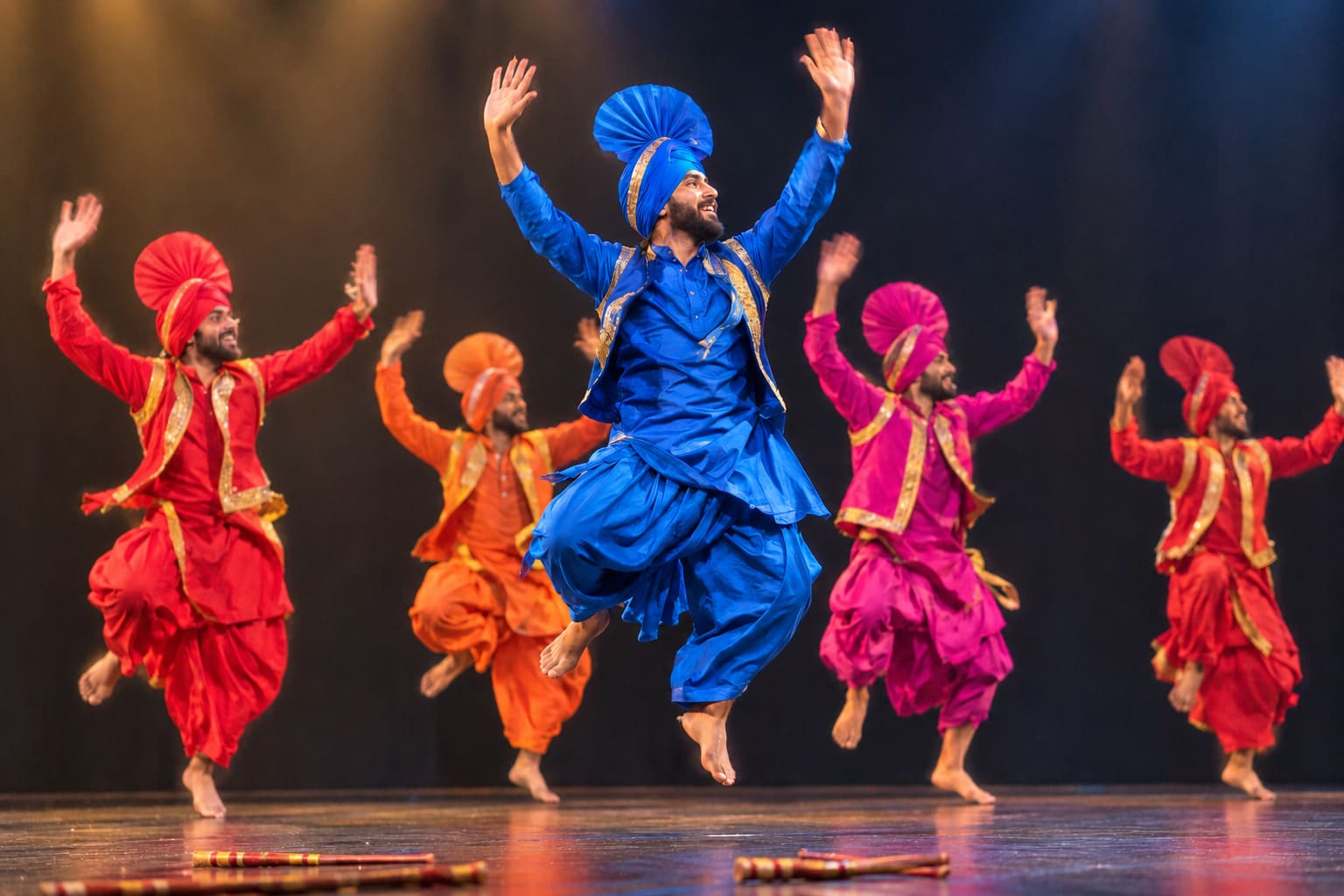
bhangra is the harvest dance of punjab — shoulders, arms up, and a dhol loud enough to decide for you. here's where it came from, what your body is actually doing, how it differs from nati and gidda, and how to find a workshop or an open floor near you.
the dhol starts at a wedding and the floor fills in about four seconds.
and you're the one still holding a plate, doing the small shoulder move people do when they want to join and haven't worked out how.
the good news is that bhangra has no entry exam. it was built by farmers at a harvest, not choreographers in a studio, and the whole thing is designed to be joined by whoever is standing there.
the nearest open floor is this saturday. bhangra at fit kangra 2026, 10 october, 7:00 pm, baan ganga ghat in kangra — no list, no judging, free. see it on Gigavent →
What is Bhangra?
Bhangra is a folk dance from Punjab, traditionally performed at the spring harvest and now the most widely recognised Indian folk dance in the world.
It's danced in a loose circle around the dhol player, with vigorous kicks, leaps and bends, and arms thrown up and forward. There is no fixed formation and no partner. The dhol sets the pace and the dancers answer it.
Which state is Bhangra from?
Punjab. The form developed in the Sialkot, Gujranwala and Gurdaspur districts — an area now split between north-west India and north-east Pakistan — and the name comes from bhang, the hemp crop grown there.
The history of Bhangra
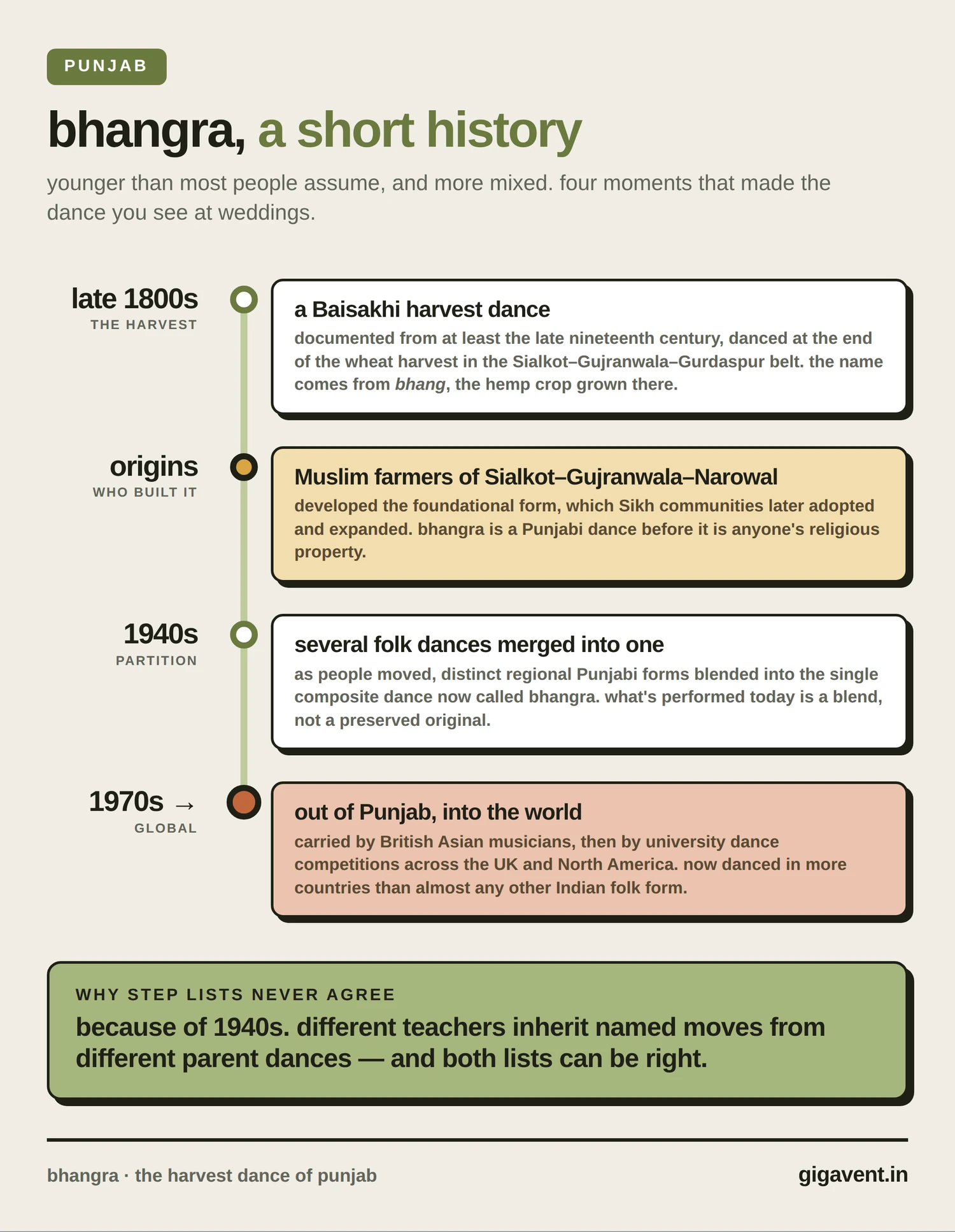
It is younger than most people assume, and more mixed.
It starts as a harvest dance. Bhangra was performed at Baisakhi, the spring festival marking the end of the wheat harvest. The practice is documented from at least the late nineteenth century, though farmers were almost certainly moving like this long before anyone wrote it down.
Muslim farmers of the Sialkot–Gujranwala–Narowal area developed the foundational form, and Sikh communities later adopted and expanded it. That detail gets lost often, and it's worth keeping: bhangra is a Punjabi dance before it is anyone's religious or national property.
Partition changed what the word means. In the 1940s, as people moved, several distinct regional Punjabi folk dances merged into the single composite form we now call bhangra. What's performed on a stage today is a blend, not a preserved original.
And from the 1970s it went global, carried by British Asian musicians and then by university dance competitions across the UK and North America. It is now danced in more countries than almost any other Indian folk form.
The steps: what your body is actually doing
Here's the honest version, and it will save you an hour of contradictory YouTube.
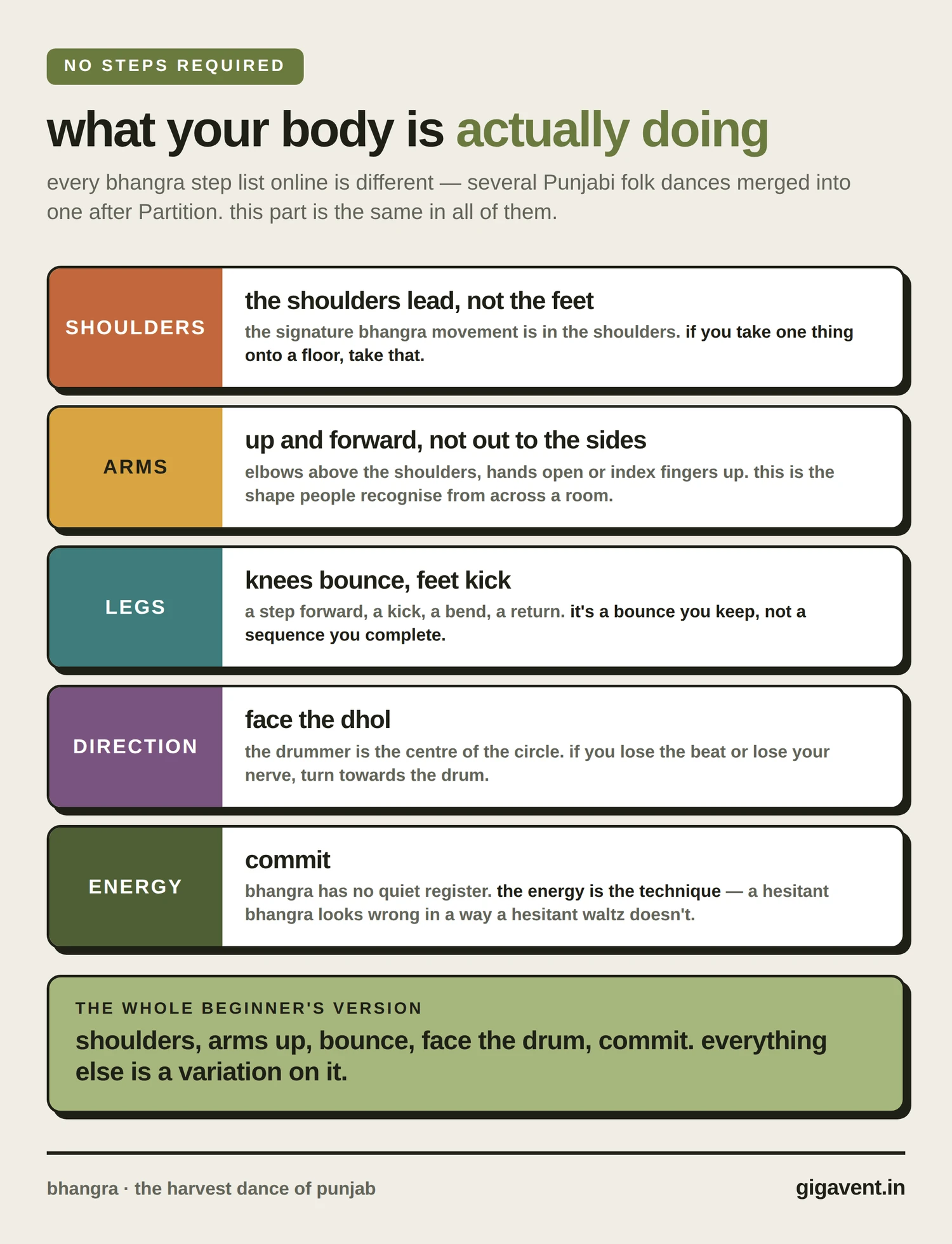
Every bhangra step list online is different, and that isn't anyone's mistake. Because several separate Punjabi folk dances were absorbed into bhangra after Partition, the named moves people teach come from different parent traditions. One teacher's list won't match another's, and both can be right.
What is consistent is what the body does:
the shoulders lead. the signature bhangra movement is in the shoulders, not the feet. if you only take one thing onto a floor, take that.
arms go up and forward, not out to the sides. elbows above the shoulders, hands open or index fingers up.
the knees bounce, the feet kick. a step forward, a kick, a bend, a return. it's a bounce you keep rather than a sequence you complete.
you move around the dhol. the drummer is the centre of the circle. if you're lost, face the dhol.
and you do it hard. bhangra has no quiet register. the energy is the technique — a hesitant bhangra looks wrong in a way a hesitant waltz doesn't.
that's the whole beginner's version. shoulders, arms up, bounce, face the drum, commit. everything else is a variation on it.
that's all of it. the rest is finding a floor. open Gigavent →
The dhol, and why it does the work
The dhol is a large double-headed barrel drum, struck with a heavy beater on one side and a light stick on the other. Those two sounds — the deep boom and the sharp crack — are the entire rhythmic structure of bhangra.
It matters more than it looks. The dhol is loud enough to remove the decision. You don't choose to start dancing at a bhangra; the drum starts and your body is already moving a beat later. That's the design.
Alongside it you'll hear the chimta (the long tongs with cymbals), tumbi (one-string, the sound in most Punjabi pop), algoze (paired flutes), dhad and saaps.
What dancers wear
Men — a bright kurta, a lungi or chaadra wrapped at the waist, a turban, and often a waistcoat. Colour is the point; there is no muted bhangra outfit.
Women performing bhangra wear salwar kameez with a dupatta, in the same bright register.
At a wedding or an open floor, almost nobody is in costume. Full dress is for stage performances and competitions. The floor is in whatever people came in.
How is Bhangra different from Nati or Gidda?
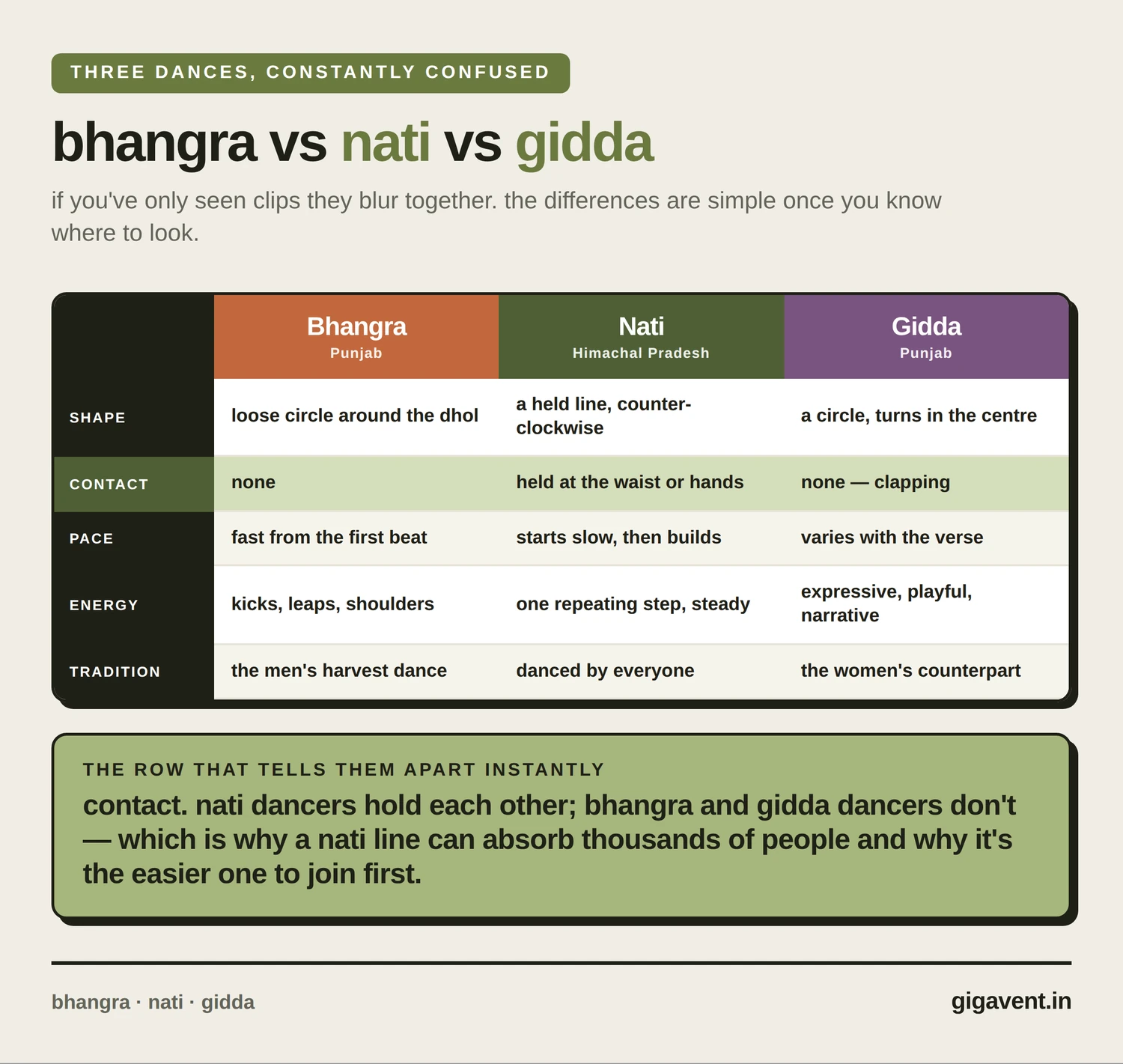
Three group folk dances that get confused constantly — and the differences are simple once you see them.
| Bhangra | Nati | Gidda | |
|---|---|---|---|
| State | Punjab | Himachal Pradesh | Punjab |
| Shape | loose circle around the dhol | a held line moving counter-clockwise | a circle, dancers taking turns in the centre |
| Contact | none | held at the waist or hands | none — clapping |
| Pace | fast from the first beat | starts slow, builds | varies with the verse |
| Energy | kicks, leaps, shoulders | repeating step, steady | expressive, playful, narrative |
| Traditionally | the men's harvest dance | danced by everyone | the women's counterpart to bhangra |
Gidda is bhangra's other half, not a different thing entirely — the complementary women's tradition, built around grace, storytelling and boliyan (sung couplets) rather than force.
And the one to know if you're nervous: Nati is the easier first dance. Himachal's line dance starts at a walking pace and you're physically attached to someone who knows the step. Bhangra is fast from beat one. If you're in the Kangra valley and want to start somewhere, start there.
Where to find Bhangra workshops and events nearby
Three honest routes, in order of how likely they are to work.
Weddings. Still the single most common place bhangra actually happens in India, and nobody needs to teach you — you get pulled in.
Dance schools and workshops. Most cities have a teacher running bhangra batches, and a weekend workshop is the fastest way from nothing to confident. These are rarely advertised well, which is the problem.
Festivals and open floors. No class, no commitment — a dhol, a crowd, and nobody watching you in particular. Fit Kangra 2026 has one on saturday 10 october at 7:00 pm, free, at Baan Ganga Ghat — the full three-day schedule is here.
How to find a Bhangra dance class near you
Start with a map search, not a web search. bhangra class plus your city in Google Maps surfaces far more than Google proper, because most teachers list a studio address and never build a website.
Then widen the search term. In most Indian cities there is no dedicated bhangra school — what exists is a general dance studio running bhangra as one batch alongside hip-hop, contemporary and wedding choreography. Search dance classes and ask which styles they teach, rather than searching bhangra and concluding there's nothing.
The wedding-choreography teacher is usually the answer. Anyone who prepares sangeet performances teaches bhangra every season, typically in short four- to six-session blocks rather than an ongoing batch. These almost never appear in a search.
College and university teams are the serious route if you're a student. Bhangra teams compete across India, the UK and North America, and most take complete beginners at the start of term.
And where none of that exists yet — much of Himachal included — a festival floor is the realistic answer, and it costs nothing to try.
That gap is why Gigavent exists. It's an app for finding what's actually on near you, so bhangra workshops, open floors and one-off festival sessions sit in one place instead of scattered across posters, WhatsApp groups and word of mouth. find a workshop or an open floor →
and if you're just working out what to do with the weekend, this one has the hour-by-hour version — bhangra is one line in a much longer saturday.
And if you're the one who can already dance it — you can list your own workshop on Gigavent in a few minutes. A weekly batch in Dharamshala or Kangra is exactly the kind of thing people search for and can't find, and the teaching side of this is thinner than the demand.
The quick version
what it is — the harvest folk dance of Punjab, danced in a circle around a dhol.
which state — Punjab, from the Sialkot–Gujranwala–Gurdaspur belt now split across India and Pakistan.
the history — a Baisakhi harvest dance documented from the late 1800s, founded by Muslim farmers of the Sialkot area, merged with other Punjabi folk forms after Partition, global from the 1970s.
the steps — shoulders lead, arms up and forward, knees bounce, face the dhol, commit.
the music — dhol above all, plus chimta, tumbi, algoze, dhad.
what to wear — at a real floor, whatever you came in.
where to learn — weddings, weekend workshops, and open floors like Fit Kangra's on 10 October.
FAQ
Which state is Bhangra from?
Punjab. It developed in the Sialkot, Gujranwala and Gurdaspur districts, an area now divided between India and Pakistan.
What is Bhangra dance in simple words?
A high-energy folk dance from Punjab, danced in a circle around a dhol drum, with kicks, leaps and raised arms. It began as a celebration of the spring wheat harvest at Baisakhi.
Is Bhangra hard to learn?
The basic version isn't. Shoulders leading, arms up and forward, a knee bounce and a kick will carry you through an open floor. Competition bhangra is a different sport entirely.
Why do bhangra step names differ everywhere?
Because several separate Punjabi folk dances merged into bhangra after Partition in the 1940s. Different teachers inherit named moves from different parent traditions, so the lists genuinely don't match.
What is the difference between Bhangra and Gidda?
Both are from Punjab. Bhangra was traditionally the men's harvest dance, built on force and energy; Gidda is the women's counterpart, built on grace, storytelling and sung couplets called boliyan.
What instruments are used in Bhangra?
The dhol above all — a double-headed barrel drum played with a heavy beater and a light stick. Also the chimta, tumbi, algoze, dhad and saaps.
Do I need a costume to join?
No. Full dress is for stage performances. At a wedding or a festival floor, almost everyone is in ordinary clothes.
so, kya scene hai — there's a dhol somewhere near you this month and a circle with room in it. shoulders up, that's genuinely the whole entry requirement.
read next
Nati dance of Himachal Pradesh → — the easier first dance, and the one you'll meet in this valley.
Fit Kangra 2026 → — the full three days, 9 to 11 October at Baan Ganga Ghat.
Stuff to do this weekend → — hour by hour, if the dance is only part of the plan.

