Nati Dance of Himachal Pradesh: Find Nati Events Near You
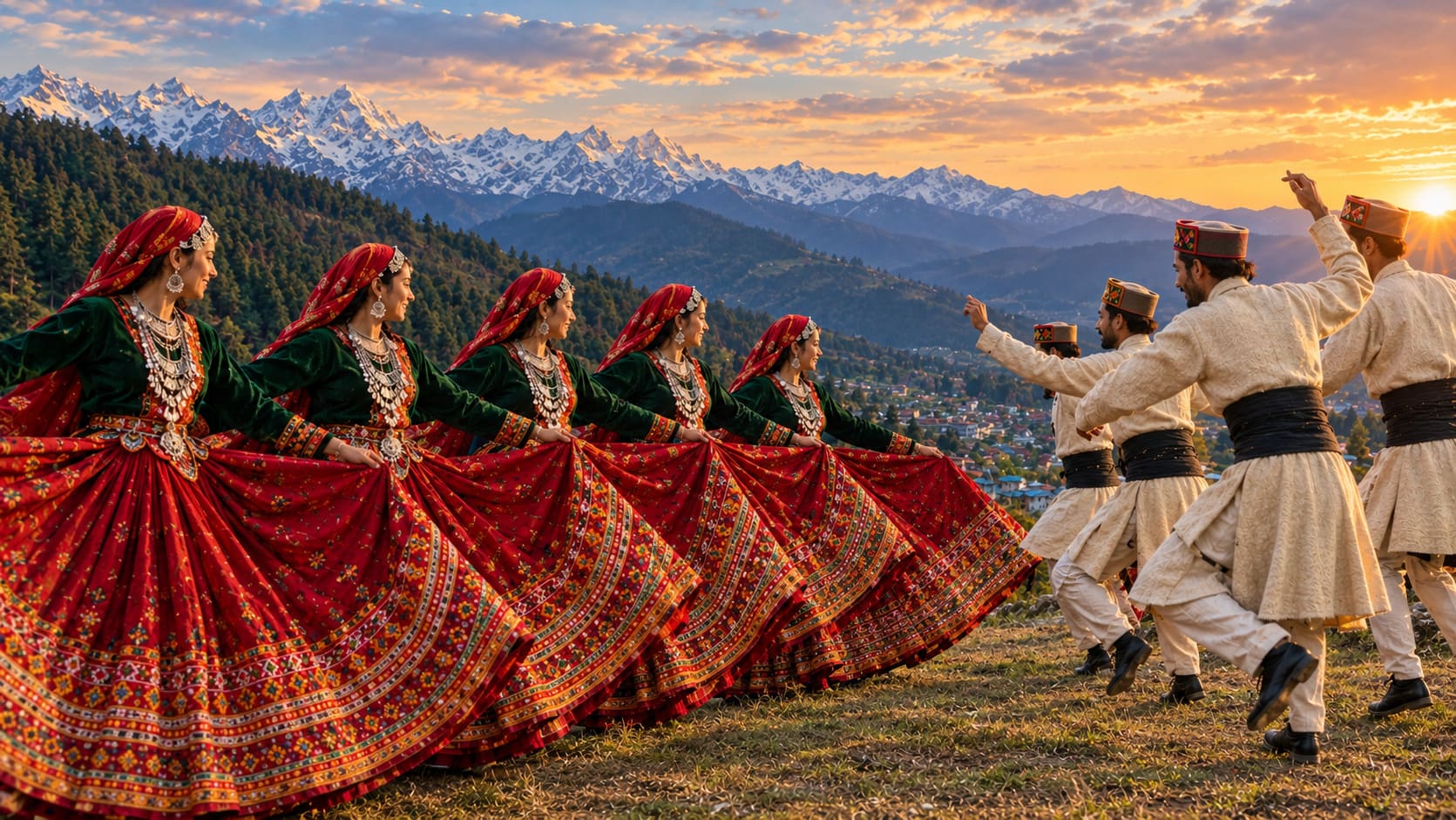
nati is the folk dance of himachal pradesh — a line of people moving together to dhol and nagara, the same step repeating. here's what it is, the six regional types, how to join a line without knowing a single step, and where to find one.
you've seen the clip. a long line of people on a field or in a courtyard, moving together, nobody leading and nobody out of step, and it just keeps going.
and somewhere in your head: i could never do that.
you could. that's not encouragement — it's how the dance is built. nati is designed so that a person who has never danced it can join the back of the line and be fine inside a minute. the second half of this page is exactly how.
the nearest one is this friday. natti at fit kangra 2026, 9 october, 7:00 pm, baan ganga ghat in kangra — an open floor, no list, free to join. see it on Gigavent →
What is Nati dance?
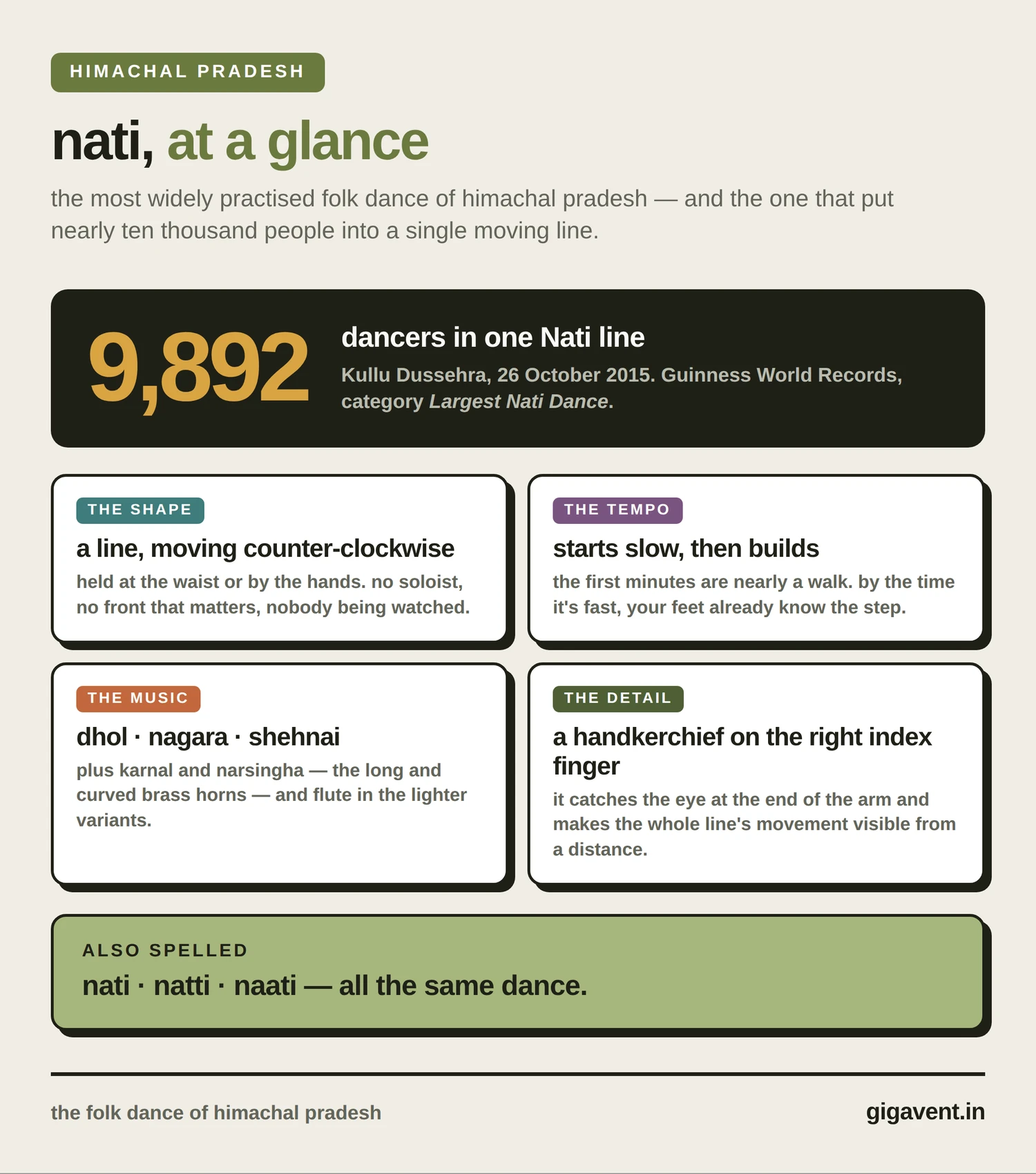
Nati is the traditional folk dance of Himachal Pradesh, and the most widely practised one in the state. It is danced across Kullu, Mandi, Shimla, Sirmaur, Chamba, Kinnaur and the Kangra valley, with a different regional style in almost every district.
Dancers form a long line or an open circle, holding each other at the waist or by the hands, and move slowly counter-clockwise to a repeating step. Live drums set the pace. The tempo starts slow and builds, and the line can run from a dozen people to several thousand.
You will see it spelled Nati, Natti or Naati — all the same dance.
Which state is Nati from?
Himachal Pradesh. It is danced throughout the state and is the single most common folk dance there, which is why "Pahari Nati" and "Himachali Nati" are used to mean the same thing.
The world record: 9,892 dancers at once
On 26 October 2015, at Kullu Dussehra, 9,892 dancers performed Nati together and entered the Guinness World Records in the category Largest Nati Dance.
Hold on to that number, because it is the argument for everything below. Nearly ten thousand people, and almost none of them were trained dancers. Very few dance forms could reach that — not for lack of trying, but because almost none are built to let that many people join at once, unrehearsed.
Nati is. The step repeats, the line has no front and no back that matters, and a person joining at minute forty does exactly what the person who started did.
How do you join a Nati line?
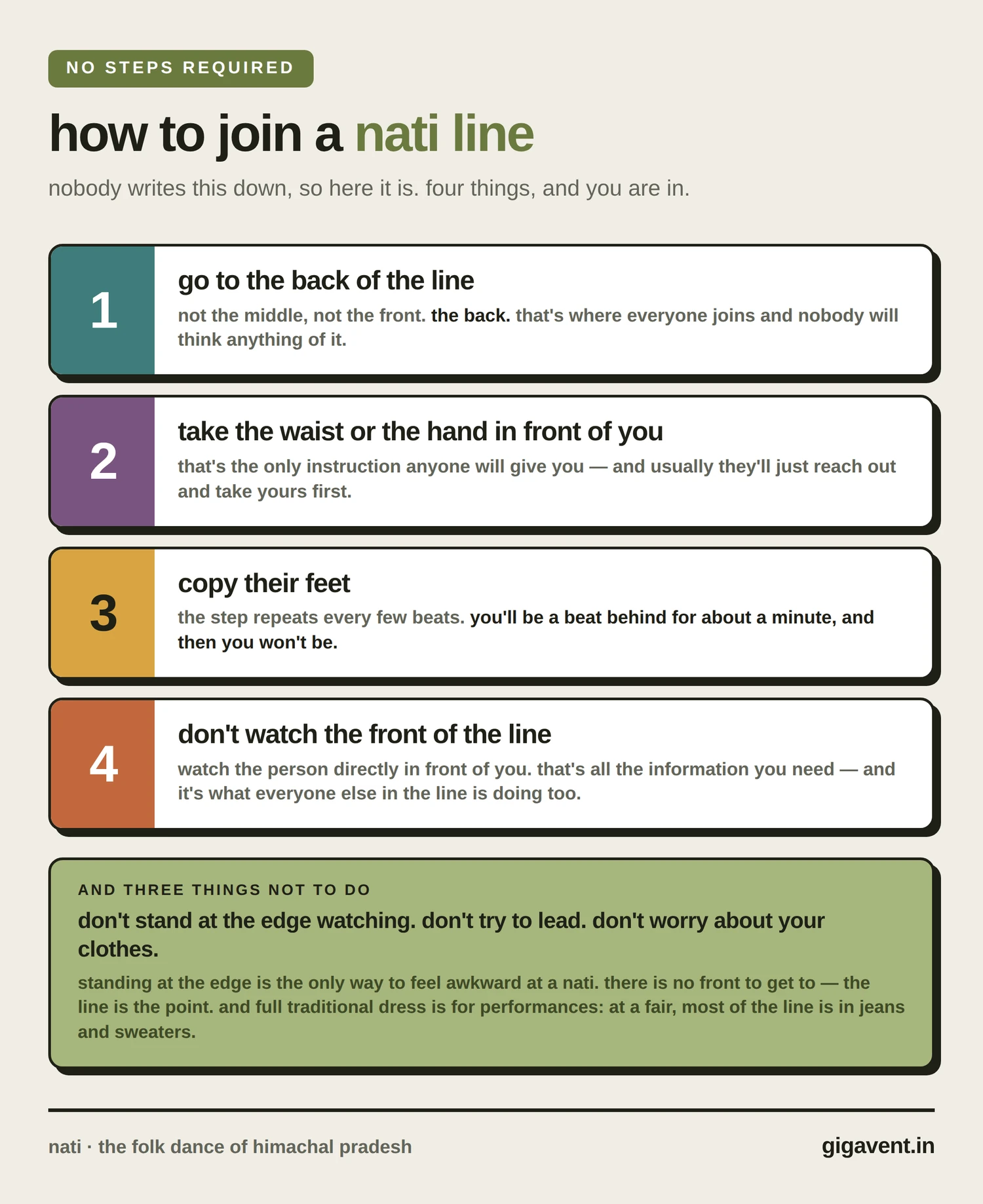
this is the part nobody writes down, so here it is plainly. four things, and you're in.
walk to the back of the line. not the middle, not the front. the back. that's where everyone joins, and nobody will think anything of it.
put your hand on the waist or in the hand of the person in front of you. that's the only instruction anyone will give you, and usually they'll just reach out and take yours first.
copy their feet. the step repeats every few beats. you will be a beat behind for about a minute, and then you won't be.
don't watch the front of the line. watch the person directly in front of you. that's all the information you need, and it's what everyone else in the line is doing too.
what the first five minutes actually feel like
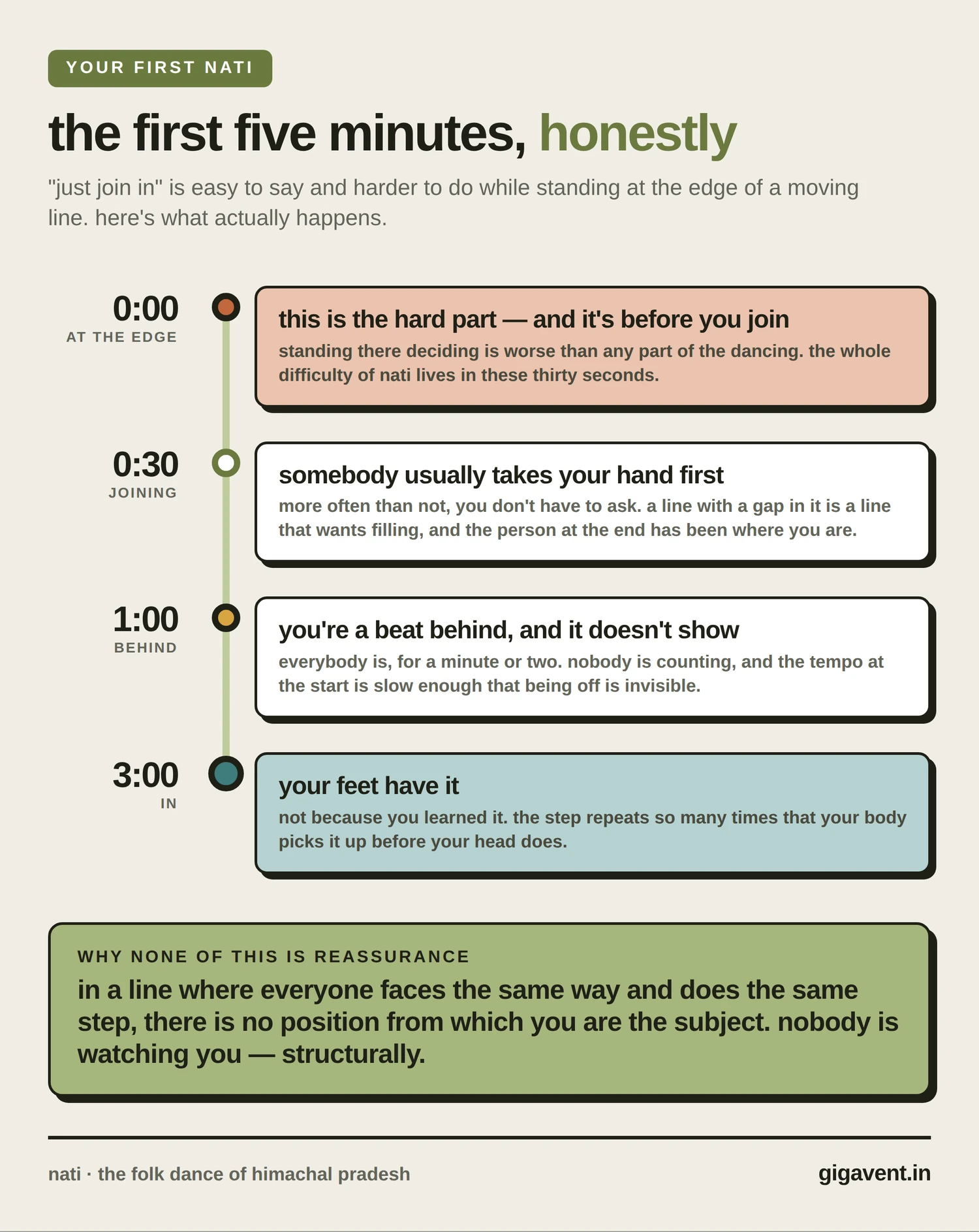
because "just join in" is easy to say and harder to do while standing at the edge of a moving line.
the first thirty seconds are the hard part, and they're hard before you join, not after. standing at the edge deciding is worse than any part of the dancing.
somebody will usually take your hand before you ask. it happens more often than not. a line with a gap in it is a line that wants filling, and the person at the end has been where you are.
you'll be a beat behind for a minute or two. everybody is. nobody is counting, and the tempo is slow enough at the start that being off doesn't show.
and then your feet have it. not because you learned it — because the step repeats so many times that your body picks it up before your head does.
nobody is watching you. that isn't reassurance, it's structural: in a line where everyone faces the same way and does the same step, there is no position from which you are the subject. several hundred years of people joining in made it that way.
that's all of it. the rest is finding a line. open Gigavent →
three things not to do
don't stand at the edge watching for twenty minutes. that's the only way to feel awkward at a Nati.
don't try to lead or get to the front. there is no front. the line is the point.
don't worry about what you're wearing. full traditional dress is for performances and Dussehra. at a village fair or a festival, most of the line is in jeans and sweaters.
The six types of Nati across Himachal
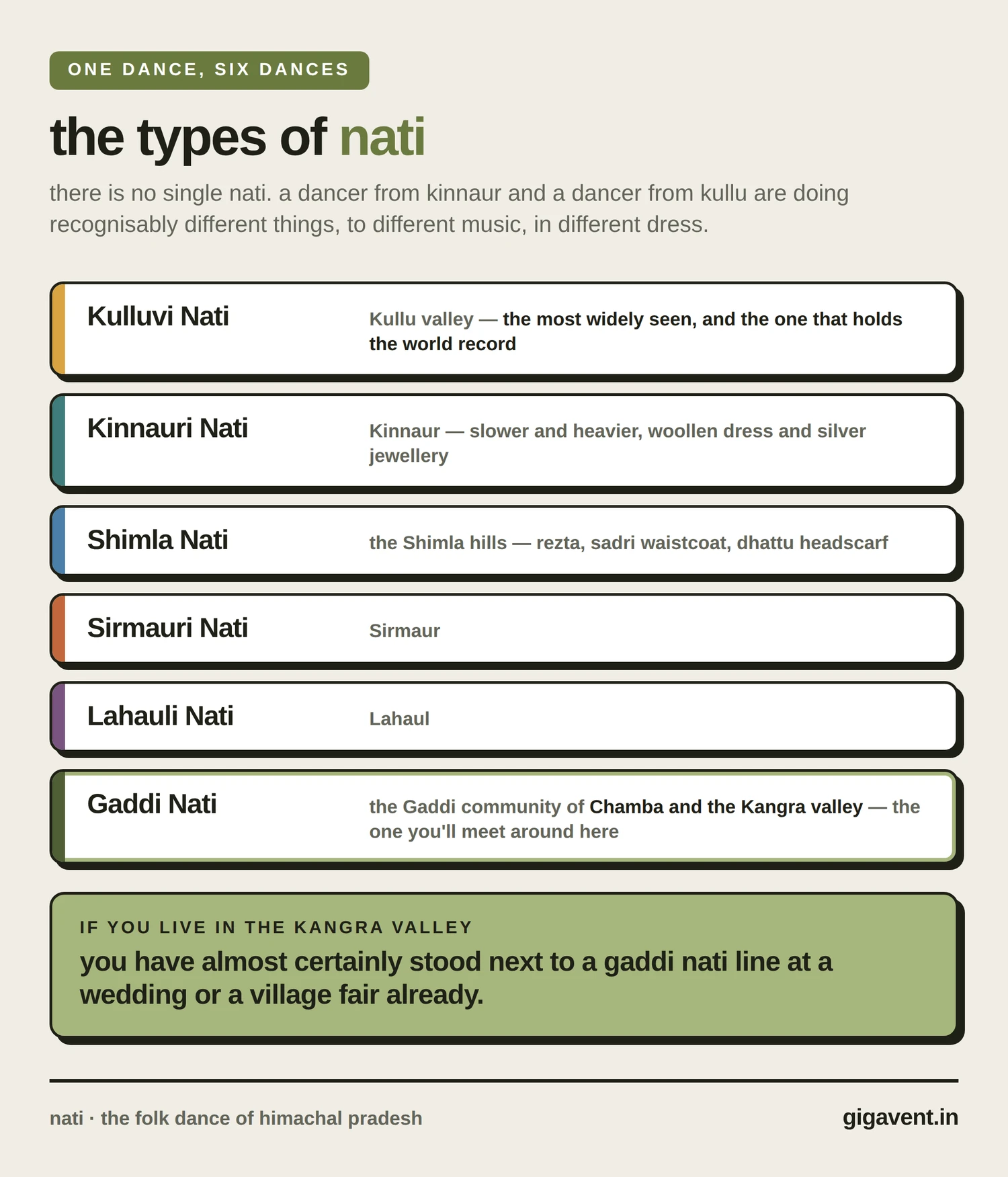
There is no single Nati. Each region has its own, and a dancer from Kinnaur and a dancer from Kullu are doing recognisably different things to different music.
| Type | Where |
|---|---|
| Kulluvi Nati | Kullu valley — the most widely seen, and the one that holds the record |
| Kinnauri Nati | Kinnaur — slower, heavier, woollen dress and silver jewellery |
| Shimla Nati | Shimla hills |
| Sirmauri Nati | Sirmaur |
| Lahauli Nati | Lahaul |
| Gaddi Nati | the Gaddi community of Chamba and Kangra |
Gaddi Nati is the one you're most likely to meet around Dharamshala and Kangra, since the Gaddi community is spread across Chamba and the Kangra valley. If you've been to a wedding or a village fair in this valley, you have almost certainly already stood next to one.
How is Nati different from Bhangra or Garba?
All three are group folk dances from different Indian states, and if you've only seen clips they blur together. The differences are clear once you know what to look for.
| Nati | Bhangra | Garba | |
|---|---|---|---|
| State | Himachal Pradesh | Punjab | Gujarat |
| Shape | a line or open circle, moving counter-clockwise | a loose group, no fixed formation | a circle revolving around a centre |
| Contact | held at the waist or by the hands | not held | not held — clapping between steps |
| Pace | starts slow, builds gradually | fast throughout | builds, then very fast |
| Music | dhol, nagara, shehnai, karnal | dhol, tumbi, chimta | dhol, dholak, clapping |
| Occasion | Dussehra, village fairs, weddings | Baisakhi and harvest | Navratri |
The one that tells them apart instantly is the contact. Nati dancers hold each other; Bhangra and Garba dancers don't. That's why a Nati line moves as one body and why it can absorb thousands of people without falling apart — you are physically attached to the person who knows the step.
And the pace. Bhangra is fast from the first beat. Nati opens almost at a walking pace, which is the reason a beginner can join a Nati and not a Bhangra.
What you're actually looking at
Three things make a Nati line read the way it does.
The formation — no soloist, and the line moves as one body. Many variants tie a handkerchief to the right index finger, which catches the eye at the end of the arm and makes the whole line's movement visible from a distance. Dancers traditionally wear pullas, the pointed-toe shoes of the hills.
The tempo — deliberately gentle at the start, which is the single most useful fact if you're thinking of joining.
The music — dhol and nagara carry the beat, shehnai the melody, and karnal and narsingha, the long and curved brass horns, give it the ceremonial sound. Flute appears in the lighter variants, and the combination shifts by region.
The dress is regional too: Kullu women in a ghagra, embroidered chola, a kalgi cap with peacock feathers and a chandrahaar necklace; Shimla's rezta, sadri waistcoat and dhattu headscarf; Kinnaur woollen throughout with silver jewellery.
Where can you find Nati events in Himachal?
Kullu Dussehra, in October, is the big one — where the record was set and where the largest lines form.
Village fairs and melas through the year, around harvest and local deity festivals. These are the real ones, and they're not on any website.
Weddings. If you're invited to one in this valley, there will be Nati, and you will be pulled into it.
And this week: Fit Kangra 2026 has Natti on friday 9 october at 7:00 pm at Baan Ganga Ghat in Kangra — an open floor, no list, no judging, free to join. It's the easiest first Nati available in the valley right now.
that's the honest problem with Nati: the best lines are at fairs and weddings nobody posts about. a festival is the easy way in, and after that you'll know where to look.
The quick version
what it is — the folk dance of Himachal Pradesh. a line moving counter-clockwise to live drums, the same step repeating.
which state — Himachal Pradesh, across almost every district.
the record — 9,892 dancers at Kullu Dussehra, 26 October 2015. Guinness, Largest Nati Dance.
the types — Kulluvi, Kinnauri, Shimla, Sirmauri, Lahauli, Gaddi. Gaddi is the Kangra and Chamba one.
the music — dhol, nagara, shehnai, karnal, narsingha, flute.
how to join — back of the line, take the hand or waist in front of you, copy their feet, don't look at the front.
what to wear — whatever you've got on.
where to find one — Kullu Dussehra, village fairs, weddings, and Fit Kangra 2026 on friday 9 october.
FAQ
Which state is Nati dance from?
Himachal Pradesh. It's danced across Kullu, Mandi, Shimla, Sirmaur, Chamba, Kinnaur and Kangra, and it's the most widely practised folk dance in the state.
Can anyone join a Nati dance?
Yes. Go to the back of the line, take the waist or hand of the person in front, and copy their feet. The step repeats and the tempo starts slow, which is how most people in any line learned it.
Do I need to know the steps?
No. You'll be a beat behind for a minute or two — everyone is — and then your feet have it. Nobody is counting.
Is Nati the same as Natti or Naati?
Yes, different transliterations of the same Pahari word. You'll see all three.
What is the Nati dance world record?
9,892 dancers performing together at Kullu Dussehra on 26 October 2015, registered by Guinness World Records as the Largest Nati Dance.
Is Nati the same as Bhangra?
No. Bhangra is from Punjab, danced fast from the first beat in a loose group with nobody holding on. Nati is from Himachal Pradesh, danced in a held line that starts slow and builds.
When is Nati performed?
At Kullu Dussehra in October, at village fairs and melas through the year — especially around harvest and local deity festivals — and at weddings across the state.
What instruments are used in Nati?
Dhol and nagara for the beat, shehnai for the melody, karnal and narsingha — long and curved brass horns — for the ceremonial sound, and flute in the lighter variants.
How many types of Nati are there?
Six main regional types: Kulluvi, Kinnauri, Shimla, Sirmauri, Lahauli and Gaddi, each with its own music, dress and pace.
so, kya scene hai — there's a line somewhere in this valley this week with a gap in it, and the only qualification is being willing to stand at the back for a minute.
read next
Fit Kangra 2026: the full three-day schedule → — natti on friday, bhangra on saturday, and seven more sessions at Baan Ganga Ghat.

